Religious and the Hemispheres of the Brain

This week we move to part four, the final post on maintaining balance. I’ve written about the differences between left and right brain functioning, including differences between the sexes. Today we look at how this has played out in the Christian religion.

For 1500 years Christianity was fairly balanced between right brain and left, though you could make an argument there was a heavier emphasis on the right hemisphere. That makes sense, since our species from its inception has been more right brain than left. The focus was on the numinous, the experience of God more than knowledge about God.

In the modern age, the age of science, that changed. The church could not wait to adopt the ways of Descartes, Newton, Bacon and other thought leaders to become scientifically respectable. Christianity moved from being focused on a holistic experience of life, to a religion that broke everything into its tiniest parts for analysis and interpretation. The Bible went from a narrative to a supposedly scientifically accurate book of facts, rules and regulations. Up to this time, the notion that the Bible might be without error in its original manuscripts (inerrancy) was not a subject of concern.

In the modern age Christianity became a system of beliefs instead of a story to be experienced. In evangelicalism, the charismatic movement of the 70s and 80s tried to counter the tide, but it had its own problems. Movements born of swinging pendulums rarely succeed. They just swing to the other extreme.

This paradigm shift took Christianity from an embodied religion to one that favored mind over body. An incarnational religion became a disembodied religion. A medium that specializes in disembodied images (computer, television, and smartphone screens) became preferable to a room full of embodied people. Does anybody else see this as a problem for what is, at its core, an incarnational religion?

When Christianity sold its soul to the modern age, it not only abandoned its roots, it rejected its role as an essential part of the nature of humans – our need for that which is numinous, ineffable, mysterious, awe inspiring, and wonder producing.

Should we be surprised that after a century in which 70 percent of Americans identified with a local religious body (emphasis on body), in just 22 short years – 1999 to 2021, that dropped to 47 percent? I mean seriously, why bother?

The right brain has always been more interested in the meaning of life, not the particulars of life. Whether Stonehenge, the carved bodies of Rapa Nui, or the burial mounds of indigenous Americans, the role of religion has always been to join people together to make meaning of life and experience life in community.

Quantum physics brought an end to the modern age. When it is understood that the ultimate building blocks of the universe are not made of matter, but of a pattern of relationships between nonmaterial entities, the modern age and its notion of scientific certainty was no longer able to maintain its stranglehold on the Western world. You know, Heisenberg’s Uncertainty Principle, Chaos Theory, and the like. When the only ultimate reality is relationships, is it much of a stretch to say the greatest power in the universe is love? Yeah, that doesn’t sound all that compatible with the modern age and its notions of scientific certainty.

I have hope that postmodernism will be more compatible with religion than the modern age was, that it will be more right-brain oriented than the modern age.

This difference between right and left brain functioning also has its impact on how we express and value the six core human emotions. That is where we next turn our attention.

The Six Core Emotions in the Modern Age

American psychologist Paul Ekman identified six core human emotions. We call them core emotions because they bring about a physiological response that can be measured. Those responses include a dry mouth, hair standing up on the back of the neck, goosebumps, rapid pulse, and sweaty palms, among others. The core emotions that elicit these responses are happiness, sadness, anger, fear, surprise, and disgust.

These six core emotions exist in the ether and come to us whether we want them to or not. They arrive with their bags and demand entry, and we have little we can do except allow them through the door and show them the guest room. We can let them know when they have overstayed their welcome, but whether or not we grant them entry is not an option. They arrive courtesy of the midbrain, the amygdala and hippocampus.

We also have feelings that develop in response to the six core emotions. Those feelings, numbering in the scores, are highly personal and arrive courtesy of our own personal experience.

The core emotions arrive via the right hemisphere of the brain, the hemisphere that focuses on experience. From there they are transferred to the left hemisphere, which tries to make rational sense of these core emotions. Normally, they are then passed back to the right brain where they can be placed in context. The right brain has the capacity to hold complex and competing concepts at the same time without rushing to premature conclusions.

During the 500 years of the modern age, the left brain was more respected than the right, though the right has always been the primary hemisphere of our species and the left its emissary. That means these core emotions end up not being placed in holistic context.

Let’s consider just two of the core emotions, anger and fear. If both remain in the left brain and are not placed in context, would it be possible for these emotions to be attached to purely external stimuli subject to the rational machinations of the left brain? Suppose you are a part of a society that says the greatest threat to our well-being is the transgender population, might you be inclined to attach your fear and anger to those external stimuli, as opposed to integrating them into your own narrative?

Eighty-seven percent of evangelicals believe gender is immutably determined at birth, and 67 percent believe we already give too many civil rights to transgender people. Interestingly, only 31percent actually know someone who is out as a transgender person. That means their knowledge about trans people is likely left brain and rational, based on their trusted sources of information.

That is one of the reasons I do my best to get in front of evangelicals whenever possible. If they actually see and listen to a transgender person, they have little choice but to allow their right brain to enter the equation and place that “rational” information in the context of an actual human. When that happens, I find fear and anger dissipate quickly. Proximity and narrative can cause the brain to move information from the rational information-based left hemisphere to the experiential holistic right hemisphere.

This is one of the reasons debates do little to change the narrative. Debates keep us in the left hemisphere of the brain. Human interaction and narrative bring us to the more context-oriented right brain.

In The Righteous Mind, Jonathan Haidt says people do change their minds, but not unless information comes to them in a non-threatening way. It took America 150 years to begin to deal with slavery. On the other hand, in little more than fifty years we moved from being a homophobic society to marriage equality becoming the law of the land. How did that happen so quickly?

I would suggest it happened because information came to individuals via the right brain in a very non-threatening way, through stories told via television comedies people watched in their homes. It began with Norman Lear’s All in the Family, which introduced the subject. From there we went to the scripted Ellen show, in which the protagonist was a woman who came out as a lesbian. Next was Will and Grace, a comedy in which the showrunners wanted to focus on will and grace, hence the names they gave the main characters. After that, we moved to Modern Family, in which one of the three main story lines was about a gay family.

And today? Today there are plenty of characters on television comedies who are gay people, but they are incidentally gay. The narrative has shifted. Outside of the evangelical world, most people are supportive of gay rights. Over half of Millennial and GenZ evangelicals are supportive of marriage equality. The tide has shifted, in part because information arrived in a non-threatening way, through narrative comedy that appealed to both hemispheres of the brain.

Every time we have a 500-year paradigm shift, movement happens in fits and starts, with those opposed to change fighting mightily to keep the status quo. Postmodernism is here. Evangelical Christians cannot stop it, but that does not mean they will give up the fight in the near future. They do seem to be softening on gay issues, while taking more strident positions on transgender issues. Eventually they will also give up that battle, though I will be surprised if it happens soon.

In the meantime, I will continue to say what I’ve said since my first TED Talk in 2017, “The call toward authenticity is sacred, and holy, and for the greater good.”

And so it goes.
Rational Consistency or Mystery?

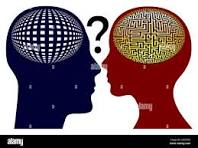
This is the third of a four part series on how the modern age changed the way we receive and process information. Today, we look at differences between how the right and left hemispheres of the brain affect our perspectives, and whether or not any part of that process is related to gender.

During the modern age, left brain functioning was more respected and rewarded than right brain functioning. René Descartes, one of the most influential voices in the development of the modern age, saw the rational mind as the apex of human development. Francis Bacon thought the rational mind could set us free from the need for God. Isaac Newton saw a rational God who created the world as a machine that could be taken apart and put back together again. Scottish philosopher John Locke, a leading voice of the Enlightenment, guided the thinking of many a 19th century theologian as they turned the Bible from a historical narrative into a rational collection of rules and regulations.

Even today, as the modern age fades and postmodernism gains influence, we still see the triumph of the left brain throughout society, including elevating the scions of Silicon Valley, like Elon Musk and Bill Gates, over the theologians, philosophers, and artists who would have been held on a pedestal in a previous age.

One of the most obvious ways in which the modern age and its left brain focus still triumphs is in the amount of attention public education places on math and science at the expense of art, music, and social studies. Public education continues to be a left-brain dominated field.

Unless your folks raised you in a left-leaning commune on the coast of California, you were most likely raised in a world that valued the left brain over the right, which caused you to see information in parts rather than wholes. It caused you to prefer literal meaning over metaphor, objective truth over inter-subjective exploration, fact over feeling, analysis of isolated parts over integration into holistic contexts, scientific explanations over awe, certainty over mystery. What you know is far more important than what you experience. I could go on. Okay, I will…

Your education focused on the subjugation of nature over the otherness of nature; the rational consistency of God over the mystery of God; the logical judgment of God over the irrational love of God; didactic teaching over narrative (which is the opposite of the teaching style of Jesus.) Your world focused on the emissary left hemisphere over the primary right hemisphere; the later developing left hemisphere over the early developing right hemisphere; Freud over Jung. Okay, I’ve probably lost everyone except the psychodynamic therapists with that last one.

While there are unquestionably differences between how the two hemispheres of the brain function, what about differences in the way male and female brains function? We know there are physiological differences between male and female brains, but what about brain functioning?

In Nature Reviews Neuroscience an article titled, Why Sex Matters for Neuroscience, an article was published on May 10, 2006 showing significant differences between male and female functioning brains. Larry Cahill noted that the unstated assumption has been that male and female brains are identical except for fluctuating sex hormone influences and a larger hippocampus in women than in men. He noted those differences are far more significant than previously thought, including showing that the left amygdala was more involved in memory of emotional material for women, particularly visual images, while the right amygdala was more active in memory for men.

An article by Alga Khazan in The Atlantic on December 20, 2013, Male and Female Brains Really Are Built Differently, referred to a study by Ragini Verma and others at the University of Pennsylvania involving 949 people ages 8 to 22. The male brains had more connections within each hemisphere while female brains had more interconnections between hemispheres. The brain’s fiber pathways, bundles of axons that act as highways routing information from one part of the brain to the other, ran back and forth within hemispheres for men, while in women they tended to zig-zag between left and right.

The article also quoted a study in November of 2013 at the University of Glasgow which found women have an edge when it comes to switching between tasks rapidly based on functioning between hemispheres. Another showed the hemispheres of women’s brains are more functionally interconnected when at rest than men’s.

A study published in April of 2012 by Dardo Tomasi and Nora D Volkow in Human Brain Mapping showed significant differences in the functional organization of the brain in 336 women and 225 men.

While all of these studies indicated differences between the sexes in brain functioning, a study reaching a widely different conclusion was  published by Rosalind Franklin University of Medicine and Science on March 29, 2021. It showed only about a one percent difference between the sexes in how brains function within and between hemispheres.

Regarding differences between the sexes in brain functioning, it is wise to heed the words of Anke Ehrhardt, a psychiatry professor at Columbia, who said in the 2013 Atlantic article, “Acknowledging brain effects by gender does not mean these are immutable, permanent determinants of behavior, but rather they may play a part within a multitude of factors and certainly can be shaped by social and environmental influences.”

Next week we end this four-part series by looking at how religion has been shaped by left brain/right brain thinking.

Experiences and Knows

This post is a continuation of last week’s post on gender. This week we will explore the ways in which men and women lead. While we do not know exactly how much of that difference is biological and how much is socialization, we do know the differences are significant.

During the first phase of the coronavirus pandemic, six countries did extremely well responding to the crisis – Norway, Finland, Germany, Iceland, Taiwan, and New Zealand. All six had a female head of state. They all worked collaboratively with their health departments, seeing them as co-workers, not subordinates. They were willing to compromise, without ego need getting in the way of good decisions. They were also willing to admit when they were wrong. Jacinda Ardern was particularly adept at that, quickly switching directions when necessary.

Compare those nations to three countries that did spectacularly poorly in the early phase of the pandemic – Brazil, the United States, and England. All three had heads of state at the time who did not work collaboratively, did not compromise, and could not admit they had been wrong. To make broad generalizations from nine examples is a stretch. Nevertheless, by most measures women are better leaders than men.

Women show more empathy than men. Women are more decisive than men, taking energy from action.  They work more hours and are better at multi-tasking[1], while taking fewer unnecessary risks.[2] Women complain less often than men, because they are more accustomed to deferring to others. Women are better at embracing nuance, because they tend to have a higher emotional intelligence.[3]

Women comprise more easily than men. Women are more open to being corrected when they are wrong than men. They have more humility. Women are more resilient than men, and are more communicative than men. They are also more collaborative[4] and inclusive than men.

How much of that difference in leadership is socially determined, and how much is a matter of inherently biological differences between male and female brain functioning, particularly as it relates to the two hemispheres of the human brain?

There are three parts to the human brain. The brain stem (reptilian brain) takes care of bodily functions, including breathing. The midbrain, also known as the limbic system, includes the amygdala and hippocampus. When we are in crisis, the limbic system decides whether fight, flight, or freeze are the appropriate response. These decisions are made in a split second by the amygdala, and the hippocampus responds by recording the circumstances.

If the amygdala has decided upon fight or flight, the hippocampus goes into heightened memory mode. If the amygdala decides the danger is too great for fight or flight, the body goes into freeze mode and the hippocampus erases conscious memory so the brain does not have to experience the trauma. Unfortunately, the trauma does not leave by some hidden portal. It moves from the brain into the body. The body remembers the trauma. This keeps therapists in business.

The prefrontal cortex is the thinking part of the brain. When a significant threat occurs, the cerebral cortex is overpowered by the midbrain. Under normal circumstances the prefrontal cortex is constantly processing every stimulus, both internal and external.

The brain is also divided into two hemispheres, the right and left. People often say the right hemisphere is where images are stored and the left is where words are stored. The truth is that both hemispheres trade in words and images. It is how the two hemispheres process those words and images that is markedly different.

The human right brain develops earlier than the left, and therefore has a kind of primacy in our development as a species. The right brain is online in early childhood and much of the work done in depth psychology is focused on those early right brain experiences. As I say to my clients, “We focus on the past for the same reason a bank robber focuses on banks. That’s where the money is.”

Iain McGilchrist a psychiatrist, writer, and former Oxford literary scholar, says the right hemisphere is the primary hemisphere and the left hemisphere is its emissary. The right hemisphere, more connected to the brain stem and the limbic system, sees things in wholes rather than in parts. It sees things in context, in relationship to other things.

The right brain is more integrative, searching for patterns. Its take on the world is based on complex pattern recognition. The right brain has a greater capacity than the left to hold several ambiguous possibilities at the same time without prematurely choosing a particular outcome or interpretation.[5] It prefers metaphor over literal meaning.[6] It understands the world based on empathy, inter-subjectivity, and metaphor.[7]

The right brain is where EQ resides, and is more concerned with meaning as a whole, in context.[8] Metaphor, irony, humor, and poetry are all the realm of the right brain. Awe, mystery, otherness and paradox are also right brain phenomena. The right hemisphere is deeply connected to the self as embodied. It is where the child’s early sense of identity is determined through interaction with the mother’s face.

The right brain is primarily concerned with what it experiences. The left brain is primarily concerned with what it knows. The right brain is more focused on feelings, while the left brain is more interested in turning those feelings into thoughts.[9]

The left brain removes information from context and analyzes the information in bits, assigning words to the bits and organizing them into categories. McGilchrist calls it the hemisphere of abstraction.[10]The left brain allows us to control, manipulate, and use the world. It breaks wholeness into parts for categorization, creating a hierarchically organized world.

The right brain processes information first, then sends it to the left brain for analysis and organization into categories and thoughts. A healthy person is then able to return that processed information to the right brain, where wholeness is created from what both hemispheres have processed. Wholeness occurs when we achieve balance between the hemispheres.

Is it possible that men have a greater tendency to function within hemispheres, while women have an easier time crossing between hemispheres? Is it easier for women to move information from the analytical left brain back to the holistic right brain, or are men equally capable of placing information in context? We will take a look at that next week.

[1] Kay and Shipman, The Confidence Code – Harper Collins, 2014

[2] Quarterly Journal of Economics 116 No. 1 February, 2001

[3] Journal of Applied Psychology 95 No. 1 January 2010

[4] Facebook symposium on diversity

http://managingbias.fb.com

[5] McGilchrist, Ian. The Master and his Emissary:  The Divided Brain and the Making of the Western World, New Haven, Connecticut, University Press, 2009, page 49.

[6] ibid, 82.

[7] ibid, 51.

[8] ibid, 70.

[9] ibid, 48.

[10] ibid, 50.

Do The Gender Wars Matter?

J.K. Rowling has again spoken out against transgender women, taking an extreme binary position on gender. She, comedian Dave Chapelle, and other anti-trans activists fight against all transgender rights, especially the extreme position that gender is a social construct, a perspective born of the work of French postmodern philosopher Michel Foucault and more recently American philosopher Judith Butler.

I believe the truth, as is so often the case, is in the radical middle. I call it radical because our human tendency is to go from one extreme to the other. I believe the manner in which we are socialized greatly affects our expression of gender. In the ten years I have lived as Paula, I have lost a lot of confidence, because the world does not encourage women in the same way it supports men. It does not empower women as much as men. There is a reason women are always apologizing for themselves. It is expected of them.

At the same time, so much of gender is, in fact, biologically determined. Only women can give birth. Men’s bodies are more powerful than women’s, and there are significantly different ways in which our gendered bodies respond to a myriad of human experiences and stimuli.

If a person has one of the many conditions that are collectively referred to as intersex, there are bodily ways in which that individual has physical characteristics of both sexes. If the sexual differences are primarily in the brain, as is true with the majority of transgender people, it is more difficult to know how to approach the physical bodies that have developed. I tried for decades to live responsibly and peacefully in my male body. My brain, however, had other ideas.

The way in which my brain responded to the departure of testosterone and the arrival of estrogen, and the changes that brought to my body, is all the proof I needed to know I am transgender. A cisgender male would be greatly distraught to have his body begin to appear female, or to lose the effects of testosterone. In my case, it felt like my brain had been screaming for a lifetime to feel the effects of estrogen and the absence of testosterone. It is as if my brain said, “Finally, this is the way things are supposed to be. I told you the body you had did not match what I knew myself to be.”

I do not know the cause of gender dysphoria. There are indications it happens in the second trimester of pregnancy when the developing brain does not make a complete connection to the body that is being created. The truth is that we do not know the exact cause of this brain disconnect. We do know it has a powerfully negative effect on the individual. Transgender people have a 41 percent suicide attempt rate, six times higher than any other condition in the DSMV. I do not have to understand causation to understand the mental distress of being transgender.

What I know to be true is that I personally feel like I come from the borderlands, the liminal space between genders. I also know I am much happier being seen by the world as a woman than I was being received by the world as a man. I am much more at peace in this body, living in this gender.

While I do not personally need to know any more about the causation of my gender dysphoria, I am interested in what the current studies are telling us about the differences between male and female brain function, particularly as it relates to how information is processed in the hemispheres of the brain.

A study, Structural Connectivity Networks of Transgender People, was published in the journal Cerebral Cortex (October 25, 2015) compared the brain functioning of 93 people, 23 of whom were male to female transgender individuals and 21who were female to male. The study compared the transgender people with a group of 25 cisgender males and 25 cisgender females. The 44 transgender people were studied prior to hormonal treatment. Using fMRI ,the study determined that the brains of transgender people function about halfway between male and female. Post hormonal treatment, transgender women’s brain functioned more closely to cisgender women. The same is true for trans men; after hormonal treatment they functioned more like cisgender men. I resonate with those findings.

Gender is a spectrum, and everyone has more masculine and feminine qualities in specific areas of their lives. For example, the human voice typically functions between 80 hertz and 255 hertz. Women’s voices usually register between 165 hz and 255 hz, while men’s voices register between 80 hz and 180 hz. As you can see, between 165 hz and 180 hz a voice can be either male or female. We decide which it is based on visual and verbal clues. How are words pronounced? Where in the body are they formed, the chest or the throat? What gender does the person appear to be? The process is not nearly as easy as we think. People of both genders are often misgendered on the telephone.

All of that to say that gender is fluid. Nevertheless, there are characteristics that are more common among those with XY chromosomes than those with XX chromosomes. Women are more likely to fire neurons across the two halves of the brain than men. Men’s brains tend to function within hemispheres, but have a more difficult time crossing between hemispheres. Women’s neuron activity looks more like a ball of yarn across the hemispheres of the brain, while men’s activity is more linear, within hemispheres.

This difference in brain functioning accounts for how differently men and women tend to lead. In  my next post, I will talk about those differences.