About This Calling

Fairy Pools, Isle of Skye, Scotland

I speak frequently about the call onto the Hero’s Journey, common to every age, language, ethnicity, and people group. An ordinary citizen is called onto an extraordinary journey onto the road of trials. Initially they reject the call because, hey, it’s the road of trials. But now you are miserable because you know you’ve been called and you’ve rejected the call. A spiritual guide comes into your life and gives you the courage to answer the call onto the Hero’s Journey, and sure enough, you’re on the road of trials. Then things get worse and you find yourself completely lost in a deep, dark cave.

This is when you can be quite sure it is in fact your call, because as David Whyte says in Consolations, “A true vocation calls us out beyond ourselves; breaks our heart in the process and then humbles, simplifies and enlightens us about the hidden core nature of the work in the first place.”

It was a given from an early age that I would go into ministry, the family business. I would attend the college at which my uncle was the president and my father was on the board of directors. Then I would serve a church of my denomination, as my father had done. I had other ideas. I was a radio announcer and had dreams of being a television anchor, but those dreams did not stir deeply enough within to change my course heading. The compass heading was hard-wired, generational. My father’s mother, gone before I was born, was a severe woman with a superego of stone, capable of setting a compass, even from the grave.

I did rebel in my own way, I suppose. Though I proved to be a pretty capable preacher, I refused to preach and sang instead, forming my own bands that made five albums before throwing in the towel to the demands of fatherhood and financial stability. Still, I never pastored a local church until 2018. I directed a large religious non-profit, chaired the board of a television network, served as the editor-at-large of a religious magazine, served on the preaching team of a couple of megachurches, but I resisted being a local church pastor.

Nevertheless, I did discover rather quickly that ministry, broadly defined, was in my genes. By my junior year of college I was asking the kinds of theological questions that annoyed the conservative professors and invited private meetings with the younger ones. Encouraging my inquisitive spiritually-curious mind, they pointed me in the direction of a mentor who taught philosophy at an eastern university. My family doctor introduced me to my other mentor, a retired Roman Catholic seminary rector with a couple of PhDs and the bright eyes of wisdom.

Over a quarter of a century they both guided my journey, passing on just a couple of years apart, leaving me the mentor who brought inquisitive young minds into my office to recommend books not suggested at evangelical seminaries.

Even as a child I questioned the traditional notion of heaven. In my twenties I read Evidence that Demands a Verdict and found it did not demand a verdict. I read Hans Küng’s, Does God Exist? and found that on the final page the question mark remained. I found insight in Francis Schaeffer’s, He Is There and He Is Not Silent, but the older I became, the more I suspected he is awfully silent.

Ministry, broadly defined, broke my heart. Once I became a local pastor I found that ministry narrowly defined also broke my heart. The local church is a messy affair, sure to bring you to your knees and make you wish you had decided to deliver the US mail instead of become a pastor. And yet there was Stonehenge, the Pyramids, the carved bodies of Rapa Nui, and all the other evidence that shows we have always preferred working out the meaning of life in community, and is it really such a bad thing to dedicate one’s working life to such an endeavor?

Today I am still pulled to my calling and the complex, mysterious, and ever expanding nature of its hold on me, not unlike the Big Bang, growing larger, closer and paradoxically more distant and miraculous with the passing of time.

Do I still consider myself a Christian? Yes, I do. I continue to be endlessly fascinated with the teachings of Jesus, though the notion of his bodily resurrection is of little fascination to me.

As Whyte writes, I have come to find that I did have what I needed from the beginning, an intelligent curiosity, an openness to mystery, and a confident conviction of the divine nature of Love, which does win, you know.

With that knowledge, my calling continues, wiser, softer, more encompassing, whether staring at the Fairy Pools of Skye or the Old Man of Storr, I see the water and rocks cry out at the wonder of it all and I know this calling was mine all along. I came to it kicking and screaming as a young person. Nowadays I rest in it, humble and curious as ever.

And so it goes.

Truth and Honesty

It is alarming to observe the rapid decline of the notion of truth. What started with Foucault has become a perverse tragedy in the era of Donald Trump. The emerging perspective is that truth is always a construct, never reliable, never objective. While I agree there is no such thing as objective truth (Quantum Theory’s Observer Effect) it does not mean we cannot, through rigorous intersubjective discipline, get somewhere close to objective truth.

Unfortunately, we are way beyond that. Donald Trump has taught us if you repeat a lie often enough, people believe it. We could lose our nation over that awful reality. But here’s another question I have been mulling over. What is the relationship between honesty and truth?

My mentor, the late philosophy professor Byron Lambert, said, “It is hard to tell the truth and it is hard to tell the truth.” In other words, it is difficult to discern the truth, and difficult to speak it. That is where honesty comes in.

David Whyte, in his book Consolations – The Solace, Nourishment, and Underlying Meaning of Everyday Words writes beautifully and unsettlingly about honesty:

Honesty is reached through the doorway of grief and loss. Where we cannot go in our mind, our memory, or our body is where we cannot be straight with another, with the world, or with our self.

The fear of loss, in one form or another, is the motivator behind all conscious and unconscious dishonesties: all of us are afraid of loss, in all its forms, all of us, at times, are haunted or overwhelmed by the possibility of a disappearance, and all of us therefore, are one short step away from dishonesty.

Every human being dwells intimately close to a door of revelation they are afraid to pass through. Honesty lies in understanding our close and necessary relationship with not wanting to hear the truth. Honesty is not found in revealing the truth, but in understanding how deeply afraid of it we are.

The ability to speak the truth is as much the ability to describe what it is like to stand in trepidation at this door, as it is to actually go through it and become that beautifully honest spiritual warrior, equal to all circumstances, we would like to become.

Honesty allows us to live with not knowing. We do not know the full story, we do not know where we are in the story; we do not know who is at fault or who will carry the blame in the end.

Honesty is not the revealing of some foundational truth that gives us power over life or another or even the self, but a robust incarnation into the unknown unfolding vulnerability of existence, where we acknowledge how powerless we feel, how little we actually know, how afraid we are of not knowing and how astonished we are by the generous measure of loss that is conferred upon even the most average life.

 Whyte’s words remind me of Ernest Becker’s book, The Denial of Death, in which he referenced the psychoanalyst Otto Rank. Becker said our greatest fear is that we lose ourselves before we ever really find ourselves. The great human task therefore becomes fashioning some kind of heroism in the face of that greatest of losses. (I finished Becker’s book while I was watching the 1986 World Series in which my beloved New York Mets fashioned their own heroism in the face of what appeared to be certain death. A pleasant memory.)

I heard an NPR report recently in which researchers said if two people observed the same event, for the remainder of that day their descriptions match in most ways. By the next day, however, their descriptions differ significantly. Encoding, storage, and retrieval differ from person to person. Add to that our own fears and wants, and no wonder truth is so elusive and honesty so slippery.

I know of no way through this dilemma but to humbly accept how self-deceptive we all can be. That is the first step. The next is to find the courage and heroism to lean into stringent self-examination and be open to challenge from the outside, while holding onto your human dignity. No small task.

We spend much of our lives avoiding the truth. Therapists say one of the problems with people experiencing depression is that they are too aware of the true nature of things and therefore unable to build the defense mechanisms most folks use to avoid painful truth. Ironic, yes?

I have been puzzling over truth and honesty for a long time. Fraternal twins, they are both too often banished to the bell tower of the cathedral, too painful to look at for more than a few seconds at a time. Which is a shame, because truth will set you free, and honesty will set you right. But first you have to bring them down from the bell tower and invite them into the rectory, where their influence can find its way into the warp and woof of your being.

A Reflection on Left Hand Church

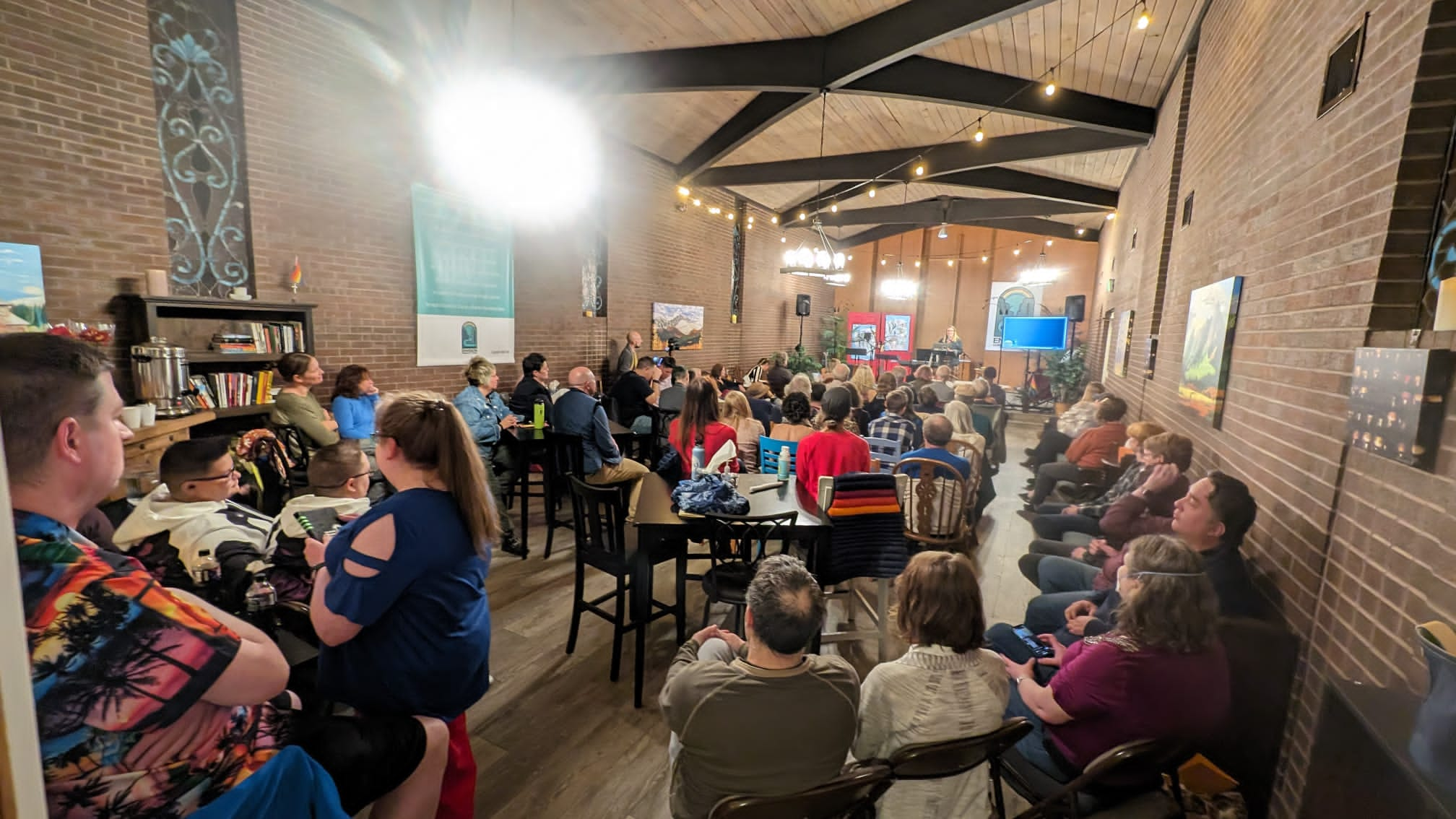
It’s been six months since Left Hand Church (later Envision Community Church) closed. The congregation existed for six years. I was the only one of the founding pastors remaining when the church closed. I was not ready to write about the church’s ending until now.

We did much right. For six years we provided a safe post-evangelical environment in which our community could work together to love God, neighbor, and self. I have no idea how many times I spoke these exact words:

“We exist to love the God who burst on the scene 14 billion years ago in all of God’s complexity, mystery, and ever-expansiveness, rooted in relationship and grounded in love. We want to love our neighbors, especially those who do not look like us. And we want to love ourselves. You cannot do the first two if you cannot do the third.”

With the first sentence I defined the Big Bang and so much more, including the reality that the ultimate building blocks of the universe are not made of matter, but of a pattern of relationships between nonmaterial entities. And if the ultimate building blocks of the universe are relationships, is it much of a stretch to say the greatest force in the universe is love?

In different seasons of the church Jen Jepsen, John Gaddis, Kristie Vernon, John Gaddis, and Nicole Vickey joined me in preaching. Heatherlyn provided our music for all six years. Her husband Jason was our very capable technical director. I thought our worship experience had the kind of quality rarely seen in churches our size.

We enjoyed our relationship with Longmont United Church of Christ, where we were gifted with full-time use of their chapel, including the freedom to completely redesign and remodel it to our liking. Through Kristie Vernon’s design and construction prowess and the help of our members, it became a wonderful worship space for a congregation of our size.

Modestly funded by Highlands Community Church, Denver Community Church, and Forefront Church of Brooklyn, the congregation began from scratch, building a nucleus of members through pre-launch dinners at Jen Jepsen’s home. Aaron Bailey joined Jen and me as the founding co-pastors. At the end of the first two years John Gaddis and Kristie Vernon joined the staff and Aaron and Jen left. Nicole Vickey came on staff the following summer. Kristie and I were the remaining co-pastors when the church ended.

The church had between 100 and 150 people at any given time who called it their church home.

I spent over three decades in church planting before starting Left Hand Church, including a quarter-century as the CEO of a large church planting agency. Since I was in a new gender, I was open to new ways of planting churches, and therefore willing to leave behind convictions from my previous work. As it turns out, there was no good reason to leave those convictions behind. I will never again start a church without incorporating the hard-learned lessons gained over 35 years of church planting.

In all of my days at the Orchard Group, I resisted any attempts to start a church with more than one lead pastor. When people wanted to start a new church with co-pastors I routinely said, “I know you think you are the exception, but it never works.” I was right. It never works.

We began LHC with the same trinitarian leadership structure of Highlands Community Church, one of our founding partners. By the time we ended, two of us remained. While the two of us worked pretty seamlessly, the trinitarian model was too unwieldy. There is always someone who is “more equal” than the others. I believe it is better to name that from the beginning. A vertical leadership structure is not inherently bad, not if the CEO is a good leader with excellent ego strength and low ego need. If I were to start another church, there would be one lead pastor.

We also adopted a board leadership structure similar to Highlands Church. From the beginning, it was a working board, involved in both the ends and means of the church. When I was with the Orchard Group, from 1989 onward we only started churches with a Carver Policy Governance board. The board determined the ends of the church, while the staff determined the means by which those ends were accomplished. The board hired the lead pastor, and the lead pastor hired his or her own staff.

Initial elders were chosen by the initial management team that formed and governed the church for the first three years. Subsequent elders were chosen by existing elders, with staff, since they held in-depth knowledge about the church, having input and veto power over those selected. All elders were expected to give financially to the church and have a demonstrated commitment to the core values of the church. I would never again plant a church in which a Policy Governance board was not a part of the leadership structure from the very beginning. Its absence was a major obstacle at LHC.

While LHC began with a budget one-tenth the size of churches started by the Orchard Group, for the most part our people did give sacrificially. Our members also attended more regularly than the average American churchgoer. However, because we were not able to fund a marketing program from the beginning, and were hampered by the arrival of Covid just two years after we started, we never did gain the critical mass necessary to build a sustainable church. That did not enable us to have the kind of robust children’s, teen, singles, and couples programming possible when a church begins with 200 or more people.

There were other mistakes made at LHC, including not developing adequate HR procedures from the beginning, and not committing to hiring a full-time staff focused on rapid, sustainable growth. On the whole however, LHC was a vibrant and healthy congregation. Kristie and I made the decision to close the church when we knew it was no longer sustainable. It was a painful decision, but we realized the trajectory was unmistakable and under the circumstances, irreversible.

I miss the people of LHC. I miss preaching weekly and caring for people’s pastoral needs. I miss helping people navigate their departure from evangelicalism and the toxic faith that harmed them so. I miss talking with those who had no religious background, and whose spirituality came alive at our church.

I do not miss the drama, both from without and within. I do not miss the attacks from other churches, or the attacks from within. I do not miss the pain that arose from the mistakes I made. Though instructive, it is never pleasant to realize you have missed the mark. The church has always been messy and always will be. In my experience, small churches are messier than big ones. At the Orchard Group, I learned more from our successes than failures. We did not have many failures, which gives one a false sense of confidence, I suppose.

The thing I will miss the most are the “Aha” moments when members grasped a new understanding of a scripture passage that had confused them for years. I miss the ordinances of baptism and the Lord’s Supper, and I miss working with Kristie, John, and Nicole.

For six vibrant years Left Hand Church (later Envision Community Church) touched lives and brought life to a community of people. We had both successes and failures. Mostly, we lived together in community, messy, vibrant, and hopeful. I will always be grateful for my time at LHC.

And so it goes.