I Will Miss Her So

She could jump up on all fours to an ungodly height, enough to slam the lower jaw of Teresa, the UPS driver. The heights to which she jumped were in direct proportion to how much she loved you. The only problem with that was that she loved everybody, very much. So she jumped high for everybody, all the time.

To a new person on the street she begged to be turned loose from her leash. She would look at me and say, “I know I know her, if you’d just let me go and remind her. Or maybe I don’t know her, but probably I do. Yeah, I do, for sure! Please let me go and tell her how much I’ve missed her! Please?”

This happened on every walk. Rabbits, mildly interested. Other dogs? Ever since an unfortunate encounter at a dog park, other dogs were not an object of much interest. Well, she was interested in other dogs, only because if there were dogs, that meant the dog’s human must be nearby. And the human was probably, no definitely, somebody she knew, who would no doubt want to be greeted by her.

When we were out running she’d tug on the leash and want to stop and smell a strange weed, the name of which I never learned. I knew what it looked like because of how much she wanted to sniff it. Other dogs had not left their scent there. It was something about the weed itself. They were in two places, on the pathway east of Sheridan and about a quarter of a mile up Stone Canyon Road, after the turnoff for Eagle Ridge.

Or maybe there was nothing special about that particular weed at all. Maybe it was all a trick. She’d always want to stop and smell that particular type of weed, and unless I was timing my run for speed, I’d let her. But on far too many occasions she would only feign interest in a weed. The true object of her interest was a dead something in which she could roll. She’d get a couple of good rolls in, rubbing her back against the thing in all of its deadness before I realized I’d been duped and would yank her away.

I live in the foothills, where there are bear, mountain lions, foxes, bull snakes, rattlesnakes, prairie dogs, skunks, and the occasional stray elk. On the day she’d arrive for a visit, every inch of the side yard was carefully studied by her considerable olfactory system. She usually found something in which she could roll. Then it was a trip to the giant bathtub, which for 18 years has had only purpose – to remove smells from overly curious dogs.

She could grab the poop of a strange animal and swallow it before I could say, “Nope!”  I’d forget about it until later that night, when she’d give me a kiss. She found my breath as fascinating as the dead things in which she’d roll. That always concerned me a bit.

She was not technically my dog. She was Kristie’s dog, and then Kristie and Mara’s dog. I think I may not have been the only one who felt like she was my dog. In my heart I loved her as much as Lilly, our golden/border collie mix who left us for the other side back in 2011.

I taught her never to bark when clients came to the door for counseling. She did bark in the middle of the night when large things lumbered into the backyard. She hated the windstorms. She’d lean hard against me on the couch, glancing at my face to make sure I was good with it all.

Finn was in my life for seven years. She will be in my heart for the rest of my days. Her ears, neck, belly, and the outside of her hind legs begged to be scratched. I got in trouble for it. Kristie would send us out onto the back patio where the hair could be blown toward the heavens. Cathy let me scratch her, but also made me schedule the cleaners for the day after she left. Hair was everywhere. I’ll never get it off of the back seat of my car.

She ran with me every day we were together. The last time we ran together she did the last mile in an 8:42. I hadn’t run that fast in years. Her last few visits she was restricted to walking. Still, I let her off the leash when she heard the UPS truck. She’d hear it long before I saw it. She’d take off like a streak of greased lightning, jump in the truck, and slobber Teresa with kisses. Then she’d sit on the passenger floor facing forward, giving me the tiniest side glance as if to say, “You can go ahead and go home. Teresa and I have got this for now.”

At every meal in every location we shared, she sat immediately next to me, not because I’d sneak her food, but because she knew I was the messiest person at the table. By my feet is where she could reliably count on the most crumbs to fall.

When Kristie told me yesterday that she was gone, I could not stop weeping – not just gently crying, but weeping. My God, how I loved that dog.

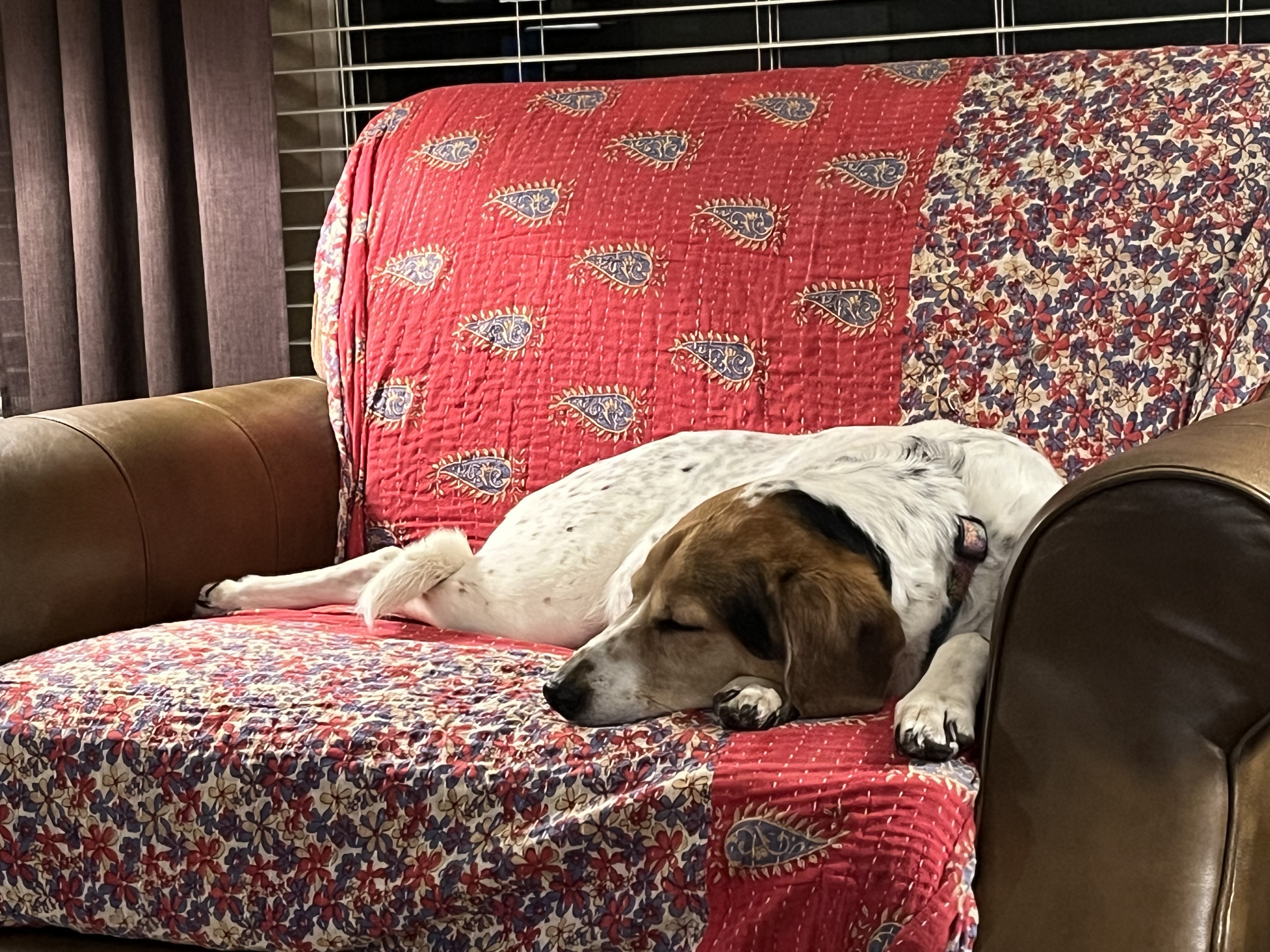
She slept by my side, sat next to me on the couch, and spent hours in the oversize chair pictured above, her favorite place when she was at my house. I took this picture four weeks ago.

Dogs were domesticated 30,000 years ago, so we’ve been able to watch them evolve along with us. No wonder they evolved to love us unconditionally. They knew that was our greatest need. Finn loved me like there was no tomorrow. And my love for her was the same.

I will miss you, sweet baby girl. And Kristie, thank you for sharing your pup with me. I will be forever grateful.

And so it sadly goes.

You Have Got To Be Kidding Me!

There has been another unfortunate turn in the war against transgender Americans, a war fought on so many fronts it is hard to keep up.

Another hideous anti-trans group is gaining influence. “Transvestigators” is a conspiracy group alleging that many well-known American woman are transgender and part of a conspiracy to, well, take over the world. They utilize “scientific” measurements of physical characteristics to make their determinations. They claim everyone from the wife of the president of France to Jennifer Anniston is transgender. I’m not joking. This group is serious.

It reminds me of phrenology, the 19th century pseudoscience that said personality traits can be identified through various bumps on the head. You’ve probably never heard of phrenology because it was thoroughly debunked over 150 years ago. Yet here we are again.

The thirst for special knowledge that sets one apart from others is as old as the species. That there is a group claiming this is not surprising. That a multitude of followers have embraced  this conspiracy is not funny, it is frightening. The misinformation about trans people is exponentially worse than it was ten years ago. I want to again briefly remind you, as I did back in 2014, about what it means to be someone who transitions from one gender to the other.

Let’s look at the facts. Transitioning from one gender to the other has been happening for millennia, in every culture, language, ethnicity, and people group. Trans people are about one half of one percent of the population, people whose sex at birth does not match how they experience themselves to be. We do not know what causes it, though it is as certain as the fact that some people are gay. We do not know what causes a person to be gay either.

I am carefully using the specific language of those “who transition from one gender to the other,” because over the last decade the term transgender has been significantly broadened to include a much larger group of people who feel gender is a social construct, and that anyone is welcome to identify at will as either gender or as non-binary. This is a new phenomenon without historical equivalency, and though it is broadly espoused by many on the left, there is little scientific information to suggest its genesis or its future trajectory.

Over the last decade this newly identified group has become the majority of people who identify as transgender. It is heavily represented by adolescents, particularly those who were identified as female at birth. It is also associated with people who did not identify as transgender until late adolescence.

Many of these young people are simply exploring gender, having rejected the gender binary. I do not think there is anything wrong with that exploration. The hardened gender categories of the past have not served us well.

On the other hand, should these young people be treated with body-changing hormone therapy when the onset of their gender dysphoria is quite recent? I think not. Many have comorbidities, such as body dysmorphia, eating disorders, and complex trauma. I believe these young people should receive therapy from licensed therapists well-acquainted with gender dysphoria before receiving hormones. For those views I have been roundly cancelled and excoriated by the left. So be it. When dealing with vulnerable young people we must follow the data. The data are not clear. Caution is in order.

This is not the same group as those who from a very early age consistently and persistently found themselves to be extremely uncomfortable in the gender of their birth. Most of these people have been in decades of therapy before deciding to transition. The distress is so great that over forty percent have attempted suicide. This group used to be called transsexuals, and maybe that is a term that should be resurrected to identify this specific group once again. As I stated earlier, there is a very long history of the legitimacy of transsexual people.

We know who these people are. It is not difficult to identify them. As stated, the onset of their gender dysphoria can be traced to early childhood and is consistent throughout their lives. It does not suddenly arrive or depart. The same is true of those who are gay. Being transsexual or gay is an integral part of one’s identity. No amount of therapy will cause a person to no longer be gay or transsexual. Neither can be “cured” through any kind of therapy.

I write all of this because most of my readers are not well-versed on these issues. I have studied them in depth, because as a therapist and trans person, I must. If you are inclined to see me as a thoughtful individual who tries to research every angle of an issue before speaking or writing, you may find my words helpful.

Misinformation can be little more than a nuisance or it can be deadly. If a map tells someone to get to my house by turning south at the light at the corner, they will be inconvenienced, but no one will die. Within a couple of minutes they will figure out they should have turned north at the light.

If someone wants to believe vaccines cause autism, and they force that belief on an entire nation, it is deadly. The same is true of those who dismiss transsexuality as an illegitimate diagnosis. They are not just inconveniencing millions of people. They are placing our very lives at risk.

Look at the data. Do not repeat misinformation. Lives are at stake. Follow the science and together, let’s save lives.

My Kind of Saturday

Last weekend it was my honor to speak for the Common Good Forum in Boulder, Colorado. This fall’s theme was Common Ground for the Common Good. I did the morning keynote, followed by a panel of four mayors moderated by KUNC reporter Rae Solomon, followed by an afternoon session with Nancy Norton, a Boulder comedian. The whole day was delightful, my kind of Saturday.

My keynote was based on the proposed title of my next book: When Their Enemy is You – Responding With an Open Mind, a Receptive Spirit, and a Curious Soul. I’ve been working on the talk for a few months, trying to get complicated information into a 40-minute talk that is understandable to all – not an easy task.

There is nothing I love more than taking complex information and making it understandable to a broad audience in as short a time as possible. When I see audience members have aha moments, I know I have succeeded.

Communication demands that the communicator and those to whom the information is communicated are both on the same wavelength. Greater discipline is required of the communicator than of the audience. Who is your audience? What is their level of education and knowledge about the subject? What is their level of interest?

To me, a talk has two goals. First, it must impart information the audience did not previously know. One attendee this past Saturday told me no less than three times, “I already knew all of that information, but I liked the talk.” Oh well, so much for having achieved the first goal.

My second goal is to provide insight. That is also one of my goals as a therapist. Good therapy involves insight, courage, and perseverance. The therapist can only provide insight. The client has to muster the other two.

When I am speaking, I want to take the audience’s knowledge and enhance it in such a way that a new piece of information allows them to connect the dots and have an aha moment. On Saturday I talked about four issues that are exacerbating the problem of our current cultural divide.

First, humans have a tendency to create enemies that do not exist. Second, we do not all work from the same moral standard. The oldest moral standard is that there is no greater moral good than to protect the integrity of the tribe. The second moral standard, also quite ancient, is that there is no greater moral good than to obey the teachings of the gods. This is the moral standard of all forms of fundamentalism.

The third moral standard is the youngest, only about 2,000 years old. It is the moral standard that there is no greater moral good than to protect the freedom of the individual. It is the moral standard of all of western Europe and the secular United States. Most of us work from the third moral standard.

After understanding our tendency to create enemies that do not exist and recognizing that we do not all work from the same moral standard, we come to the third issue I talked about last Saturday.

For the last 500 years we have lived in a left-brain heavy world, which is unfortunate because the right hemisphere is the primary hemisphere of the human brain. The left is its emissary. Yep, I know that is not enough information for you to grasp what I was talking about, but I hate it when a post goes over 1000 words. Sorry ’bout that.

The fourth issue about which I spoke was the myth that humans care more about the truth than they care about belonging. That is simply not true. We consistently care more about belonging than we care about the truth. It is the rare person who has enough ego strength to care more about the truth than they do about belonging.

I did manage to cover all four topics in less than 40 minutes, and then was joined by Stan Mitchell for another 30 minutes of Q&A. Stan is one of my favorite interviewers. It is always best to have an interviewer who is smarter and more knowledgeable than you. Unfortunately the lecture is not available to the public. If you were in attendance I can send the manuscript to you. Otherwise, you’ll have to wait for the book.

I will write about my observations about the mayors panel next week. Suffice it to say I believe mayors are the politicians most likely to have their feet planted firmly on the ground.

This week I’m preparing lectures for next Monday and Tuesday at Brite Divinity School on the campus of Texas Christian University. It’s a good thing I’m not lecturing at Texas A&M, since when it comes to issues of gender identity, as of today Texas A&M looks more like a bible college than a public university. How did that happen?  I send you back to the beginning of this post. We humans do tend to create enemies that don’t exist.

And so it goes.

Someone to Love, Good Work to Do, Something to Look Forward To

It is difficult to maintain an interior life in the midst of today’s cultural upheaval and political uncertainty. We are hardly unique in history. In do understand how easy my life has been compared with so many who have come before. I have not known war within the boundaries of my nation. I have not known starvation or, in my decades as a white male, oppression. Only now am I gaining a tiny glimpse of what so many have known for so long.

In the midst of it all I am surprised that my approach to getting through these times does not differ much from how I have approached my entire life. I have always intuitively recognized that a good life includes someone to love, good work to do, and something to look forward to. Those three needs remain with us regardless of our circumstances.

I bring the three up with my clients all the time. Sometimes what they need to work through is deep and complicated, with elusive solutions. But sometimes what makes their life better is simple. It is always interesting how few people have ever heard of the ability of those three elements to create the alchemy of a well-lived life. We all need someone to love, good work to do, and something to look forward to.

In my case, someone to love is complicated. Well, come to think of it, it’s complicated for pretty much all of us. I love my children and grandchildren. That love is without conditions. I also love Cathy, my companion of almost 55 years. We currently live together, though we both recognize that is not ideal. It has been made recently necessary because of our financial realities, and we are both old and mature enough to make it work. We respect each other. Since we no longer consider ourselves married, we both have dated. Through it all, our devotion remains, though it is expressed quite differently than it was when we were married.

There are dear friends I love who I see often. Only one was with me pre-transition. The others have come into my life in the last dozen years and never knew Paul. One of  my biggest struggles has been the discontinuity between my previous life and my current life. Family has been there through the transition, but few others.

The second “necessity” is good work to do. I have always been a Renaissance person with varied interests. Currently I am in an elected position as mayor pro tem of Lyons, Colorado. I am considering running for mayor in the spring, but I will not make a decision about that until the end of January.

My doctorate is in pastoral counseling and I continue to serve as a counselor. I have had many wonderful clients over the years. They are delightful humans, one and all. I continue to keep my counseling practice fairly small, by design.

After serving as a speaker’s ambassador for TED and a coach for TEDxMileHigh, I discovered that I love coaching speakers, helping with content and delivery. It’s been my privilege to coach  NPR reporters, an Air Force general, politicians, attorneys, pastors, therapists, CEOs, and sundry other humans. Speaker’s coaching is a vibrant part of my current work.

I also continue to enjoy preaching. It looks like I’ll end up having preached about 20 Sundays this year. I preach regularly at Denver Community Church and The Village in Atlanta. This year I preached everywhere from the iconic Riverside Church in New York to Austin to San Francisco. A fair amount of my speaking has been at churches connected to either the Post Evangelical Collective, a vibrant group of progressive churches, or the Wild Goose Festival, one of my favorite events each summer. It’ll be my privilege to speaking five of the next six Sundays at Pine Street Church in Boulder. The church is located one block east of the intersection of Broadway and Pine in central Boulder. Services are at 10:00 each Sunday. I mention that because I’d love to see you there!

I also have a book proposal with my agent right now with the working title, “When Their Enemy is You – Responding with an Open Mind, a Receptive Spirit, and a Curious Soul.” I hope to have a contract and be working on the book by the first of the year.

I’ve been fortunate that I have always loved the work I do, which means that having good work and something to look forward to are one and the same for me. Over the next three months I’ll be preaching in Boulder, Denver, Brite Divinity School in Texas, Sarasota, Austin, and somewhere else I can’t remember right now. (I’m old. I forget things.)

On the fun side, I’ll be with my family in Florida over Christmas, in Kauai in early December, and on the beach in Southern California with my granddaughters during their February break. I like to get out of the cold in Colorado at least twice a month during the winter. Snow has outlived its usefulness to me.

Is it a tough time to be trans in America? I mean, what do you think? But you have to keep on living your life without fear. I try to be safe. I cut off the stalkers and trolls and inform the authorities when necessary, but thankfully, most threats are idle.

I’m headed off to a town board meeting now, fulfilling my role as mayor pro tem. Tomorrow I’ll put the finishing touches on my keynote on Saturday for the Common Good Forum in Boulder. Life is good, and also hard, so we take joy when we can.

And so it goes.

But Will It Eat Us?

In my book proposal currently with my agent I have a chapter with the working title, “How Shall We Then Live?” The sentence has been on my mind for a few months now, ever since I began reading the work of Iain McGilchrist on how left brain/right brain differences affect today’s culture.

The right hemisphere is the primary hemisphere for humans, and the left serves as its emissary. But for the last 500 years left hemisphere thinking has ruled western culture, with plenty of attendant problems. Simply but accurately, the left hemisphere is great at figuring out how to grab things, while the right is great at making sure you’re not eaten by a grizzly bear while you are reaching out and grabbing things.

In a left-hemisphere dominated culture, not enough attention is paid to the right brain’s protection. The left brain says, “I can create AI.” The right brain’s job is to ask, “But is it going to eat us?” In today’s world, not enough people with enough power are focused asking that right brain question.

In the best-selling book, If Anyone Builds It, Everyone Dies, the authors paint a pretty bleak picture of what happens when artificial super intelligence arrives. They present a convincing case that ASI will in fact, eat us. They say it is not too late to stop it. We’ve controlled nuclear weapons for 80 years because the entire world knows how dangerous they are. They believe ASI can be controlled too, but only if everyone in the world stops building it. Of course, that won’t happen until we all see how truly dangerous it is.

I cannot act at a global level, but I can at a personal level, and I have additional concerns about AI. The arrival of cell phones has brought adolescents who do not know how to show empathy, do not have the ability to put information in a holistic context, and who have a low emotional quotient. With the arrival of ChatGPT we can expect a whole new crop of deficits to develop, all harming the development and health of the human brain.

Only recently have I begun to have to interact with AI, primarily through Google search. Google makes it very difficult to turn off the AI feature in their searches, and those searches have a lot of inaccuracies. If you do a Google AI search of my name, the first seven paragraphs contain five errors, and none of the paragraphs contain information that is current. All of it relates to my first few years as Paula.

If that is the case with my name, it is safe to assume that is the case with pretty much anything Google AI pulls up in searches. I am no longer doing my searches through Google. I’m now using DuckDuckGo.

I never activate the AI feature of Word, nor am I using ChatGPT. I am a writer and speaker. I do not want to diminish those skills. I want to enhance them. I work with speakers, and I can quickly tell if a client is utilizing ChatGPT. They end up speaking in a stilted way because they are using words and grammatical structures that are not natural to them. The words may be smooth, but they are not natural when spoken by my client.

I am not making these decisions because of my age. Learning new technology continues to be relatively easy and natural for me. I am rejecting AI because it is not good for me. I will stick my neck out and say it is not good for you either. If you can explain to me how it truly enhances your life instead of diminishes your life, then I will acquiesce. But nothing I’ve read or heard convinces me that it is good for any of us.

Will AI eat us? That is a bigger question than I can answer, but I would recommend the book I mentioned earlier in this post. I would not suggest reading it when you are depressed, or dysthymic, or suffering from acedia. It will not help you break out of your ennui. But if you are in a place in which sober thinking has room to take root, I’d suggest you inform yourself of the dangers of AI, both for your personal growth, and for the future of the species and planet.

Okay, I promise, in my next post I’ll find something positive to write about. My posts have been skewing a little dark of late.

And so it goes.

The Dilemma of Young Men

A spotlight was shone on gaming culture when it became known that the young man charged with killing Charlie Kirk was a gamer. It is a growing worldwide phenomenon whose major adherents are young men in their twenties. Many become so immersed in gaming culture that it becomes the defining feature of their lives.

As with America’s fixation with zombies, which I will get to a little later, gaming culture is a direct result of the search for meaning in postmodern life. Humans are hard-wired for story. As I have written many times, we do not sleep without dreaming, and we do not dream in mathematical equations. Well, at least most of us don’t. We dream in stories. Story is a biological necessity for humans.

Today’s world is bereft of meaningful metanarratives, (big stories that explain the meaning of life and provide structure for living.) With our need for story being biological, when our culture provides no meaningful stories, we will create our own, hence the arrival of gaming culture, among other cultural shifts taking place today.

What is the allure of gaming culture? It gives the participants a role in a big story with understandable rules, a clear task, and a way to increase their standing in the world. They can immerse themselves in the game and get in a flow state in which they lose track of time, something that happens to all of us when we are immersed in something that requires our full attention. All of these are missing for young people today.

Video games do not require a high emotional quotient or the ability to bodily interact with other humans, making it attractive to those with a left brain preference and/or right brain deficit. It might be noted that with the arrival of AI “relationships” these young people can also have all kinds of interactions, including sexual, without human contact, something we already see on the increase.

Gen Z, those born between 1997 and 2012, is a generation marked by a sense of digital fluency, pragmatism, and unfortunately, meaninglessness. No wonder they gravitate to video games. They provide the elements otherwise missing from their lives.

Interestingly, Gen Z is also returning to church, conservative churches to be exact. You might be surprised to learn that more young men are turning to church than young women. One third of Gen Z are not religious and 38 percent never go to church. None of that is a surprise. But 24 percent go to church every week, quite a surprise, with young men more likely to attend weekly than young women. Only 60 percent of Gen Z females say they are religious, while 66 percent of males say they are.

What kinds of churches do these young men attend? Conservative churches that give them a role in a big story with understandable rules, a clear task, and since only men are allowed into leadership, a unique way to increase their standing in the world. Sound familiar?

With only men allowed in leadership, conservative churches actually have a one-up on video game culture. If we understand this, we understand the allure of Charlie Kirk, a man with a limited education but  high intelligence, with a focused ability to make arguments from very specific categories in rapid-speak that demands one’s full attention. He gave young men a big story with understandable rules, a clear task, and a way to advance in the world.

Had he not been killed, as the years passed Kirk might have come to see the sadly narrow categories of intellectual ability he had nurtured. He might have come to understand the need for a better education, and he might have come to see that his brand of Christianity had more in common with Plato than Jesus. But then again, the kind of power and notoriety he enjoyed would have made it difficult to develop the self-examination necessary to come to those insights. Tragically, we will never know the ways in which he might have grown had he come under the influence of better angels.

When we see the dilemma of Gen Z young men, however, we can understand Kirk’s meteoric rise. He provided a religious and political alternative to gaming culture, with the added feature of misogynistic notions of leadership. Mark Driscoll provided the same elements when he was in his heyday at Mars Hill Church in Seattle, before he was let go for his “domineering leadership style, quick temper, and arrogant demeanor.” One wonders if those features of his personality would have caused him to be terminated today? I’m thinking probably not.

The current fixation with zombies is also a sign of a culture that has lost any sense of meaning. Zombies move collectively, but not communally. They move in the same direction with arms outstretched, but alone. Now, think of the streets of Manhattan during rush hour? What you see is people moving collectively, but not communally. Only instead of their arms stretched out in front of them, they are stretched downward and slightly forward as they stare at their phone screens.

Zombie culture also illustrates a world in which there is no spiritual transcendence. There is a resurrection, but it is not to life as a greater being. One is resurrected to life as a lesser being.

Cultural trends do not develop in a vacuum. If we are willing to spend the time necessary to study them, they will provide clues into the sicknesses of our times. The loss of meaning in today’s world is an epidemic. AI is not going to help, as humans become less connected, and ultimately, less necessary. It might be time to take another look at the Luddites.

And so it goes.

Well, Here We Are!

I had a wonderful time last weekend at the Lynnewood United Methodist Church in Pleasanton, California. What a delightful group of people, and how incredibly responsive they were. I hope I have a chance to return. The weekend was a reminder of how much good there is in America.

I flew home from San Jose on Sunday evening, and on Monday I spent about seven hours  in meetings at town hall. The town board meeting included a lot of residents who wanted to speak about concerns in their neighborhoods. They were civil, though I’d have to say not very trusting of the town board or staff, which I find puzzling. Under the circumstances, however, I was happy to have civility.

I have served on the Board of Trustees for three and a half years. For the last eighteen months I have served as mayor pro tem. I’ve had a lot of people angry with me over that period, but far more who have expressed support for me and for the rest of the board, grateful for our willingness to do a job that takes a lot of time with little return on investment, other than knowing you’ve done the best you can for our residents. Come to think of it, that is actually a very good return on the investment of my time.

I have been very cognizant of the fact that not once in three and a half years have I heard anyone in town attack me because I am transgender, or even acknowledge it. I think that is wonderful. What I like most is when my gender identity is incidental to the work I do. It is that way in Lyons, but in the rest of the nation, not so much.

Transgender opponents have been greatly emboldened since the 2016 presidential election. In 2024 over 700 anti-trans laws were introduced in the United States with 51 passed into law in 17 states. I tried to see the good news in that – fewer than eight percent actually passed.

All of that now seems almost quaint. On his inauguration day the president signed an executive order that said transgender people do not exist. He has since signed six more executive orders targeting transgender people. That does not include his offer to nine universities to receive preferential treatment for government funds if they will stop teaching “gender ideology” and recognize only two genders, biologically determined. Nor does it include the almost countless number of additional inflammatory statements and threats that have been made by the president and other federal employees about transgender people.

Knowing they are supported by the federal government, conservative states have also been emboldened. The number of anti-transgender bills signed into law has grown from 51 in 2024 to 122 in 28 states thus far in 2025.

Other than losing speaking engagements because corporations are dropping DEI events, I have not personally felt the increase in transgender attacks, until now. Personal attacks are on the increase, enough that I am going to have a conversation with the head of the sheriff’s department in our town. I’m not sure if the attacks I’ve received are at the level of threats, but they are significant enough that I feel the need to have a conversation about them.

I know that the vast majority of you who read my words are supportive of me, even if you remain in the evangelical world. Your support means more than you can know.

Here’s the thing. If I’m getting nervous and a little frightened about how I might be treated as a transgender person, we’ve got a major problem. I mean, I don’t know any trans person who has more privilege than I have.

If I’m starting to feel the heat, how about that trans teen at your local high school, or the trans woman who does not pass as a woman in public, or the trans child whose first phrase was, “Mommy, I’m a girl” and has a lifetime of difficult choices ahead? Those are the people I fear for most.

Is it right to compare what happened in Nazi Germany to the experience of transgender people in the United States today? At this point I still think it is alarmist and not particularly helpful to do so. But when I see the kind of rhetoric and actions accelerating as they are, I am definitely paying attention.

In 2015, when trans acceptance was rapidly increasing, I thought today we’d be seeing broad acceptance of transgender people, not far less acceptance. If things get as bad over the next ten years as they have over the last ten, we will all be in trouble. Not just transgender people, but every freedom-loving American who believes there is more that unites us than divides us. We will all be in trouble because in making that generous assumption about America, we will all have been dead wrong.

And so it goes.

Is Bro Culture a Problem?

Over the course of my time as a pastoral counselor I have had multiple clients who have been into gaming culture. When I first became aware of its existence, I assumed it was an avoidance mechanism, with gamers preferring electronic interactions to embodied connections. Instead of being together in the same room, these men, and they were all men, were using the Internet to avoid developing real life relationships. With the passing of time I came to see that while my assumption is sometimes true, there is more than meets the eye.

Young men are finding it difficult to find a clear sense of meaning in today’s world. If they live in more liberal environments, they probably have heard ad nauseum how white men are the genesis of all of society’s ills. I saw an advertisement for a workshop this month in a mainline Protestant publication. The title of the workshop was, Curing Whiteness. As well-meaning as the workshop might be, I’m afraid the title is an illustration of the problem these young men face. If my very race is a sickness to be cured, then what meaning is inherent in my life? For young men of color it is a question they have been asking since the beginning of slavery, or manifest destiny, or any of the institutional atrocities that ripped away their historical sense of self.

For many young men, gaming culture provides essential elements missing in modern times. First, in a world devoid of meaning, they provide a clear purpose. Purpose is not the same as meaning. Searching for meaning suggests searching for the ultimate answers of life. Why am I here? What makes my life matter?

Purpose is more functional. It is not asking the deeper questions. It is finding something interesting to do. We were made to work. People are not naturally lazy. Laziness is usually resistance, not true laziness. We are resistant to begin an endeavor because of previous experience, or the likelihood of limited return on investment, or clinical depression, or lack of self-esteem, or any one of a number of other factors. Deal with those factors and the “laziness” disappears.

Purpose relates to the feeling you get when you have good work to do, work that contributes to something bigger than you, and gives you a sense of satisfaction when doing it. It is even better if the task is meaningful.

Gaming culture provides a sense of purpose. It gives a narrative structure, a story that makes sense, and tells you your place within that story. You are a part of something bigger than yourself. Gaming also provides a feeling of competence and a pathway to move to higher levels.

A story you can understand. Work you can do that will further that story. Feeling competent to do that work, with a path to higher levels. All of these were once provided by our culture. In today’s world, however, with more and more people in meaningless jobs without opportunities for advancement, should we be surprised that these elements essential to people’s health, especially men’s sense of wellbeing, have to be artificially provided via gaming culture?

There are dangers inherent in gaming culture. One of the dangers in finding purpose through gaming is that it is a decidedly left brain pursuit, without the ability to be placed in the greater context of one’s life. That is one of the reasons some young men become addicted to the games they play, spending every waking moment immersed in their alternate disembodied universe.

Without having work that is placed in the context of an embodied life, they come to lack empathy, have a lower emotional intelligence, and experience difficulty placing information into a holistic context. These are all elements that need embodied activity, relationally completed. A pickup basketball game is vastly preferable to solo gaming. In the basketball game we bring all of our bodies and brains to the game. We are experiencing life in an embodied way.

Interestingly, the rise of gaming culture has been paralleled by the rise of what many call Bro culture, a hypermasculinity that focuses on dominance, aggression, and competitiveness. Bro culture does answer two important questions related to our wellbeing: “What do you want to exist if you don’t?” And a related question, “How are you contributing to that right now.” The problem is with the answers provided by Bro culture.

A couple of decades ago I watched with curiosity as Mark Driscoll built a huge conservative church in liberal Seattle by encouraging men to be unashamedly misogynistic, using a corrupt interpretation of the Apostle Paul to justify their behavior. I thought it was an aberration. I was wrong. Now there are pastors saying the Civil Rights Act of 1964 was a mistake, something Charlie Kirk said in 2023, and that giving women the right to vote was a mistake. These extreme views have found purchase because they provide in real life the same elements available in gaming culture: A story you can understand. Work you can do that will further that story. Feeling competent to do that work, and an opportunity to move to higher levels.

In Bro culture, all of these things are available to men without a college education, meaningful employment, or opportunities for advancement. Seeing the need, conservative churches have filled the gap.

No wonder Pete Hegseth had no idea how ridiculous he appeared when he brought all the nation’s generals together to give them a pep talk about how to be a real warrior. This, from a man who was a weekend anchor on a Fox News opinion show. But he is excited about what he has found and wants to share that excitement, as well as flex his leadership muscles. He has found meaning through the hypermasculine Bro culture he discovered through his church and its denomination. The Communion of Reformed Evangelical Churches is a radical denomination founded by Doug Wilson, a pastor in Idaho who espouses Christian Nationalism and an extreme patriarchal view of life.

We all need a story we can embrace. We all need work we can do that will further that story. Feeling competent to do that work and having a pathway to higher levels are important to our satisfaction. Say what you might, Bro culture has provided those things. What have Democrats provided in return? Not much, but there are signs of hope.

Watch Pete Buttigieg and listen to his words. He knows what is at stake and how to proceed. He is able to speak to men. Evangelicalism will reject him because he’s gay, but when I listen to him I see light at the end of the tunnel. Jimmy Kimmel provides a similar hope, as well as Jon Stewart and Stephen Colbert.

Bro culture is dangerous. It will set women back decades and it ultimately does not provide men with the guidance they need. But there are men whose example can be followed. Here’s a novel thought. How about we follow Jesus? You know, not the one ignored by the religious right, but the one in the Gospels, the one who commanded us to love God, neighbor, and self. How about we follow that Jesus?

A Wildfire of Toxic Anger

It has not been a good week. Monday evening brought extremely angry rhetoric at a town board meeting over zoning, of all things. As the week unfolded, that all seemed trivial in comparison to the tragedies that unfolded.

Tuesday brought awareness of a major personal problem a good friend is facing, as well as the loss of a speaking engagement because of reluctance to allow DEI events. Wednesday was, well, Wednesday. Two students were shot at a high school not 20 miles from where two of my granddaughters attend high school.

The other shooting that took place that day took the life of a young husband and father who was living out with conviction his beliefs that he thought were incontrovertably true. He was mistaken, as most are who are one hundred percent sure of the rightness of their perspective, but no one deserves to be killed for it, not ever. The Utah killing received overwhelming national media coverage. I have a lot of thoughts.

First, I was greatly encouraged by the way in which Spencer Cox, the governor of Utah, handled the killing there. Every time he spoke, there was an appeal to a classic liberal understanding of America, that there is more that unites us than divides us. His words attempted healing, and poignantly so.  It was in extreme contrast to what the president of the United States was saying. I would like to know Governor Cox, though I imagine he would not generally be supportive of me as a transgender person.

Second, it was moving to see how a father in southern Utah put the nation’s wellbeing over his son’s, convincing his son to turn himself in. Whatever else is true about the alleged shooter’s father, he did have an extraordinary sense of moral clarity in the midst of what was undoubtedly the worst day of his life.

I was also struck by the similarities between the two shooters. Both had been radicalized by the Internet. Both were loners, young men obsessed with their online activities. The etchings on the shell casings showed someone obsessed with gaming culture, which is often violent in nature, and almost always the territory of young men struggling to find their way in the world. I think of my past clients who have been obsessed with video games. All were male. All were angry. And I loved them all. They were good young men, struggling to find their way. There are evil people in the world, but most who do evil are not inherently evil. They are horribly wounded.

The media responded on Wednesday as they are programmed to do. We have become so inured to school shootings that outside of Colorado Public Radio and other Denver media, no national media led with the school shooting. They led with what would bring ratings, which drives profits, the shooting in Utah. James Hillman said the only God that remains is the economy. I think he is right.

For two reasons, I was frightened for my own safety on Wednesday. I thought of the lawmakers killed in Minnesota, killings already fading from the news. I don’t think I’m in danger as mayor pro tem in my town, but I am no longer certain that is the case.

Mostly, I feared for my own life this week because very quickly after the shooting, it was apparently leaked from the Bureau of Alcohol, Tobacco, and Firearms that etchings on the bullet casings had transgender messaging. It turned out to be a lie, but in today’s world that does not matter one tiny bit. The conspiracy machine will churn out hatred. Will anyone try to find and discipline the ATF employee who took that message public? You know the answer to that.

The last question asked in Wednesday’s Utah event related to transgender people and mass shootings. When asked if he knew how many transgender mass shootings there were in America, the answer was “too many,” which elicited cheers and applause from the audience. It was a technically correct answer, but ultimately disingenuous. The answer was two. More importantly, two of 502.

Less than one half of one percent of mass shooters were  identified as transgender. And their identification as transgender included an exceedingly broad definition of what it means to be transgender. How many of the 502 were young men who were loners, radicalized online? Just about all.

It is frightening that I have been targeted as a danger to society. That is what happens when fear becomes your shadow government. It is the result of those who espouse divisive rhetoric and eschew data. Anger is more than just toxic. It is deadly. We live in the midst of a wildfire of toxic anger.

The world is not evil. Mankind is not evil. Original sin is a made-up doctrine of the Reformation. Are there evil people? Yes, a few. Do hurting people perpetrate evil? Yes. That is what we saw this week and tragically, it is what we see every week. It is unlikely that my life will end in violence, but it is not out of the question. Should that happen, remember, the world is not evil. It is hurting people who perpetrate evil.

Trading Your Map for a Compass – Part II

When you finally realize you must exchange your map for a compass, it always comes with great fear, because it means you are stepping into the unknown. You come into a certain ennui or dysthymia or cynicism and you know you must change.

What had been a knowing now becomes a calling. Is it from God? Maybe. I can’t say I really understand these things. But I do know that this calling comes from place deeper than the ego. It comes from the realm of the soul.

When you come to this place of having been called, you will find you are right on time, ready to collect the gods who have arrived down at the station.  With trembling, you embark on a path in service to the numinosity of those gods wanting to make themselves known through you. Previously, we avoided engaging in that endeavor because we were not sure we wanted the gods to make themselves known through us. Doing so comes with a responsibility we are hesitant to accept.

The world is desperately in need of the gods making themselves known through us. It is how we are touched by the numinous, an experience we all crave. It is why we cram into concert halls and theaters, hoping to be transported onto a higher plain by a person or persons who are open to the gods making themselves known through them.

We have no idea why Stonehenge exists. When I visited Stonehenge with my daughter Jael, I did my own musing as to its existence. I thought, “Some powerful person had a profoundly meaningful experience on this plain. Maybe this is where they fell in love, brought here by their heart’s desire because the love of their life knew exactly where to sit and watch the sunset on the summer solstice. The person later paid homage to that luminous moment by using their power to engage an army in moving a lasting tribute into place, where for millennia the solstice sun would be captured between the stones every year. The encased sun a reminder of that moment of luminosity from so many years ago.”

It was just a fantasy, but it meets all the requirements of a moment of numinosity. I have a water color of Stonehenge just outside my therapy office. I always hope my clients might search for their own explanation for the stones as they come and go.

When moments of numinous beauty arrive, we desperately want to memorialize them. We set them in stone as a way to hang onto them for as long as we breathe and beyond. This is what religious dogma represents. Jungian analyst James Hollis calls it the afterthought of a people seeking to contain the mystery of an original experience. The experience itself is transformative, but the attempt to codify it is little more than thoughts after the moment of numinosity. It is afterthought, and in its desire to hold onto the ephemeral, it is transformed into dogma.

Dogma is trying to encase a numinous experience in a plaster cast we can place on a holy shelf. To those who did not experience the numinosity, it is but an empty shell vainly trying to hold an experience. It might be a family Bible on the coffee table, unopened for decades but representative of something that was alive to someone once upon a time. It no longer has a heartbeat. Dogma is doomed to fail in its attempt to encase a numinous experience in time.

We cannot live in the dogma of someone else’s numinous moment. We must experience our own.

The most numinous of experiences do have a timeless quality. The experience takes place in real time, but even then, as Pascal noted, we wander in times that are not ours. We have all said of such as experience, “It was as if time stood still.” The lingering of a moment is a true gift.

I always knew I was transgender, but in my sixth decade I came to realize it was more than a knowing, it was a calling. I wrote about it in my memoir, As a Woman – What I Learned About Power, Sex, and the Patriarchy After I Transitioned. The journey was perilous. I lost all of my jobs, my pension, my friends, pretty much everything from my past life but my family and a couple of  friends. My life now is marked by discontinuity from my previous life. In many ways it feels as if my life began twelve years ago. I dislike the discontinuity. My dreams are filled with narratives attempting to reengage with my past life, all of them fruitless. When evangelicalism expels you, it expels you for good.

The last dozen years have been incredibly productive. I have influenced far more lives and engaged in more experiences than ever. I have done three TED Talks with over 10 million views. I’ve coached TED speakers. I have been interviewed by more media outlets than I can count. I have spoken for scores of companies, conferences, and universities all over the world. I have written two books and built a thriving therapy practice. I started a church, and have preached at dozens of churches around the nation. I serve as the mayor pro tem of Lyons, Colorado.  And I am humbled by the reality that countless numbers of people from all over the world have told me how inspired they are by my journey. For them, I have been a source of light.

I find all of that more than fascinating, because I still have the same human flaws I have always had. I am too needy of the spotlight, too impatient, always in a hurry. I rarely have an unexpressed thought. I continue to be prone to dysthymia and think the sky is falling when I receive any kind of bad news. It is quite a paradox that people find the numinous through someone with so many manifest weaknesses.

When you trust the soul to follow its own compass instead of someone else’s map, people want to know you. They want to understand where you found the strength to set aside the conventional for the road less travelled. They are looking for someone a step or two in front of them on the journey toward authenticity, and they realize that for them at least, you are that person. The gods are making themselves known through you.

The responsibility is heavy. You warn these fellow travelers of the rocks and shoals that want to smash your boat to pieces, including the ones yet to be faced. You do not want them to follow you, but to be moved by your journey to find their own compass, their own true north, their own journey toward living authentically. Then the gods will make themselves known through them too. This is how we all move forward.

I am grateful I abandoned my maps for a compass. I may not know the specifics of where I will journey next, but I do know the direction of true north.

And so it goes.