Communities and Chapels

Over the years I have worked in education, the for-profit world, and with multiple non-profits. I have never worked in government… until now.

The city manager of Englewood, Colorado, was a member of Left Hand Church when he lived in Longmont. We were at a party in December when I mentioned that a neighbor wanted me to run for the Board of Trustees in the town in which I live. I had always heard that small town politics is like national politics – you never please anyone.  But my friend said we all have our civic responsibilities and running for the town board would be good for me and for the town. He said more often than not, our particular town’s government was comprised of people who tended to work together, moving in the same general direction.

So, I gathered the signatures necessary and left my completed application with the Town Clerk and waited for the election on April 5. I figured I wasn’t likely to win, since I am transgender and all. Only I found out a few weeks ago that there will not be an election. Only six people filed to run for the Board of Trustees, and only one person filed to run for Mayor. Apparently when that is the case, everyone whose paperwork was accepted automatically becomes a member of the Board of Trustees, or Mayor, without an election. Huh. Now this is starting to get real.

After several weeks of training, on April 18 I will be sworn in as a member of the town’s Board of Trustees. I am eager to serve – seriously. I mean, why not? I am the pastor of a church, a pastoral counselor, a speaker on issues related to gender equity, and an author. Why wouldn’t I add public servant to the list? I have no idea if I will be any good at it or not. I’ll let you know.

Speaking of things at which I may or may not be good, did I ever tell you about the time I helped renovate the chapel with several church members and one of my co-pastors, who had to say repeatedly, “Uh, no, Paula, let me help you with that.” She was patient and kind, and the chapel is a beautiful, sweet intimate space. I get to preach in a place with a cool coffeehouse vibe.

Left Hand Church meets in the chapel of a United Church of Christ. Like every other chapel built in the 1960s, it was not given a lot of forethought. Adding a chapel was just what churches did back then. Nobody builds chapels anymore. They figured out that they don’t get used. This chapel collected dust and sat behind hideous solid brown doors, one of which defiantly pierced a splinter all the way through my finger when I was carrying it to the dumpster. Behind the doors was a neglected carpet, dirty purple chairs, and a giant mosaic of Jesus which left the room out of balance. Jesus didn’t leave the room out of balance, just the mosaic.

But my co-pastor had a vision, and with the help of a bunch of other lesbians with power tools, she brought it to fruition. She bought lots of mismatched chairs and recovered the cushions with bright fabrics which we put around wooden tables, and the whole thing looks just like our church looks– eclectic. If we’re expecting a lot of folks, we take out the tables and put the chairs in rows. If it is likely to be a more intimate gathering, we sit around the tables and talk and sing and listen and worship.

I touch a lot of the bases in my life. As a therapist, I spend sixty minutes at a time with precious humans and help them remove the obstacles hindering them from discovering their own answers. It is hard and holy work, helping them find the light hidden inside their hearts.

My church work is where I join with a group of people to figure out how to do life together. Outside of the family, the church is the only institution whose main purpose is to help people search for meaning together. That is why the church is always messy. Humans are messy.

And now I am joining my town’s Board of Trustees, caring for its citizenry. I won’t be helping individuals find answers; I won’t be helping fellow church-members search for meaning; I will be helping our town figure out how to be a better servant to its residents.

I hope I don’t let people down, though I am sure I will. It’s just the nature of things. I’m sure someone will have to say to me, “Uh, no Paula, let me help you with that.” But maybe I’ll do enough redemptive work to help keep the universe in balance. That is my hope.

My term on the Board of Trustees lasts for two years, probably just enough time to figure out what I’m doing. It took me a few decades to figure out ministry, and several years to become a decent counselor. Let’s hope I’m better at town governance. I don’t have that kind of time to get up to speed.

I have no intention of slowing down. I like to be busy. Between my speaking career, my pastoral work, my counseling practice, and now my service on my town’s Board of Trustees, I’ve got enough to keep me going for a few years, and that’s how I like it.  I’ve been saying that I’m semi-retired for about eight years now. I’m not sure any of the last eight years are what semi-retired looks like. But hey, it is my life, and I do want to make a difference while I’m here.

And so it goes.


It’s Not Them

Anne Lamott didn’t know the person, but she liked the tattoo on his arm, “It’s not them.” My son has solvitur ambulando tattooed on his arm, Latin for, “It is solved by walking.” I like Jonathan’s tattoo. I walk or run for 45 minutes to an hour, six or seven days a week. I find it cathartic and life giving. When I run and walk long distances, I solve things. A lot of people walk and don’t solve anything. In his retirement, Richard Nixon walked every morning, though it apparently didn’t solve much, since he never seemed to grasp the significance of his failure.

I, for one, do not need a tattoo that says, “It’s not them.” That is because my default mode is to say, “It’s all me.” There is a tattoo burned on my consciousness with those words. When you grow up with a narcissist, you learn quickly that you must acquiesce and admit it is always you, even when it isn’t. It’s the only way to live in peace, since that parent is where the locus of power resides.

I was in my thirties before I really stood up the narcissist in my life. It’s in chapter 19 of my book. Still, more often than not, my default position when something goes wrong is to focus on what I might have done or said to cause the problem. It is far easier for me to say, “It is me, always me,” than to say, “There were mistakes all around. I’ll own mine and you own yours.” When we were married, Cathy wanted me to fight more with her. Instead, I just rolled over. I assumed she was right. It did not serve our marriage well. Come to think of it, it does not serve our friendship all that well either.

So far in this post I have been talking about one-on-one relationships. I have not talked about entire classes of people. When it comes to conspiracy theories and whatnot, I may in fact need the reminder of the guy’s tattoo.  I find it too easy to dismiss entire classes of people. Over the past five years I have become a part of the polarization that has affected our nation. My Facebook feed is all from the left. My friends and work are all heavily tilted in that direction. There are few environments in which I rub shoulders with people from the other side of the divide.

Part of that is because I am transgender, and a lot of people from the other side want nothing to do with a transgender person. Eighty-four percent of evangelicals believe gender is immutably determined at birth, though there is not a single Bible passage that would indicate that.  Two thirds of them also believe the United States already gives too many rights to transgender people. Since the Supreme Court upheld marriage equality, the battle lines have been redrawn around us. Though we are only .58 percent of the population, transgender people now receive the wrath once reserved for lesbians and gays. More specifically, the target is on the backs of transgender children and adolescents, those least able to advocate for themselves.

Which might be why I find myself wading further and further into the culture wars, aligning myself with those fighting for basic civil rights. Not many of those fighting for trans rights are also into conspiracy theories, Donald Trump, and anti-vaccination rhetoric.

I do know that the more distance I gain from the anti-trans, anti-vaccination crowd, the less I think about them. And the less I think about them, the less empathy I feel toward them. And the less empathy I feel toward them, the less human I see them. Do you see the problem? None of this is even remotely okay. Once I start thinking like that, I am the problem, and I need to be reminded of the guy’s tattoo, “It’s not them.”

I believe the only solution to our current divide is through narrative, to tell our stories to one another, to get in the same room, around the same table, and talk about the common human experience. I have always found it powerfully redemptive to counsel people who do not share my political views. I learn so much, and gain so much empathy and understanding through our work together. Our shared human experience is evident in spite of our differences.

We know that humans like to tell themselves that we are more interested in knowing the truth than we are in belonging. Not so. Belonging has always trumped truth. That’s how people remain in religious fundamentalism for generations; it is too painful to leave. They know the center doesn’t hold, but as long as they remain in the tribe, their friends do. Having lost literally thousands of friends, I get it. It can be lonely outside of your multi-generational tribe.

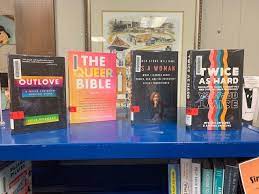
I want to be a part of healing the divide, not widening it. As a transgender woman, I have few opportunities to interact with people from the right. Just today I was made aware that my book is part of a controversy at a library in Mississippi. The book is displayed along with three others from the LGBTQ+ community. Apparently, the display caused the mayor of the town to withhold over $100,000 from the library and brought a lot of angry folks to a meeting of the board. I wish I could show up at the library and let people talk with me one-on-one.  Not about the book, or the display, but about who makes the best sweet tea in town. Finding the common ground that can unite us is critically important if we are ever going to bridge this divide.

In the 1930s, theologian Reinhold Niebuhr wrote what has become known as the Serenity Prayer. Niebuhr’s actual prayer was not exactly the same as the one that has been popularized. Here is his prayer as originally written. I prefer the original.

Father, give us courage to change what must be altered, serenity to accept what cannot be helped, and the insight to know the one from the other.

The Merry-Go-Round

I was a fearful child. I refused to ride on most of the attractions at Camden Park, the amusement park near my hometown of Huntington, West Virginia. Even the merry-go-round was more than I could handle. The horses had menacing gazes. The lions gaping mouths were ready to devour small children. The merry-go-round had a brown bench with a narrow seat and a high back, colorless among the brightly painted ponies. My mother made me go on the merry-go-round once and tried to coax me onto one of the horses, but I went straight to the brown bench, where I sat until the ride mercifully ended. She never made me go on the merry-go-round again.

My mother was fearful of life. As a child who paid attention, I did not miss the fact that the person I depended on to navigate through the world of big people was a frightened guide. That is how we inherit intergenerational trauma. Mom never got over her fear. She tragically gave up and quit trying, never getting out of bed the last ten years of her life.

Over the past decade I have had reason to be fearful. I lost hundreds, even thousands, of friends and acquaintances, to say nothing of losing my job of 35 years and a large pension. We make it through life by holding onto the notion that we are in control of our lives. We are not. Well, we do have control over whether we eat three chocolate covered strawberries for breakfast, which I may or may not have just done, but most of the big things are out of our control. You might have noticed.

Every time I pick up an Anne Lamott book, I am struck by how transparent she is about her shadow sides. Invariably, I find myself in the pages, unable to put the book down. Her shadow sides are similar to my own, only she writes about them with so much more clarity than I do. She also writes with more self-compassion, which makes her words easier to digest than mine. When I write about my shadow sides, my friends say, “Give yourself a little grace.” But they don’t know what it is like to live in this body. I really do want to get it right, though I miss the mark so often.

If we are committed to the process, we go through many conversions in life. We begin our adult lives fulfilling the unfulfilled dreams of our parents. That works until it doesn’t. Then we move into what Carl Jung called the second adulthood, in which we begin to focus on our own dreams and aspirations. As the years progress, we find we have fewer friends but deeper friendships. We are more interested in being in relationship than being right. And most frightening of all, we realize that when we are called, we no longer have the luxury of rejecting that call. We can no longer claim that we need to put the kids through college and save for retirement. We are forced to look the call straight in the eye, knowing time is running out. Will we show up or will we stay locked in our comfortable houses? Because of our predisposition to remaining comfortable, the call in the second half of life does not come as a moment of joy, but as a moment of terror.

Assuming you do answer the call, the surprises continue. You find you might be called time and again, onto ever more frightening journeys, the kind that will show your every flaw and demand that you work on the stuff you’ve avoided for decades.

I’ve read that the sixties are the most productive decade of life, followed by the seventies, followed by the fifties. If we haven’t done so in our forties, during our fifties we find the courage to answer the call. Our sixties are when we find our stride. Our seventies are when we realize there is yet another call, one we never anticipated. This one is easier to navigate. We’ve already failed enough to know that failure is good for the soul. We let our wisdom make the major decisions, looking deep inside our own souls for our sense of direction, knowing that looking outside ourselves never works out so well. I don’t know anything about the 80s, but I’m watching two mentors closely. They are still finding new ways to serve and grow.

I still occasionally get overwhelmed by fear. After every blood test I anxiously await the results. Things happen when you get older. Our bodies wear out. Mine has been very good to me. I still mountain bike and run and hike and all the things. No one ever thinks I am the age I am. But you can’t outrun time. I remember the day my mentor, Jim, said he was going through his final conversion, giving up his attachment to his own body. He was 98.

I will be back in Huntington, West Virginia next month. It will still be winter, so Camden Park will be closed. That’s fine with me, though I would like to know if the same merry-go-round is still there. I wouldn’t be frightened of the horses and lions now, though I still would not ride on them. I’m prone to vertigo when I spin. The spinning of the planet is enough of a challenge, thank you.

It will be good to be back in Huntington. I will be speaking at Marshall University, where my father worked on a master’s degree. Huntington is only about 30 miles from where my parents and other family members are buried. In many ways, the region is still home. When I return, it looks like it has been expecting me.

I am not as fearful as I once was. I have looked life straight in the eye and done the hard work. I don’t ride on the brown bench in life. I ride on the wildest pony, and when I go back to the Tri-State region of my youth, I am reminded of just how far I’ve come.

And so it goes.

I’m Back

Anne Lamott writes that defeat has been, for so many of us, the portal to soul. James Hollis says wisdom comes through the integration of suffering. Megan Devine says grief is not a problem to be solved, but an experience to be assimilated. Do you see a theme?

A handful of you have noticed I have not written since early December. Well, it’s not that I haven’t written anything. I’ve written several sermons, a few birthday cards, a letter of reference or two. But I haven’t written a blogpost.

My memoir wore me out, both the writing of it, the second guessing of what I wrote, and the promotion of it. My last book event was the Miami Book Fair in November, when I spoke alongside an author whose works are world class. My book isn’t bad, but it’s not world class. That was humbling.

I have a few books on the kitchen counter waiting to be read. My book is on top. I haven’t read it since I read it aloud for the audiobook. Sometimes I look at it with a sense of accomplishment. Other times, I can only muster a halfhearted, “Meh.” It’ll probably be a few years before I actually read it again. Someone showed me a Facebook post the other day with a picture of my memoir next to other books people want to ban from a public library in the south. That hadn’t occurred to me, but in today’s America, I suppose it makes sense.

I really do want to read all of the other books neatly stacked on my kitchen counter, but the only ones I have gotten to so far are Anne Lamott’s Dusk Night Dawn, and two books by James Hollis. His book, Middle Passage – From Misery to Meaning in Midlife, found its way into a scene in the second season of Ted Lasso. It’s out of print, so it’s been hard to find since its television debut. I’m way past midlife, but the book speaks to me. It’s section on marriage is one of the best I’ve ever read on the subject. The other Hollis book is Swamplands of the Soul – New Life in Dismal Places, probably his finest work. My copy is all dog-eared and marked up.

All three books are appropriate for those attempting to live authentically, and not afraid to look in the mirror. While I was in the midst of reading both Hollis books, I was also discovering still more flaws in my being that I had not previously acknowledged.  We’re not talking nitpicky flaws, like leaving my reading glasses smudgy. We’re talking big stuff. I said to Cathy the other night, “I don’t know if I would have done any of this hard work had I remained Paul. Life was too comfortable.” It is not comfortable now. I squirm a lot. I’ve seen shadow sides of myself that cast long and lean shadows, the kind that come just before sunset.

In Swamplands of the Soul, Hollis writes, “Perhaps this existential guilt is the most difficult to bear. To know oneself responsible, not only for the things done, but the many undone, may broaden one’s humanity but it also deepens the pain.” He goes on to say, “The ironic consciousness can see the flawed choices, can understand their consequences, but this knowledge is neither redemptive nor avoidable. Such a person is always left with a troubled consciousness, but at least, as Jung pointed out, he or she is thereby less likely to contribute to the burdens of society.” Except when you do contribute to people’s burdens. Sigh.

Hollis calls this, “an existential guilt from which there is no escape, only denial or a deepened acknowledgement.” Most people choose denial. Choosing deepened acknowledgement requires enough ego strength to go into the depths, where the light barely penetrates and self-condemnation shows up behind every door you open. Self-forgiveness is nowhere to be found. It’s dangerous down there. That is why Hollis acknowledges that self-forgiveness is the hardest goal of all. Anne Lamott says she “continues to believe that love is still sovereign here, and that the hardest work we do is self-love and forgiveness.”

So, that’s why I haven’t been writing. I’ve been looking into the dark places, seeing clearly the flaws, while doing a terrible job at self-love and self-forgiveness. But if someone as individuated as James Hollis and as cool as Anne Lamott face the same dilemma, I must be on the right track.

Theologian Paul Tillich understood self-forgiveness. He defined grace as, “Accepting the fact that you are accepted, despite the fact that you are unacceptable.” I can’t use that quote much at church, because too many people carry the wounds of having been taught that an angry God is just waiting to send them to hell. You can’t take in Tillich’s words until you have left that notion behind and can take in your full humanity. God is not going to send you to hell for being human. But that doesn’t mean you won’t send yourself there, right here on earth.

Which is why most people stay on the surface. Let’s just act like everything is fine, because if we dive into the chaos and emptiness that follows, God only knows when we’ll be able to come back up for air. Or write a blogpost.

I think I’m ready to write again, to keep up the weekly schedule I’ve maintained since 2014. I used to do that with no problem.  From 2003 to 2014 I was the editor-at-large of a national religious magazine, with a deadline for a weekly column. I miss that work, and the people with whom I worked. I miss a lot of people from my past life.

The people in my current life know nothing of Paul. They only know the woman whose life is intersecting theirs. They see her very differently than people saw Paul. Her flaws are visible, her insecurities are worn on her sleeve, her distraught face is as easy to read as a children’s novel. Life was easier as Paul. It is more soul-disrupting as Paula. But that is good. It is very good.

There Must Be a Pony Somewhere

On Thanksgiving morning, for the second time on a holiday, I was greeted with early morning hate texts from evangelical Christians. The texts seem to be coordinated, though I can’t be certain. What would cause people to work so hard on a holiday to find my cell phone number and send hateful messages? Yet again, I had to remove my phone number from all public sites, including my counseling practice.

I have received thousands of hateful messages, texts, comments, and phone calls since I transitioned. The biggest waves of nasty mail came after my New York Times article, my first TED Talk, and the release of my memoir. Positive correspondence is about ten to one over negative correspondence, so you don’t need to worry about me. My soul is fine. From the time I transitioned, I knew that embedded in my identity were responsibilities. I could not slip off into the night. I had to speak out. I knew I would be a lightning rod for the naysayers.

Recently, however, the tone of that correspondence has been darker and more frightening. We have to monitor our live Left Hand Church services on Facebook every week, because we have been attacked by groups of fundamentalists who storm our site and disrupt the online service. Since 2016, it has gotten worse, as those on the extreme right have been empowered to publicly express their hatred.

I am not the only one receiving hate messages. Just last week I talked with a brave person trying to navigate the waters of evangelical hate. This week I spoke with another. The calls are getting more frequent from good-hearted souls with their eyes steadfastly focused on leaving a world they know is too small for them. But on their way through the restrictive city gates, they are attacked by people terrified of trusting the truth inside their bones, people who turn their fear outward and project it onto those with more courage than they can muster.

My greatest concern is that virtually all of this vitriol is emanating from the religious right. An article a few weeks ago in the New York Times said Americans are increasingly equating evangelicalism with right-wing Republicanism, as if the two terms were synonymous. I see no evidence to refute that perspective. The utter confidence with which these fundamentalist Christians make their attacks is alarming. They do not exhibit one ounce of doubt about the rightness of their conclusions. I have no idea what the more moderate members of my former denomination are doing to combat these vigilantes. I’m not sure they feel capable of doing anything, since the extreme conservatives are getting the upper hand in most evangelical denominations.

But here’s the thing. We’ve been here before. This is not America’s first time at a chaotic rodeo. We’ve always created enemies that don’t exist, vilified those newly arriving on our shores, turned our neighbors into the opposition, and generally made a mess of our democracy. And somehow, we have always been able to right the ship.

Nevertheless, I am frightened. This is the worst I have seen the ship listing during my lifetime. It feels like one rogue wave could finish us off and send sober minded citizens scrambling for the Canadian border. Yes, we are in a crisis, and what we do next will determine if our democracy survives.

How do we stop the madness? I know of no other way than to love those frightened souls. I think of a counseling client I had years ago whose political views and perspectives were the polar opposite of my own. I wondered if I could truly help my client. It wasn’t long, however, before I came to truly love the client. To my shock and utter surprise, they remained with me after I transitioned. A bond had been formed, and the client was able to look past their fears to find the common ground in our professional relationship.

Yes, it was a professional relationship, not a friendship. But it is a model that plays out every day in companies, government entities, schools, health care institutions, and other environments in which people from opposing views are brought together. The norm is not Congress. The norm is not the church. The norm is ordinary people brought together in the public square.

Most of my public speaking is in the corporate sector. I talk with the employees of corporations and offices across our nation. I find an openness to the message I bring that I would never receive in a church. I see it in the eyes of the audience members. They begin skeptical, but the longer I speak, the more I see their resistance fading, “She seems relatively normal – at least as normal as I am.” I know when they reach that point that the battle is over.  Yes, I am the same as you – bone and sinew and neuroses and complexes and prejudices and blind spots – in a word – human.

I focus on those positive encounters. I do not answer hate mail. I encourage those receiving hate mail to block the senders, have their correspondence vetted by allies, and above all, to never ever read one single hate message. No one is strong enough to endure a steady stream of vitriol.

But if you can see the larger picture, and understand these people are terribly frightened souls, you can protect yourself when you are being attacked, but also look for opportunities to reach out in those environments in which both sides come together. At work, or on the soccer field, or at the baseball game, you can take the common ground you share, and leverage it to see the precious human hiding behind that harsh facade. If we can learn to do that, we can save our nation.

In my soul I am an optimist. I believe we can right our ship. I believe if there is a pile of excrement, there must be a pony somewhere. I am determined to find the pony. I know there’s a pony.

Wholeheartedly

Now that I have reached a certain age, it is fascinating to see how others of a similar age live their lives. It is as though we journey on two different planets.

All of us start life in the all-encompassing grasp of parents who we believe have the magical power to meet our every need. They choreograph the dance of childhood and most of the moves of adolescence. Eventually, however, we make the awful discovery that their choreography is all wrong for our lives. That is when we figuratively and literally leave home and enter the first adulthood.

The first adulthood is defined by the big three – jobs, marriage, and the cultural expectations of our age. Equally powerful are the unrealized dreams of our parents. Somewhere in childhood we came to believe it is our responsibility to fulfill their unfulfilled dreams, and it becomes a subconscious focus of our first adulthood. That is why one of the most important gifts a parent can give their child is to live as fully as possible, so the child does not feel the need to complete their unfinished business.

Eventually most of us reach the stage in which the first adulthood is providing diminishing returns. We are tired of living our parents dreams and answering the demands of our culture, and we move to our second adulthood, in which we are less concerned about resume virtues and more focused on eulogy virtues. We have fewer friends, but deeper friendships. We no longer look outside ourselves for our sense of identity but look inside our own souls, never an easy task because it involves moving beyond our objecting egos. Our ego is concerned about keeping up appearances. Our soul is interested in the ride. Our soul understands what it means to live wholeheartedly.

Some people enter their second adulthood in their forties. Most begin in their fifties or sixties. Interestingly, the most productive decade for most Americans is their sixties; the second most productive is their seventies. (In case you are wondering, the third is the fifties.) All three come during our second adulthood, when we finally give ourselves permission to live wholeheartedly, seeking to satisfy the needs of our own souls.

Which brings me back to people who are my age. Many are bitter, grumpy, and perpetually annoyed. Life has not lived up to their expectations and they want the world to know it. I remember an elderly man on Long Island who painted on his truck door, “The Golden Years Stink.”  A lot of folks share his sentiment, if not his hubris.

In my experience, many of these bitter senior citizens became trapped in their first adulthood, fulfilling the dreams of their parents, their culture, and the other external forces that demanded fealty. They became so fixated on safety and security that life passed them by. And now it is finally dawning on them that the most secure place on earth is a cemetery. In the interest of safety, they have lived a life that was never truly their own.

If they are religious types, they are often trapped in Fowler’s Stage Three of faith development, following the rules and regulations demanded by an angry God, never moving on to the necessary work of spiritual disenchantment. Unfortunately, if you refuse to do the hard work of disenchantment, you will also miss the joy of faith’s re-enchantment, as you embrace an understanding of the holy and sacred that is far wider and deeper than anything you imagined. A re-enchanted faith is what Mary Oliver expressed in her poem, The Summer Day. Its final line is a testament to living wholeheartedly: “Tell me, what is it you plan to do with your one wild and precious life?”

My life is not easy. I know, yours isn’t either. Life is difficult for all of us, whether you embrace the second adulthood or not. As I have acknowledged before, I am currently going through a rough patch. It is the third time that has happened since my transition. This period of difficulty is a reminder that taking the road less traveled by will always include stretches of road filled with fallen branches and stones.

But if you live wholeheartedly and dare to believe that the call toward authenticity is sacred, and holy, and for the greater good, you know that despite your suffering, you have no choice but to move forward, one step at a time, though the desert. It is the only path to wisdom.

I am glad I live a life that has more in common with my friends in their 40s and 50s than with Baby Boomers. The last decade was by far the most productive of my life, and I fully expect the coming decade to be just as productive.

Life is difficult. But if you live wholeheartedly, life is also full of joy. To be sure, we have to travel through the road of trials to get there, but if we have eyes to see, joy is always waiting, just around the bend.

Intelligence Without Education

A friend recently sent me a video of a mutual acquaintance who had spoken on a subject in which they expressed great confidence, but did not exhibit a level of knowledge that would justify the confidence.  The individual’s intelligence was evident. Their lack of education was also evident.

Throughout my career in ministry, I have discovered that the stronger one’s conservative theological opinions, the higher the likelihood the person has not attended seminary. In fact, they often have not even received a bachelor’s degree.

I do not believe you need a Master of Divinity degree to be a good pastor, but I do believe a post-graduate degree in almost any field will help you become a more critical thinker. Learning the breadth of information in a field of study helps you realize the importance of broadening your horizons before reaching hard and fast conclusions on any subject.

If all you know is the hills of eastern Kentucky, you might use that limited knowledge to determine the measure of a mountain. The first time you set eyes on the Rockies, you realize your previous knowledge was inadequate. The truth is that we don’t know what we don’t know.

When you add high intelligence to the lack of formal education, the problem is exaggerated. Your intelligence gives you the confidence you can process and categorize information quickly, and indeed you can. But your conclusions are drawn on limited information.

I was talking with a seatmate on an American Airlines flight, and he was quite confident that American Airlines flew only one kind of Airbus 321. As some of you know, I am a bit obsessed with airliners, and I happen to know American flies four different versions and two different types of A321s. (My least favorite is the 321neo, by the way, a plane they are increasingly using on longer over-water trips.)

I didn’t argue with my seatmate, because there are certain people with whom you know better than to pick a fight. His confidence knew no bounds. Lives were not at stake. No one was going to need therapy based on his misinformation, so I left him alone. His supreme confidence was a telling sign of someone with more intelligence than knowledge.

While I know an A321neo has new engines and a better climb rate and range than previous 321s, I am not a pilot, and I know virtually nothing about the inner workings of the plane. My knowledge is limited to my level of education and experience. Recognizing the limits of one’s education and knowledge is important.

When I look at the polarization of America, I think of Nick, the sweet-spirited bagel maker at my favorite bagel store on Long Island. Nick was intelligent but had ended his formal education after high school. He arrived every morning at 2:00 AM to start making bagels and listened to talk radio until the shop opened at 6:00. His favorite show was one that focused on aliens. I was frequently traveling between Denver and New York at the time, and Nick confidently assured me that aliens were living in the concrete corridors beneath Denver International Airport. Nick was intelligent. Nick was not well-educated.

Nick wanted to be credentialed as a person of intelligence, and in his mind, that meant having information the “average” person did not have. I wish he been given the opportunity for a good education. Instead, his circumstances were such that he could not further his formal education, so he subjected his intellectual curiosity to the pundits of talk radio. There are a lot of Nicks in the world.

When I look at the number of people who believe the absurd claims of the Q conspiracy theory, I see lots of Nicks, intelligent folks with an inadequate education, and therefore the inability to discern the difference between truth and fiction.

Nick’s views about the existence of aliens beneath the Denver airport is misguided, but not dangerous. That is not the case with the speaker who was on the video my friend sent to me. The speaker has a lot of influence with a vulnerable population. Claiming a clear hold on objective truth, the speaker chastised the rest of Christendom for being dismissive of biblical authority.

What exactly would “biblical authority” be? Are we talking about the absolute accuracy of the original autographs of the scriptures, which do not exist? Are we talking about a literal interpretation of the scriptures? Or is “biblical authority” just a catchphrase of a certain kind of insider Christianity, pretty much meaningless to everyone except evangelical Christians? I believe in the inspiration of scripture, though I am not certain exactly what that means. I really do not know anyone who is exactly sure what that means. Appealing to biblical authority is hardly the way to win a theological debate.

At Left Hand Church, all our pastors are well-educated in their respective fields, and have also completed some form of advanced theological education. But they tend to defer to me on issues of theology because I have two master’s degrees in the subject, and a Doctor of Ministry degree.  I do not have a PhD degree in theology however, and I am aware that when it comes to theological knowledge, I also need to lean on others with a better education than my own. This is how life works. You don’t claim knowledge you don’t have. The truth matters, in every endeavor, all the time.

To be sure, it is difficult to discern the truth. It will always require rigorous intersubjective discourse, as we study and probe and compare notes to get as close as possible to something approaching objective truth. But the truth is that you cannot do that without a good education.

I hope the speaker reconsiders their future course and finishes at least a bachelor’s and a master’s degree. Should they do so, I have a feeling they might look back on their speech with more than a little regret.

And so it goes.

Well, That’s Weird

There is a strange phenomenon taking place in American evangelicalism. It’s been chronicled in recent articles in The Atlantic, the Washington Post, and the New York Times, my three go-to sources for vetted, reliable information. It’s also been documented by the Pew Research Group, one of the polling organizations I trust.

We’ll start with a study out this week. The Pew Research Group discovered that 90 percent of American atheists have been vaccinated, followed by 86 percent of Hispanic Roman Catholics (who knew), followed by 84 percent of agnostics, 82 percent of Roman Catholics (again, who knew) followed by assorted other groups in the 60th to 80th percentile. Who scores lowest on vaccination rates? If you guessed evangelical Christians, you are right. Only 57 percent of evangelicals have been vaccinated. Which brings me to the newspaper and magazine articles.

A few of the more influential evangelical megachurches in the nation have recently experienced the kind of backlash previously reserved for school boards in conservative states. Three elders in McLean Bible Church in the DC area didn’t receive the 75 percent of votes needed to be affirmed as elders. A group of conservatives made a concerted effort to sully their reputations with a false accusation that they intended to sell their building to Muslims (which by the way, one of our Orchard Group churches did while I was still CEO. Nobody seemed to care all that much at the time.)

A megachurch in Minnesota lost four of its pastors after being subjected to what they called “spiritual abuse and a toxic culture.” In that case, it seems the pastors were speaking “too often” about the need for racial reconciliation. Southern Baptists Russell Moore and Ed Stetzer have both been accused of supporting a liberal agenda. I don’t need to go into it here, but neither gentlemen would likely take a meeting with me. They have never supported LGBTQ+ rights or a woman’s right to choose. They are not liberals. Apparently, they are just not supportive enough of far right causes.

A New York Times article published last week showed that Americans are increasingly equating evangelicalism with Republicanism, as if the two were synonymous. One recent study showed that among Christian groups, only evangelicalism was growing. Upon closer examination, it was determined that evangelicalism is not growing. Lots of people are calling themselves evangelicals who are not, in fact, evangelical. The list includes Mormons, Roman Catholics, agnostics, and a whole plethora of others. In answering the survey, they self-identified as evangelicals primarily because they equated evangelicalism with their right-wing Republicanism.

I’ve been watching this politicization of the evangelical church since long before I transitioned. Back in the 70s, I had to attend (my music group was on the program) a far right-wing event in the Ozark Mountains of Arkansas. When speaking of feeding the hungry in Biafra, one of the speakers actually said, “The more we feed – the more they breed – the more there are to feed.” Yep, that was spoken at a Christian conference.

In the 80s, I was appalled to learn that the national convention of my denomination was trying to book a Republican president to speak for a main session. Main sessions were always reserved for sermons and worship, not political speeches. Thank goodness he cancelled.

While I was the editor-at-large of our denomination’s national magazine, I watched with alarm as more and more of our churches made a hard turn to the right. As a moderate evangelical, I became persona non grata within that group. Time and again, the editor with whom I worked, a good and decent man, had to defend me to the increasingly vocal right wing.

Since I transitioned, I have watched the entire denomination take a hard turn to the right. I feel for all of my friends who I know do not hold right-wing Republican views. Many of them are staying quiet, just like the Republican leaders in Washington. Job security is a real concern. Kids need to go to college and health insurance is expensive. I get it. Enamored with security, I stayed in the evangelical world far too long, afraid to tell anyone my political views, let alone my gender identity. I understand how frightening it is to leave the comfort of a good job and a lifelong community.

But to those friends I say it is time to leave. There comes a time when enough is enough, and you have to take a stand, come what may. I recently was on YouTube and stumbled across one of the television shows I shot sometime around 2007. I was in a field at McGregor Ranch, bordering Rocky Mountain National Park. In the third segment of the show, the camera shot was a close-up of my face, with golden aspen and a brilliant blue sky in the background. It was mid-September. I was talking about the importance of taking a stand and living with the consequences. I ended the segment encouraging the viewer to action, and repeated the words, “You must do the right thing, come what may, come what may.”

Seven years later I took a stand, and “come what may” brought about the end of my career. Was it worth it? Come on now, you know the answer to that. It’s on the dedication page of my book, “To all who believe the call toward authenticity is sacred and holy and for the greater good.” Of course, it was worth it. Was it easy? Nope. Does it make me happy? Not always. But as the Jungian analyst James Hollis says, you can live without happiness, but you cannot live without meaning. And for me, following the truth brings meaning.

I am glad I am no longer an evangelical. I like the post-evangelical world I inhabit. There is room for mystery and complexity and differences of opinion, while still steadfastly focusing on Jesus. And yes, Jesus remains as controversial as ever. It turns out loving God, your neighbor, and yourself isn’t all that easy, or popular.

And so it goes.

Religion is Good – Really, It Is!

Over the last two weeks I’ve been doing a series of podcasts and radio shows for my book tour. Last week I did my first indoor speaking event (other than Left Hand Church) since the beginning of the pandemic. I spoke to the high school students and faculty at Colorado Academy. Just yesterday I spoke in-person for a mental health conference at the University of Denver. Earlier in the day, I had spoken virtually to the employees of Viacom/CBS.

In most of these podcasts, radio shows, and live events, the subject of my speaking was gender equity. Interestingly, however, a lot of the questions had nothing to do with gender equity. They asked how I could be a part of the church after having been ostracized by it. I never mind answering those questions.

I usually begin by talking about the three desert religions, Christianity, Islam, and Judaism, and their beginnings as religions of scarcity. Without enough resources to go around, every tribe had to take care of its own.  Unfortunately, in their fundamentalist forms, all three remain religions of scarcity, believing there is not enough of God’s love to go around.

As the sociobiologist E. O. Wilson so clearly warns, humans have evolved to believe an enemy is necessary for their tribe to survive, and where no enemy exists, they create one. Among evangelical Christians, the created enemies have been the LGB population and those who support a woman’s right to choose. When marriage equality became the law of the land, they shifted their attention to the transgender community, hence the 17 bills passed and 168 currently pending that take away the civil rights of transgender adolescents, one of the most at-risk groups in the nation.

In one of Monday’s events an attendee asked, “With so much public animosity toward transgender people, wouldn’t you see religion as a problem to be solved rather than a solution to be endorsed?” I answered that if you were only referring to evangelicalism, my answer would be for the most part, yes. But like every other institution on earth, there are good apples and bad apples, those focused on reconciliation and those focused on destruction, and plenty of folks in between. When all is said and done, I still believe religion is a positive force in society.

Religious institutions are the only ones designed to help us figure out how to do life together. Governments serve the citizenry. Corporations create profits for shareholders. Educational institutions impart knowledge. But only religious institutions have the primary purpose of helping us learn to be human together. If you expect the church not to be a mess, you are not considering one of the major purposes of the church. There will always be messiness in any endeavor teaching us how to be human together.

Religion also exists to help us search for meaning in life. We are an inherently spiritual species, and we have always best worked out our spirituality in community. In fact, that is how we moved from being a species focused on blood kin to a species focused on community. We did not take off as a species until we developed tribes, and we did not develop tribes until we joined together in a search for meaning. Our communal search for meaning catapulted our species forward. At that basic level, religion has always been a good thing.

I also believe religious institutions are uniquely situated to do good work for the people of their communities. For decades, churches wanted to be the best church in their towns. Now, at least some churches have a healthier mantra, they want to be the best church for their towns. After 9/11, the organization of which I was the CEO quickly directed over one million dollars in disaster relief to meet immediate needs of those who lost family members, jobs, and property in the terrorist attack. How did we do that so rapidly? We granted the money through local churches. Local churches didn’t have to wait for national organizations to tell them where the needs were, they already knew the needs of their neighbors.

I believe Left Hand Church, and churches like Left Hand, can provide the same service today. We can be churches in which we search for life’s meaning together. We can figure out how to be human together, and we can learn in community how to love God, love our neighbors, and love ourselves. That is the kind of community into which I am willing to devote my energies.

Yesterday I was reading an article in the New York Times that lamented the state of the American church. The article suggested that evangelicalism and Republicanism have become synonymous. I believe the writer was correct, and it is tragic. It is time for the church to return to the teachings of its founder – loving God, loving neighbor, and loving self. That is the only path forward. Everything else is empty rhetoric.

That’s How the Light Gets Brighter

Frederick Nietzsche said truth is always on the side of the more difficult, which is a fancy way of saying what I said in my second TED Talk, “The truth will set you free, but it is likely to make you miserable first.”

Since childhood, I have hungered for knowledge and never much cared what the subject was. Everything interested me. When I was a teenager in eastern Kentucky, I learned about measuring tobacco (the patch, not the leaf) and Old Timey (no, that is not misspelled) music, the precursor to Bluegrass.

As a former TED speaker, I have the privilege of having regularly scheduled conversations with other TED speakers. The names of the people and nature of the discussions are private, since a bunch of the folks are public figures, but suffice it to say I’ve gained more than a little knowledge as I listen to these brilliant leaders. Sometimes the knowledge is esoteric, but fascinating.  For instance, did you know a female praying mantis without a head can still mate with, and then dismember, a male praying mantis? Yeah, I didn’t know that either. And no, they did not remove the head of the female praying mantis. They found her that way. She lived a week before her inability to take in food did her in.

I also have a lot of useless information about Southern Gospel music in the 60s and 70s, high-end stereo systems of the same period, and commercial airliners of any era. When I visited a local airfield to take a short flight on American’s first DC-3 airliner, the chief pilot started taking me seriously when I talked about its Curtis-Wright engines. I ended up sitting in the flight engineer’s seat. Kristie, my co-pastor, calls me an airplane savant.

I do enjoy gaining knowledge about a plethora of subjects, but I also understand the limits of knowledge. While knowledge can be learned, wisdom cannot be learned. Wisdom only takes shape and grows through assimilating the lessons of suffering. The key word is “assimilating.” Lots of people suffer, but not everyone gains wisdom from their suffering.

To gain wisdom through suffering, you have to allow your suffering to sink beneath your ego level to rest and abide at the level of your soul. You have to  move beyond being outraged by your difficulties, to being instructed by them. Only then can you allow suffering to do its good work within.

I am convinced that love makes the world go round, but where there is love, there will always be loss. The deeper the love, the greater the loss. The greater the grieving, the greater the wisdom that results from having grieved well, because you are assimilating the lessons of suffering.

I have an acquaintance whose journey through childhood, college, and ministry was similar to mine. We had the same kind of cultural experience and education, and did the same kind of work. Yet my acquaintance is no wiser than when he was in his twenties. He has been relatively happy. In fact, by most measures I would say he is happier than I am. But he has not been invited by a publisher to write a memoir, nor has he been sought out to share his wisdom from the stage. I do not say that to be boastful, but to speak to the truth that people who are willing to assimilate suffering in the service of wisdom are people who are in demand in the world. The world wants their wisdom.

If I had to choose between happiness and wisdom, I would take wisdom every time. Happiness is an end. Wisdom is a means to an end. The end is joy. The end is using your own suffering to lessen the suffering of others. It is taking a step forward, then shining a light back so another can take a step forward along the same path. That is how the human journey proceeds, one suffering-assimilating person at a time, using her wisdom to chart a course through the thickets and brambles that are the nature of things.

Through all my struggles, I have never lost my capacity to imagine something more for my life. I have never been one to get stuck on what happened in the past. I work through it and focus instead on what I might become. I do understand that my white male privilege is one of the reasons I can take such a forward-facing view of life. But it is my responsibility to make the most of that privilege, and to use it to enhance the journey of others.

D. H. Lawrence said a writer sheds his sickness in his writing. If you follow my blog, you know my unresolved issues and current struggles. I write about them. You also know that I am nothing if not earnest. That has come up over and again in reviews of my memoir. I understand only too well that Nietzsche is right – that truth is always on the side of the more difficult, and I am not going to shy away from that which is difficult.

What wisdom is my current suffering teaching me? It is teaching me that when you find fellow-travelers on the journey of authenticity, others who believe the call toward authenticity is sacred and holy and for the greater good, you hold onto them no matter what. You fight to keep them in close proximity, so your wisdom and their wisdom can intermingle, because that’s how the light gets brighter. And the brighter the light, the greater the joy that enters the world.

I am grateful for the knowledge I have gained in this short pause between two great mysteries, but what makes life worthwhile is the accumulation of wisdom.  So, I continue to take the path less traveled by, and therein lies the difference.