From Paint-by-Number to Rembrandt

The Journey From Paint-by-Number to Rembrandt

I once spent the day with a movie script doctor, a British gentleman who made a lot of money fixing flawed scripts before they were turned into blockbusters. He said, “No matter how messed up a person’s life, when watching a movie they become moral. They might make wrong decisions left and right in their personal lives, but they want the hero to do the right thing.”

What makes us a moral species? Is it just the efficient machinations of the evolutionary process, or something more? When I was well indoctrinated in Fundamentalist theology, these and other questions consumed my thinking days.  I was a child of the modern age, steeped in the logic of the Scottish philosophers. I demanded that religious faith behave rationally. I preferred a Christianity of systematics. I did not know what to do with the Holy Spirit, who seemed far too wild and unpredictable for a thinking man’s religion.

As a man, I was rational. If something could not be measured rationally, it was probably not very important. That was one of the perversions of the modern age, with its confidence in scientific certainty. Then Quantum physics came along and the modern age was turned upside down. It turns out nothing is quite as certain as it appears. While science has come to accept this major shift, the Evangelical church is still caught in the more certain, but false, world of Newton, Bacon, Descartes and the modern age. I can’t help but wander if part of the reason is because the Evangelical church is still dominated by men.

Pretty much everyone in my circle of close friends says I no longer think as much like a man. My thought processes have moved somewhere between the two genders, which studies show is pretty typical for transgender women. No one knows the exact reason, though it appears to be both hormonal and social. I only know what I have personally experienced, and the changes have been enlightening.

As a man, my world looked like a paint-by-number set. Everything made sense, but it wasn’t very pretty. My world is now looking more like a Rembrandt, with the infinite play of light and shadow. Most of the time I no longer need answers, but I do need time to ponder. Questions that once demanded resolution have become mysteries to be accepted and embraced. On the other hand, and paradoxically I might add, nowadays there are some things I just know, confidently. I need no scientific proof.

I no longer need to know why a movie audience is always moral; it just is. I know that through the worst religious oppression, women still fill churches and nurture faith from generation to generation, while men concern themselves with wars and rumors of wars. I know mothers will awaken at the slightest sound from a baby’s room, while fathers can hear a the tiniest of aberrations from a car motor, but are likely to be unaware whether or not their child is actually in the car.

I know I say all of this at the risk of sounding sexist, but there are differences in how men and women move and have their being.  I now spend the majority of my time with women, and my priorities are changing.  I want to listen more and talk less.  I want to find solutions collaboratively, instead of imposing them unilaterally.  I want to look through the eyes of the powerless, not the powerful.  And these changes taking place in my being are confirming something else I always intuitively knew. There is a reason Mother’s Day is a bigger deal than Father’s Day.  Somewhere way down deep, mothers see the world the way it really is, hopeful and redemptive.

When all the scientific truths have been upended and the wars brought to their tragic conclusions, some things will remain.  The audience will always be moral; science will never be certain; and the nurturing, gentle, whole heartedness of mothers will still make the world go round.

And so it goes.

rembrandt-harmensz-van-rijn-return-of-the-prodigal-son-art-poster-print

Seriously, Please!

Seriously, Please!

I know those of you who choose to read this blog because of my posts about the church are frustrated with the number of recent posts on transgender issues. I understand your frustration. However, right now there is a national attack on the transgender community, and it is critical for Christians to do their research before weighing in on the topic.

In March of this year Dr. Paul McHugh and the American College of Pediatricians published a position paper on transgender issues that has been widely quoted by pastors of Evangelical churches. There are a number of problems with that decision, all related to inadequate research.

  1. The American College of Pediatricians, which published the position paper, is not a highly respected medical society. It is a 200-member group of conservatives whose positions are often seen as radical by the mainstream medical community. In no way is it affiliated with the 60,000-member American Academy of Pediatricians, a venerable institution supportive of gender transition.
  1. The paper indicates there are no biological origins of gender dysphoria. In reality there are over 150 professional peer reviewed resources showing the biological origins of gender dysphoria. For instance, as far back as 1973 it was widely known that mothers who took DES had sons with a much higher incidence of gender dysphoria. A recent Boston University meta-study of the plethora of peer reviewed resources concluded, “Current data suggests a biological origin of gender identity.”
  1. The position paper indicates up to 98 percent of children who present with gender dysphoria will desist from expressing a desire for gender transition, a number quoted out of context and without documentation from the DSM-V. There are no known studies that support that figure or any similar figure. In fact, recent studies show a child solidly claiming at an early age to be transgender is highly likely to continue to identify as transgender into adulthood. In response to a study entitled, “Gender Cognition in Transgender Children,” by Olsun, Key, and Eaton, the New England Journal of Medicine Journal Watch concluded, “Gender non-conforming children show clear implicit and explicit preferences for their expressed gender early in life…They do not appear to be confused, pretending, delayed, gender-atypical, or oppositional in these views.”
  1. Dr. McHugh and the paper’s co-authors speak of grave medical consequences of cross-gender hormonal treatment, yet their information is based on a form of estrogen not widely used in over 15 years. In regard to today’s hormonal treatment, in July of 2014, Henk Asscheman, MD, PhD, the principal investigator in a study of 2,000 transgender individuals treated in 15 US and European centers concluded, “There are mostly minor side effects and no new adverse effects observed in this large population.”
  1. Dr. McHugh continues to refer to a study headed by Celia Dhenje, MD that researched post-transition suicidal ideation. Dr. McHugh concludes suicidal ideation exists because gender transition does not resolve gender dysphoria. That is, in fact, the opposite of what the study concludes. Dr. Dhenje has publicly called Dr. McHugh’s misuse of the study unethical. The study concludes that the cause of higher than average suicidal ideation in transgender individuals is not related to their view of themselves in their preferred gender, but is related to external discrimination, rejection, and isolation. In other words, Dr. McHugh’s position paper is one of the causes of transgender adolescents having suicidal ideation.

I appeal now to my Evangelical friends who have quoted Dr. McHugh. Just because Bob Russell, Jim Burgen, or even the Wall Street Journal quote the positions of Paul McHugh, it does not give you license to repost that information without determining if it is factual. It is unethical to reprint (or preach) what you refuse to thoroughly research.

This is not an esoteric conversation; lives are at stake. For a people who claim to “speak where the Bible speaks and be silent where the Bible is silent,” there is a lot of loose talk going on. For God’s sake, if you want to preach about a social issue, choose racial injustice, spousal abuse, misogyny and poverty. Those are real issues very present in the American church. Give the transgender rhetoric a rest. It is based on nothing but uninformed prejudice.

And so it goes.

preacher

When the Tempest in the Teapot Is You

When the Tempest in the Teapot Is You

One day last March, over the course of 12 hours, the legislature of North Carolina spent $42,000 for the singular purpose of taking away my civil rights, stopping me from using the restroom that corresponds with the gender on my driver’s license and passport. Within a few weeks a major American controversy had erupted, and I said, “Whhhaaatt? This is a tempest in a teapot. Transgender people don’t abuse children, though evidence suggests some clergy and politicians do. What is going on?”

This whole fiasco might be fascinating to watch, except for one thing. I am the tempest in the teapot. After a lifetime of fear of retribution for emerging as I truly am, my fears are being realized, not just within the Evangelical church, but in the entire State of North Carolina, to say nothing of the 22 other states in which anti-transgender legislation is pending. Evidently a lot of Americans do not want me to exist, let alone go to the bathroom.

My initial response was a sarcastic piece that appeared in the Huffington Post. It was fun to write and garnered a fair amount of national attention. But as the controversy escalates, I am getting uncomfortable.

This is quite a comeuppance from my previous life, in which I was treated deferentially. Paul enjoyed the benefit of the doubt. If I accidentally took the wrong seat on an airplane, the other person assumed the problem was theirs. If I was waiting in line at the grocery store, they were likely to open a new register. If I told the guy at the Apple Genius Bar my Mac wasn’t fixed by repairing permissions, he believed me. Yeah, that was then.

It was startling enough to enter the world of women, where you are always considered not quite as competent as the boys. But now to be the object of outright derision is quite the conundrum. What began as a North Carolina nuisance has become a genuine problem. I’m starting to think, “What’s next?”

Then I stand back and take stock. My suffering can be measured in millimeters, not miles. No one is burning crosses on my lawn. I am not being turned away from poling places, or made to sit in the balcony at the movie theater. Racism was, and is, a national disgrace.  For me, transphobia is little more than an inconvenience.

I flew through Charlotte last Friday. Everyone at the Admiral’s Club was apologizing for the actions of their self-important legislature. They said, “This is embarrassing. It makes us look like backwoods bigots.” It is important to note that North Carolina’s HB2 was in response to an expansive civil rights law passed by the Charlotte city council. Not all of North Carolina has lost its mind, just the prejudiced and ill-informed part. It is the same crowd that has always looked pretty bad in history’s rearview mirror.

I go to North Carolina again next week, and I will spend ten days there in July. I am not worried. What I face is nothing compared to what my African-American son-in-law faces, or what my Indian daughter deals with, or what my Indian daughter-in-law has had to endure. They have known real prejudice, not just the media-hyped transgender wars. And what they have faced is not as difficult as what their parents went through, or their parents before them. Prejudice has been around a while.

I am embarrassed I had so many years of privilege. Last Friday I watched a man all dressed in Brooks Brothers, about my age and height, as he was given more than his share of attention at the Admiral’s Club at LaGuardia. He has no idea how much America is tilted in his favor. I would not trade the knowledge I have gained by losing that privilege. It has been eye opening and life changing. When I compare my life of privilege to the bit of prejudice I receive nowadays, it will take decades before the scales of personal privilege are balanced.

Don’t get me wrong. I am not happy about HB2. But if that and Evangelical rejection are the only problems I have to face, I should stop complaining and count my blessings. I live in a nation in which the President and  Attorney General have my back, and America’s largest corporations are willing to take a stand against LGBTQ injustice. I live in a world in which I still get to preach and teach in the church (though not the Evangelical church) amidst people who are wonderfully supportive. All in all, I’ve got it pretty easy.  This tempest in a teapot will pass, and life will go on, and all manner of things shall be well.

Rejecting Adaptation for Allegiance

Rejecting Adaptation for Allegiance

I have spoken with several psychotherapists who often ask their clients, “Where are you stuck?” They all say their clients have no problem answering. We humans know where we are stuck. We just need help getting unstuck.

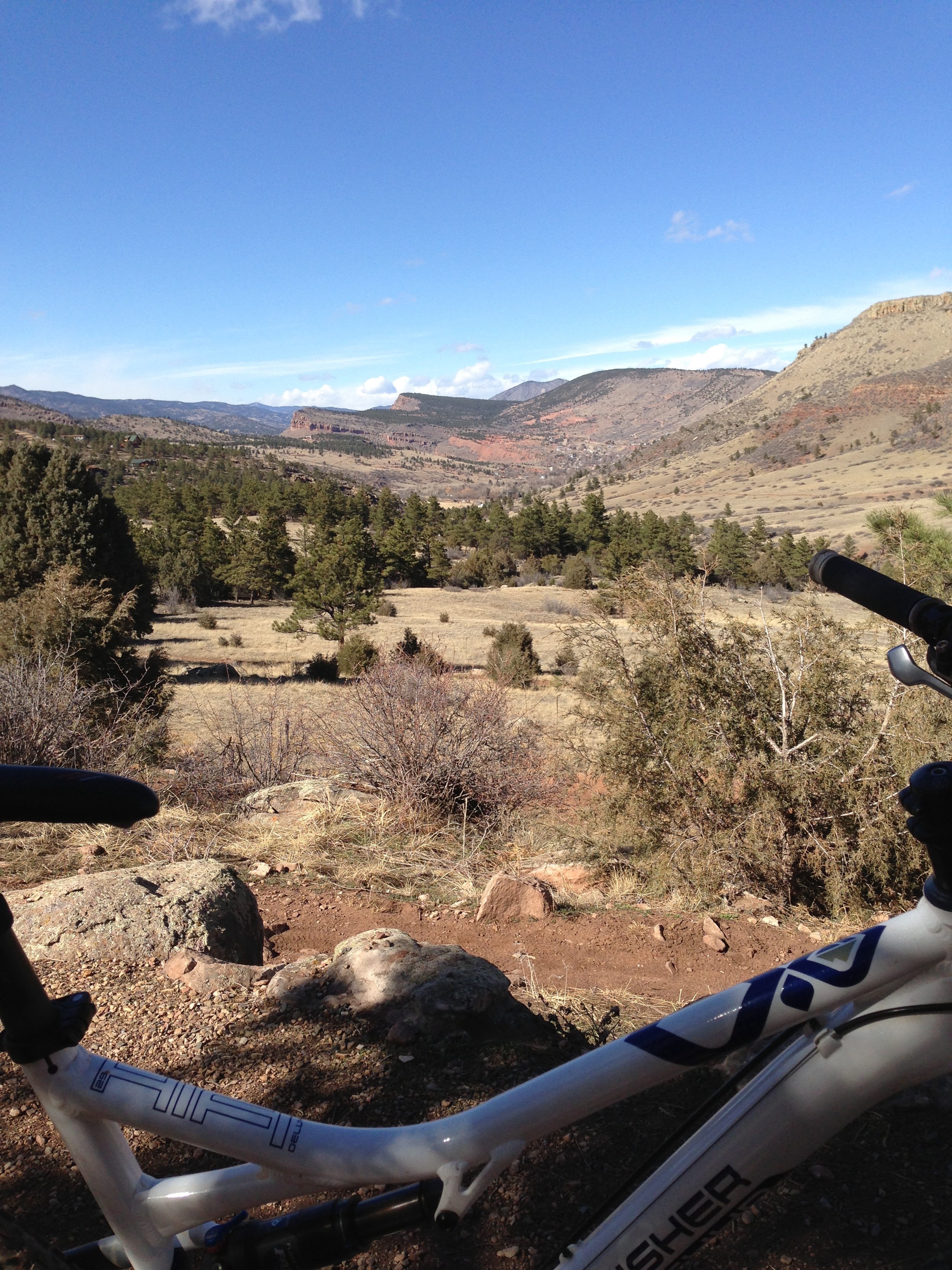
I love mountain biking, evidenced by how often I find illustrative material on the trails. On the trail I ride most often, Picture Rock (pictured below), I go through periods in which I cannot seem to get through a section I have ridden previously without difficulty. It is always puzzling. “Has the trail changed?” It happens. As rocks become dislodged and clay turns to dust, the terrain shifts. Areas once easy become problematic. On other occasions I am riding in the wrong gear, which causes pedal strikes from the different rhythm. Sometimes the problem is my physical body, specifically the effects of estradiol on the continuing diminishment of my muscle mass. Most of the time, however, the problem is none of those. The problem is in my mind.

Mountain biking takes extraordinary focus on nothing but the few inches of trail in front of you. It engages all of your senses and demands both sides of your brain. Since the dominant side of the human brain (the left brain for most of us) tends to edit and filter what the right brain wants to express, it takes unusual circumstances for the right brain to find opportunities for unedited expression.

All of which means when you are riding narrow singletrack, which demands the full attention of your left brain, feelings normally repressed find the opportunity to bubble up into consciousness. As they wend their way through the harshness of your demanding ego, they grab your attention. You lose your focus on the trail and forget how to ride through sections that used to be easy to navigate.

After ruling out the simple problems, like taking a line in the wrong gear, I stop looking at the trail and turn inward. What is my problem? Is it a complex I am seizing from the past, ghosts from childhood? Is it the fear always close by, life’s twin existential threats of abandonment and feeling overwhelmed? Is it my unwillingness to take the next risk my life demands, the last one having been so traumatizing?

If I sit with myself long enough, I can usually identify the problem, though it takes a lot longer to find the courage to face it. Taking the road less traveled means rejecting adaption for allegiance to the soul. It is never easy work.

I have recently passed a number of milestones. I have gone back to work in church planting, my vocation for the better part of four decades. I am working with churches and pastors, helping them find their rhythm in ministry. I am counseling individuals and couples, helping them pedal through their own rough terrain. And I am preaching again, a great joy.

I have a gnawing sense my work is not done. There is a restlessness that remains, holy, unsettling, necessary. Some things we do not choose. They choose us. I will be patient, and the message of the heart will bubble up through the fissures of my willful ego.

Recently I started attacking a new section of trail, my previous stopping point having been determined by a skill level I have now surpassed. It is time to climb higher, through more difficult terrain. I have not traversed the new section one single time without coming off the pedals. But I will figure out the lines to take and the gear that matches my strength. It is all a part of the journey.

And so it goes.

IMG_0025

Will Anyone Care?

Will Anyone Care?

If, like me, you would like to see the Evangelical church fully welcome LGBTQ people, do not argue Scripture. Instead, spend your time studying church history and cultural anthropology. It will be a better use of your time.

As the Pulitzer Prize winner E. O. Wilson has written, humans are the only eusocial species that believes an enemy is necessary for a tribe to survive. Religion has been especially adept at creating enemies where none exist. There is no surprise in this behavior. It has been happening as long as there have been religions.

If you peruse church history, however, you also see the church never gets too far behind the culture at large. Because he believed the earth revolved around the sun, the church forced Galileo into eight years under house arrest. When was the last time you saw a church supporting the notion of a geocentric universe?

Though it took 100 years, the church eventually came around on slavery. Through the middle of the last century, Evangelicals would not allow people who had been divorced into church leadership. When is the last time you saw a divorced person barred from Evangelical leadership? The Bible says more about all of these subjects than it says about LGBTQ issues.

When we adopted our daughter from India 37 years ago, we became a transracial family. Some Christians from my Evangelical community believed we were “mixing the races,” which they saw as against the teaching of Scripture. I haven’t heard that complaint lately. As with so many other subjects, the Evangelical church eventually embraced transracial families and moved on. True, it is taking longer to see women in Evangelical leadership, but the trajectory is clear.

When it comes to marriage equality and other LGBTQ issues, the story will be the same. There is no evidence that living out one’s sexual or gender identity harms anyone. The only argument they have for rejecting the LGBTQ community is their own interpretation of a handful of Bible passages. That is not enough to sustain their opposition.

The Evangelical world is struggling, but change will come, because the Evangelical church is nimble. It does not have the hierarchy of the Roman Catholic Church or mainline Protestant denominations. Those institutions can take decades, even centuries, to pull the lever on change. When Evangelicals decide to shift gears, it happens fast.

Today’s influential Evangelicals are entrepreneurs who cut their teeth in a free market economy. They understand market share. Their leadership is lean and adaptable. Their roots do not extend to Rome or Canterbury. Their roots reach back to iconoclastic firebrands like Jonathan Edwards and Dwight L Moody. They know how to attract and keep a crowd. And they know when it is time to move on.

The activism we see today is a last gasp. Large Evangelical churches have been among the loudest supporters of the recently enacted hate laws in Houston, North Carolina and Mississippi. But if you look more closely, a greater number of influential Evangelical churches have remained silent. One megachurch senior pastor recently said, “I know when it comes to marriage equality the culture has moved on, but my money hasn’t.” Many of these churches are lying low, waiting for the opposition to die down before they begin playing catch up.

LGBTQ issues in the Evangelical church will not be decided in the theology departments of Evangelical seminaries. They will be decided in the boardrooms of today’s religious influencers, America’s large churches. And the decisions will ultimately be pragmatic. If we are patient, the landscape will change.  We will be fully welcomed into these churches.  I suppose the question is whether or not anyone in the LGBTQ community will care?

Except the One to Which We Belong

Except the One to Which We Belong

We are story-based creatures. My earliest memories are of my father lying in bed next to me, spinning yarns about Jim and Jiggles, cowboys on the western frontier. I told similar stories to my children, crafted as I went, the end as much a mystery to me as to my delighted children.

Whether Greek myth or Irish tale, all of the great stories have similar elements. There is a protagonist called to the difficult journey. Initially she rejects the call, until a wise sage gives her the strength to choose the road of trials. There is an antagonist, intent on stopping the hero from finding the Holy Grail. The hero is led into the depths of darkness, where the outcome is in doubt. Eventually there is a dread/hope axis, a climactic moment in which the audience dreads the protagonist will fail, and hopes she will succeed. When she does emerge triumphant, the hero has one remaining responsibility. She must return home, bearing gifts of wisdom. Only then does she gain the freedom to move on.

Most of the myths passed down in our civilization are stories about males. It is not that there have not been female heroes throughout history. It is just that men controlled pen and scroll. The few female heroes tended to be seen as more masculine. Think Joan of Arc, instead of the giant spiritual contemporaries of her era, Julian of Norwich and Teresa of Ávila.

I love the fiery heroines of the recent Disney princess movies. Even more powerful are the female characters in the Disney-produced television show, Once Upon A Time. They are all complicated characters, flawed and vulnerable, just like real heroes.

The universality of the great myths, with their consistent elements across cultures and times, tells us a lot about our species. We know we are a part of something greater than our own individual lives. We know our decisions have consequences, for our own lives and for generations to come. We know the courageous and brave will eventually choose the difficult path, and will be rewarded with both travail and blessing. We wonder if we will be among the courageous. For all of us face at least one great moment when we must choose either the path of safety, or the dangerous way through the long dark night. We know everything hangs in the balance.

These are the moments that define our lives. Have we learned to be vulnerable? Have we come to know that at some level we are both hero and villain? Do we realize our lives do matter, greatly, and our decisions have consequences far beyond anything we might imagine? Do we see our children watching, and their children after them, and their children after them? Do we know that God is with us, whether we find courage or not? Do we have the strength to truly believe the world was made to be free in?

If the answer is yes to all of these critically important questions, we are ready to give up all other roads except the one to which we belong. As we take our first tentative steps on that road, it is wise to remember the Via Dolorosa was a road to resurrection.

We Need Better Tribes

We Need Better Tribes

Humans are a tribal species. We know it as soon as we are old enough to realize our world has been divided into “us” versus “them.” The American myth of rugged individualism is an illusion. So, we might ask, what do we need from a tribe?

In his book, Hauntings – Dispelling the Ghosts Who Run Our Lives, James Hollis says a tribal myth needs to answer four basic questions:

  1. Why am I here, in service to what, and to what end?
  2. How are we to live in harmony with our natural environment?
  3. Who are my people, and what are the rights, duties and expectations of my tribe?
  4. Who am I, how am I different from others, and how am I to find my way through life’s difficulties?

Castles and cathedrals are a common tourist destination in Europe. Our deep yearning for these places is a reflection of our desire to return to a day in which tribal life was simple, if not very satisfying. God and King set the boundaries. We were beholden to our creator and our geography. Today life is not so simple.

Carl Jung said the key question of all humans is, “Are we related to something infinite or not?” If we feel connected to the infinite, our desires and attitudes change. But modern man has been told there is no Infinite, at least not a capitalized one. In our devotion to Western science we have shut off all but the logical, reasoning side of the brain. It has left us with a world of information, bereft of meaning.

Mike McHargue (Science Mike) tells of a discovery physicians made after severing the corpus collosum (the nerve bundle that connects the two halves of the brain) in severe epilepsy sufferers. They discovered the left side of the brain, the logical and rational side, often silences the right side of the brain, the intuitive and creative side. To use Jungian terms, the ego silences the psyche.

In these patients, their more intuitive side gained equality with their more rational side. Their left hand might literally pick out one dress, while the right hand chose another. Severing the nerve bundle did not solve the epileptic problems of these patients, but it did result in a lot of curious scientists.

One of their discoveries was when they were able to isolate the right brain, the scientists said they believed in God, something their logical left brain rejected. While they were shocked by the wars taking place within the two hemispheres of their own brains, Jungians would not have been surprised. They had spent decades helping clients listen to their psyches through the constant noise of the ego, primarily by helping them access their dreams.

Dreams allow the psyche to bypass the ego and tell us what we really feel, and what modern man often feels is cut off from any larger story, or metanarrative. Our current tribes, shallow and extreme, do not provide an adequate framework to answer life’s basic questions. As Jung said, man is left with “no love, only sexuality; no faith, because he is afraid to grope in the dark; no hope, because he is disillusioned by the world and by life; and no understanding, because he has failed to read the meaning of his own existence.”  Modern man is in quite a dilemma.

What might be the solution to such existential despair? How about better tribes? We need tribes that depend on compasses, not maps. Emily Dickinson wrote, “a sailor cannot see north, but a compass can.” Too much of American religion demands fealty to outdated maps. Jesus taught us to be compass followers. He replaced detailed maps with the true north of loving God, loving neighbor, and loving self. He made us partners in the ministry of reconciling all things to the creator. He gave us work to do, applying the law of love to an ever-changing world.

Following Jesus requires an open heart, a good compass, and wise discernment. Jesus speaks to ego and psyche, right brain and left, body and soul. If the tribe of Jesus will follow his instruction to love God, love neighbor and love self, we might wander a bit every now and again, but our trajectory will always be toward true north.  And confident of that goal, instead of arguing among ourselves, we could get back to the ministry of reconciliation.  How marvelous would that be?

I’m allowed to dream, aren’t I?

Loyalty to the Inner Light

Loyalty to the Inner Light

I lectured at the University of Colorado this week and the students had questions about the early days of my transition.  It started me pondering about the insights I have gained since that difficult time.

First, I definitely underestimated how shocking it was for people to hear I was trans. I had been living with the knowledge since childhood, but only four people knew of my circumstances. Having chosen adaptation over authenticity, I had hoped to keep it under wraps throughout my life.   I finally realized I needed to come out.

Many Christians experienced my transition as a betrayal. One friend who has not spoken with me since, said, “I wish you had taken this to your grave.” Others felt keeping it a “secret” had been wrong. I protested that it was not a secret because there was no moral wrong in being transgender. It was just private, like your sex life with your spouse is private. Of course, when my intention was to stay in the closet, I had every reason to keep it quiet. I knew speaking up would end my career.

After I came out, many Christians chose to identify me as a person of questionable character. I suppose it made it easier for them to separate themselves from me.  With impunity, they told stories that were not true.   It was my darkest hour.

I had an “Aha!” moment early in the process. One of my family members asked a woman to watch a speech given by filmmaker and trans woman Lana Wachowski. The woman replied, “I started to watch, but her hair and voice were just too weird.” Her response made me realize that the narrow norms of the Evangelical community were going to stop most of these fundamentally good people from exploring the transgender journey. It was my loneliest time. Grief descended. As novelist Lindsay Clarke writes, “Loyalty to the inner light felt like stepping into outer darkness.”

Fortunately, time is a great healer. Brené Brown says before forgiveness can occur something must die, usually grief. As my grief expended itself in painful fits and gasps, peace arrived like a deep river. I learned to trust its flow.

I know my return to the church hastened my healing. The acceptance I have been shown by a small handful of people from my former church world has been powerful. The welcome I found at Highlands Church in Denver has been extraordinarily transforming. I love that church as I have loved no other.

The decision to forgive is a decision of the will, born of the heart, forged in the soul and sustained by the spirit. It is not cheap forgiveness, the kind offered prematurely by souls frightened by their anger. It is hard won, willing to go through the pain of briefs for the prosecution and briefs for the defense, and a judgment of guilt for both sides. It requires humility, and includes asking the forgiveness of others, for there are always two sides to every story.

I am very much at peace with my life and my faith. I am comfortable in my own skin. I hold no illusions. The attacks will continue. Just today I heard of an online group that has decided I am possessed by a demon, more than likely because of my playful picture in last week’s blog, which also appeared in the Huffington Post. There was no sting in hearing the news, just sorrow for the good people who might be affected by that kind of bigotry. It is a given that I will continue to be vilified. It is all right.  The truth is, I showed up, and it was difficult for everyone. But we serve a God of mercy and forgiveness.  And when the last rays of sunlight grace the western sky on each and every day of this sacred odyssey, I retire knowing love has won.

Obeying the Law in North Carolina

Obeying The Law in North Carolina

This post first appeared yesterday in the Huffington Post, where I have been asked to be a blogger.  It is my second post for them.  Being sarcastic is a little unusual for me, but I must say I enjoyed writing this, and I’ve enjoyed seeing the response.

I fly through Charlotte almost every week. If it’s dinnertime, I stop at Carolina BBQ and say hello to the manager. I have my favorite corner in the American Airlines Admirals Club, where I enjoy the veggies and hummus. I am comfortable at CLT. Though I am usually only passing through, Charlotte feels like home.

Or maybe I should say Charlotte felt like home. My birth certificate does not reflect my correct gender. Every time I enter a women’s restroom at the Charlotte airport, I break the law. As a good citizen, I am not pleased. I have never been arrested. Gees, I’ve never even gotten a speeding ticket. I do not want to start breaking the law now that I am old enough to get a senior discount at the movie theater.

I worked in radio and television for 20 years. The New York Times is delivered to my house every Sunday. I peruse the Huffington Post every day. I stay abreast of the news. How could I have missed hearing I am a threat to North Carolina’s women and children. I must have been sick the day that news came out, or maybe I couldn’t read because I had a speck in my eye.

I knew I made a lot of Evangelicals angry when I transitioned, but last I checked no one saw me as a physical threat. But hey, you never know. I guess I missed hearing when you take away testosterone and replace it with estradiol, you are likely to become a sexual predator. I mean, take a look at all of the other people without testosterone, but with plenty of estrogen. Everywhere you turn they are assaulting women and children, right?

Since I was four years old I’ve been working on my plan to disguise myself as a woman and assault women in restrooms. I went to therapy for twenty years just to mess with my therapist’s head. I endured expensive surgeries, not covered by insurance, because I knew I would have the chance to pursue my nefarious agenda. Though the medications I take give me the sexual desire of a post-menopausal woman, it is just a clever ruse. Once I get into that bathroom, I will take a little blue pill that will — oh wait, that won’t work anymore. Aw dang it, I guess I didn’t think this through.

But thank goodness the Republican legislators and governor of North Carolina thought things through. I mean, they gave themselves 12 full hours, right? They thought through the reality that trans guys with their hipster beards would end up in women’s restrooms, making it much easier for a male sexual predator to walk in as well. Surely they thought of that, right?

I’m pretty tall, so sometimes I am identified as a trans, though most of the time people do not seem to notice. Now I get a chance to let the entire state of North Carolina know I am transgender, because you know, it’ll make everyone feel safer. Never mind that my presence in a male restroom makes me a target for predators. But according to North Carolina Republican legislators, my safety is not important. In fact, I probably should not even exist. Then no one will have to think about this stuff. Yeah, that’s a good solution.

I suppose I will keep on flying through Charlotte, because I can use the women’s restroom at the Admirals Club. It’s on private property. The workers at the front desk have been ardent supporters. Kim and Earleen and others were friendly with Paul for years, and now they are even friendlier with Paula. Come to think of it, there must be something wrong with them too. I’ll have to ask the Republican legislators. They should know.

But what if I have to go to the bathroom while I’m at the gate, waiting for my plane to depart? Oh well, once a law-abiding citizen, always a law-abiding citizen. “Here, could you hold my purse while I take this selfie?”

IMG_1139

The Life You Are Saving

The Life You Are Saving

In my 40s, I agonized over whether or not to take the lead pastor position at an influential megachurch. I told them no, yes, and no again. They were not pleased. A few years later I did the same with another megachurch. Though everyone said these were wonderful ministries for which I was well suited, I could not find the courage to answer the call. For years I doubted myself. I thought I was a coward, lacking any real measure of courage. Over time, however, I came to understand courage was not the issue. I was not pulling the trigger because I had not been called to pull the trigger.

When we think we lack courage we should look more deeply. What we see as a failure of courage might actually be wisdom, masquerading as fear. We refuse the call that is not ours. Others might believe it is our call. Even our own mind might believe it is our call. But the soul knows better. The soul knows a true call, and informs the heart and mind when the call is our own. When you realize the call is yours, you discover you have all the courage you need. Indeed, you are braver than you think.

Over the past few years my life has been turned upside down and inside out. When I answered the call to transition from Paul to Paula, I was thrown into a massive storm of great intensity. That call was not received as a gift. I screamed and railed at God, who seemed to reply with a dismissive, “Deal with it.” I was furious. But I knew I had been called.

Last summer I was called again. I attended church for the first time in years. I experienced post-traumatic stress as I dragged myself across the threshold. Once I entered the sanctuary, however, I realized it was my sanctuary. I wanted to scream at God again, “Seriously, you want me to return to the church? Do you have a short memory? The church rejected me.”   But the tears would not stop and I knew God had called again. Through bread and wine received from the hands of a dear friend, she (God, not my friend) said, “Come home Paula; there is work to be done.”

So I came home and accepted the responsibilities embedded within my journey.

Since transitioning I have spoken in many different venues, from the national conventions of the Gay Christian Network and PFLAG, to lecturing at colleges and universities, to completing a video lesson on trans issues for Lifetree Cafe. I have had articles published in the New York Times and the Huffington Post, and have told my story at Bespoken Live events. The most satisfying work has been my return to the pulpit, where the good folks at Highlands Church have allowed me to preach and offer all of my gifts with great joy.

The call has also been to more challenging venues. Last week I spoke to an appreciative and responsive audience. But even as I spoke, some were registering their displeasure that I had been invited. I was not surprised. It was not the first time people had risen in protest. Two years ago I was informed I should not attend my own high school reunion. (Other high school friends have been wonderfully supportive.)

Nasty letters, emails and comments still arrive on a regular basis. My inclusion in last week’s Huffington Post article on Christian feminism brought lots of positive comments, but it also brought mean-spirited replies from angry feminists and cocky fundamentalists.

When you are in the sweet spot of your calling,  it does not matter whether the moment is difficult or delightful. What is important is fidelity to the call. When you are faithfully within your call, on most days you can actually repeat the words of Dag Hammarskjold, “For all that has been, thanks. For all that shall be, yes.”

If you believe you are not a person of courage, give yourself some grace. You do not lack courage. Your apparent lack of courage is simply a sign that what you have been asked to do is not your calling. It is someone else’s calling. With an open heart and a trembling hand, take a walk and listen to your soul. It will give you permission to wait. For the day will come when the world’s great hunger finds your deep joy.

When that moment arrives, courage will well up from the depths of your being, scattering butterflies in its wake. The soul’s courier will announce herself at the door of your open heart, “The wait is over; the time has come.” You will look around and see there is no one to answer but you. You alone must decide. And you will find the courage to step across the threshold.  And you will realize the life you are saving is your own.