Quite an Evening

I preach occasionally at The Village Church, a wonderful post-evangelical congregation in Atlanta. My friend Ray Waters is the pastor. Ray and I have similar interests and backgrounds. We both worked as radio station announcers back in the day, and we sang and maintain a love for Southern Gospel music. Get us into a conversation about The Stamps, the Oak Ridge Boys during their Southern Gospel days, or any iteration of the Imperials, and we will talk until the cows come home.

I spoke at The Village Church earlier this month. When I got into town Ray said, “Ernie Haase and Signature Sound are in Gainesville tomorrow night, doing their Christmas show at a Baptist Church. Interested?”

When it comes to traditional Southern Gospel, they are one of my favorite groups. Since it was their Christmas show, I knew they’d be singing What Child Is This, so I figured, “I’m in.” Then it occurred to me, I’d be at a Southern Baptist Church in Gainesville, Georgia, not exactly the most welcoming environment for a transgender woman.

Unless people know of my circumstances before we meet, around 99.9 percent of the time I am identified by others as female. I am very rarely misgendered. But about nine million people have seen one of my TED Talks. I’ve been on Good Morning America, NBC, CBS and a host of other media likely viewed by Southern Baptists. I thought, “What if I am recognized?

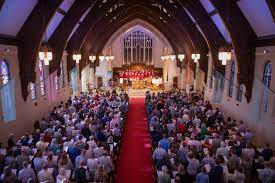
Ray was good with whatever I decided. He understood the problem. I decided to go. We got to the church just as the concert was beginning and sat safely toward the back. I had to use the restroom as soon as I got there, which was a little surreal – using a women’s restroom at a Southern Baptist church in Georgia. Not something I do every day.

The vast majority of the people were very white and very old. Come to think of it, I am very white and very old. It’s been ten years and three months since I was in an evangelical church. The last one was a megachurch and I was preaching.

It felt unsettling to be in a place in which, had they known who I was, I most certainly would have been asked to leave. It felt especially ironic to know that all of that would likely happen even though I am still a Christian and still a pastor.

As it turned out, no one knew who I was, and all was well. As I expected, the concert was excellent. I thoroughly enjoyed myself and yes, they did sing What Child Is This. I waited around afterwards as people quickly filed out. Not many CDs were being sold. Turns out even old people download their music nowadays.

Ray knows Ernie Haase, so I waited until they had a chance to talk. I took a picture of Ray, his wife and mother-in-law standing with Ernie. He wanted me to join them, but that didn’t feel right. We went to Cracker Barrel afterwards, because, well, we had just attended a Southern Gospel concert, and that’s where you go to eat after a Southern Gospel concert.

Evangelicalism is very removed from my current existence. It has been a long time since I’ve been in a big traditional Southern Baptist church building with very Southern Baptist people. I grew up on Southern Gospel music. I started my own group when I was 17. I joined another at 18, and started yet another at 21. We made five albums and managed to earn a living singing for the better part of a decade.

I do not read music well, but I do hear parts. I did vocal arrangements for all of the bands of which I was a part. I could have sung pretty much every part at the concert that night, though the tenor and bass lines might have been a stretch every now and again. I would love to sing that kind of music again, but since pretty much everyone singing it is a fundamentalist Christian, I’m thinking my chances are pretty slim.

When I transitioned I lost a lot. At the concert I was reminded I have lost the ability to feel comfortable in a church building where I once would have been very much at home. I would not be allowed through the door of any of the churches I attended as a child, or those I served before my transition.

Sometimes I wonder why I keep writing about this stuff. Maybe I’m gonna be working through these losses until the cows come home.

And there it is. I managed to work in the line, “until the cows come home” twice in a single post. I mean, I spent a good bit of my growing up years in the rural south. Those metaphors stay with you.

And so it goes.

What Goes Into a Name Change?

About a year ago we changed the name of the church I served from Left Hand Church to Envision Community Church. A few members drove the change, with the support of the majority of our leadership. I did not oppose the name change. My thoughts were not sufficiently formed at the time. But since then I have carefully studied the subject, and now that the church is closed, I do have some thoughts about whether or not changing the name was necessary.

We changed the church’s name because of concerns about cultural appropriation. Why did we name it Left Hand Church in the first place? Left Hand is a canyon and creek between Boulder and Lyons in Boulder County. The creek runs through Longmont and eventually makes its way to the South Platte River. Left Hand is a name people identify with the entire county, not just one city within the county. As a church for the entire region, we wanted a name that reflected that reality. Left Hand felt like the right choice. We were not alone. There are 34 entities using the Left Hand name, including a well-known brewing company.

Left Hand Canyon and Creek are named for Chief Niwot, a chief of the Southern Arapaho people who was tragically assassinated in the Sand Creek Massacre in 1864. (A massacre led by a US colonel who was also a Methodist pastor, I might add. Oh, the things we do in the name of religion.)

Niwot was translated Left Hand in English. Apparently, Chief Niwot was among the ten percent of humans who are left-handed. He was also a generous soul who wanted to welcome European settlers, which makes his assassination even more heinous. It was with respect that his name was chosen for the creek and canyon and church.

What does this have to do with cultural appropriation, you might ask? Cultural appropriation is one of five markers of what Yasha Mounk in his book, The Identity Trap calls the identity synthesis, markers he believes do more to separate us than bring us together. It is the notion that we should be identified primarily by the smallest common denominator of our identity. That identity is ours and only ours to experience and know. For anyone else to borrow elements of that identity is an unacceptable appropriation.

But what if I do not want to be known by my lowest common denominator? What if I do not want to be seen primarily as a white transgender woman? I prefer to focus on my commonality with other humans, not what separates me from them. I believe this new form of extreme segregation in the name of one’s unique identity is more divisive than unitive.

I do not want to be misunderstood. I do know that European settlers destroyed Native Americans and their culture as they marched across the country with their destructive  notion of Manifest Destiny. The arrogance is astonishing. I know majority cultures have been destroying minority cultures since the beginning of the species. But is the only way to rectify that sin to separate even further, to draw lines between us that destroy any hope of the traditional liberal humanism that emphasizes our commonalities, not our differences? I cannot see where today’s extreme identity synthesis has any hope of bringing about true reconciliation. I see it only dividing us further.

There is not a culture on earth that is purely itself, uncontaminated by other cultures. All are an amalgamation of many cultures. The group with the least cohesive identity in the unfolding of the United States was the Scots-Irish. Originally clans from Scotland, they had been forced to move to Ireland in the 1600s to stop the Spanish from bringing Roman Catholicism to the Emerald Isle. The Scots-Irish never wanted to be in Ireland and came in droves to the Colonies between 1715 and 1760, heading to the western frontier, where they intermarried with pretty much any group they found, creating an entirely new identity in the process.

The result was Appalachian culture, which birthed bluegrass and country music, among many other rich cultural traditions. It created American evangelicalism, turning the Great Revival into a national phenomenon. Elements of the culture are Irish, Scottish, Native American, English, and a plethora of other cultures and nationalities. What is their lowest common denominator? No one knows.

I am talking about my own roots. I am English, Scottish, Irish, and Welsh. Each its own distinct culture, but in the Ohio Valley where I was raised, we were identified as Scots-Irish. The Scots-Irish have died in disproportionate numbers in every war ever fought by our nation. We were not respected in the northlands, where they referred to us as hillbillies. Our identity was honed in the heart of Appalachia. (That middle “a” is a short one in case you don’t know how to pronounce it.)

There are no pure cultures. In my own family we have Indian, West Indian, German, and Scots-Irish identities. Jubi, whio is Indian, fixes amazing fried chicken. Cathy does too. She’s German. So does Jael, also Indian, and Jana, German and Scots-Irish. I’m pretty sure fried chicken is not a staple of any of those specific cultures. Is it wrong for Cathy, Jubi, Jael, and Jana to fry a chicken in the manner of my Grandma Stone? Should Jubi only be allowed to fix Indian food, and Cathy German food? I do not believe Cathy, Jubi, Jael, or Jana are appropriating Appalachian culture. They are frying chicken, something for which I am extremely grateful. (I doubt the chickens share my sentiment.)

In my opinion, using the name “Left Hand” was not culturally inappropriate. We are a part of the stew pot that is America. America never was a melting pot. Cultures do not disappear, they take on flavors of other cultures over long periods of time. That is a universal truth of our species.

Should we be appalled by prejudice and oppression? Absolutely. Should do everything we can to bring about equality and equity? Yes. Should we preserve our cultures? Of course. But I do not think any of that precludes celebrating our common humanity more than we celebrate our specific uniqueness. We are all on this fragile planet together.

I believe it was all right to honor Chief Left Hand and his people by using his name for our church. I believe the identity synthesis now sweeping our nation is not helpful. Many of you will disagree. That’s okay. And by the way, disagreements are usually not microaggressions. Most of the time, they are just discourse.

This is an important subject that needs to be discussed. Unfortunately, in today’s world everyone cowers in the shadows for fear of offending someone unknowingly. We’re frightened of being identified as culturally insensitive or guilty of microagressions. What this extreme perspective has wrought is not dialog, but fear. If we only focus on that which separates us, and not on that which we share in common, I am afraid today’s cultural divide only gets worse.

So, let’s start talking. I believe the health of all cultures hangs in the balance.

Abiding Hope

For six years I preached at Left Hand Church, which changed its name to Envision Community Church in its last days. Kristie Vernon and I were the co-pastors who remained when the church closed its doors on November 12. Our decision was agonizingly difficult, but we knew it was time. We both preached for the last service. I chose to speak from the same passage as my first sermon at Left Hand – Matthew 22.

I refer to the final story of that chapter as the Last Press Conference because it was the last time Jesus met with the crowds at large. After that day he retreated to work with his disciples. Until the time of his arrest, this was the last time religious authorities had access to him. In this final press conference, three questions were asked. Jesus’s answer to the final question was the culmination of one era and the beginning of another.

The first question was about paying taxes to Caesar. One religious group thought it appropriate. a competing group thought not. Jesus asked for a coin and noted that Caesar’s image was on the coin. If the people were using his monetary system, were they not gaining benefits of the Roman Empire? “Pay Caesar’s what’s Caesar’s and God what’s God’s.”

With the first question quickly dispatched, a Sadducee asked about multiple marriages and the resurrection. “Say a guy marries and dies before his wife has kids. The brother marries the wife and then he dies before they have kids. Then the next brother dies, and so on until they’ve run out of brothers.” He was referring to the Leverite Law, which was focused on nation building and encouraged exactly what the man was suggesting. But that had nothing to do with why he was asking the question. The reason for the question was to challenge the notion of a heavenly afterlife. The Sadducee asked, “After all the dead husbands, she dies. So Jesus, which guy is she married to in heaven?”

I see Jesus rolling his eyes, knowing that answering that question is like trying to explain the meaning of life to a snow crab. No matter what he says, this guy ain’t gonna get it. Jesus dismisses the question with a quick, “There is no marriage in heaven.” To which half of the audience was upset and the other half was thinking, “Hmmm, there is an end to this. Okay then…”

Then came the final question of the last press conference, asked by an honest guy looking for answers. This student of the law asked, “Which of the 613 laws is the greatest?” Jesus did not hesitate. He said the greatest were to love God with all of your heart, soul, and mind, and love your neighbor as you love your own self.

There was no real surprise in his answer. They began all of their religious services quoting those laws. It was what he said next that threw the whole crowd into a frenzy. Jesus said “On these are all the law and prophets based.” Matthew tells us there was dead silence. This is a press conference, with enough questioners and questions to last a week, and there was dead silence. Matthew goes on, “From that day on, no one dared to ask him any more questions.” So, it really was that simple. Good religion was not 613 laws; it was three things – to love God, neighbor, and self. Profoundly simple, but never easy.

At Left Hand Church I always talked about these three things with exactly the same language. Regarding God, I said, “We are to love the God who burst on the scene 14 billion years ago in all of God’s mystery, complexity, and ever expansiveness, rooted in relationship, and grounded in love.”

The first part of that explanation of God is the Big Bang, which took place around 14 billion years ago, with the universe ever expanding since that moment, mysterious and complex. Rooted in relationship is a nod to the discoveries of Quantum Physics, which determined that the ultimate building blocks of the universe are not made of matter, but of a pattern of relationships between non-material entities. The core building blocks of the universe are therefore relationships. If the core building blocks of the universe are relationships, then it is not much of a stretch to say love, the greatest of relationships, is the most powerful force in the universe.

Regarding neighbor, I said, “To love your neighbor is to love anyone with whom you come in contact. The best way to bridge the divide between humans is always through proximity and narrative – to come in contact with one another and hear each other’s stories.”

I always finished with these words, “And you cannot love God or neighbor if you cannot love yourself. As my friend Mara says, we are neurobiologically wired for deep human connection. Yet our core wound is that there is something about us that makes us unworthy of deep human connection. That is the wound we all spend a lifetime trying to heal.”

Our epic journey, or quest, is to travel from the place of supposed unworthiness, through the land of the lost to the land of peace, where we find we are loved by God and worthy of deep human connection just as we are – no questions asked – no changes demanded. Only then can we love our neighbors, and the God who crafted us all.

I have always loved preaching the simplicity of that story, a simplicity on the far side of complexity. A simplicity fought for and profound, as if Jesus was saying in answer to that final question, “Everything that came before comes down to this, and everything that springs forth is born of this.” These words are the rising of a new day, the green flash of light as the sun first appears over the water’s horizon. Following Jesus means loving God, neighbor, and self.

I loved telling that story time and again. I wanted it seared on the consciousness of the folks who called Left Hand home. If we can keep our focus on those three truths, then there is hope for our species and the planet we inhabit.

What’s In an Identity

I just finished Yascha Mounk’s new book, The Identity Trap, A Story of Ideas and Power in Our Time. It’s the best book on current culture I’ve read since The Righteous Mind by Jonathan Haidt.

Mounk writes about the unfortunate contributions the left is making to our current cultural divide and what might be done about it. He includes a short section on the debate over transgender issues. For the most part, I have no problem with what he writes.

As a transgender speaker, I have not had much pushback from the anti-trans community, With my TEDTalk views approaching 10 million, I find that intriguing. To be sure, I receive  hate mail, mostly from the evangelical community, but not as much as others. I also have had conferences and corporations pass on me as a speaker because of my gender identity, but again, not as often as you might think.

The difference might be in the way in which I approach my gender identity. In my first TEDTalk I said, “People ask me if I feel 100 percent like a woman. I feel 100 percent like a transgender woman. There are things a cisgender woman knows that I will never know.” Those three sentences set a tone throughout the talk that says I’m not trying to claim to be something I am not.

I come from the borderlands between genders, a certain kind of liminal space. I have no doubt I am supposed to be living as Paula. The world receives me as a woman and that feels appropriate. I never felt as comfortable as Paul as I do as Paula. But I am not a cisgender woman. I am a transgender woman.

I do not understand it. You do not have to understand it either. I have read everything there is to be read on the causes of gender dysphoria, and as it relates to me, a lot of them seem plausible, even probable. Do I need to know if it was some hiccup in the second trimester of gestation or a genetic marker that caused me to be transgender? I’m curious, but I don’t need to know. I know testosterone was wrong and estrogen is right. Not many men would be happy losing their testosterone and having it replaced with estrogen, nor women losing their estrogen and having it replaced with testosterone. That alone is enough to assure me I am transgender.

There is a certain segment of the left that leans toward a strange form of isolationism. They say, “No one who is not transgender can understand what my life is like, so don’t even try.” It is a form of what Mounk calls Identity Synthesis, in which we are identified only by that which separates us from everyone else. From that perspective the only appropriate way to interact with a transgender person is to acquiesce to whatever we say, because we are the minority. Question our perspective and you become a part of the majority culture oppressing us. Since transgender people are about one half of one percent of the population, by the logic of Identity Synthesis, 199 out of 200 people can never understand us.

Uh, okay. The truth is I don’t even understand me. I’ve had the same therapist for 30 years and we’re still trying to figure it out. It is okay, you don’t know why you do half the stuff you do, either. We are all complex and mysterious and difficult to understand.

Like Mounk, I am a fan of classic liberalism. I prefer the kind of language you heard from Barack Obama, Martin Luther King, Junior, and come to think of it, Jesus. As members of this species, we all have more in common than we have that separates us. We will never bridge a divide by increasing the divide. We will bridge it by coming together in the areas we hold in common.

Are transgender people oppressed? Yes. Do I experience oppression? Again, yes. But I brought a lot of White male entitlement with me when I transitioned, and that also plays a part in how I experience life. Oppression is bad all the time, wherever and whenever it is experienced. But I don’t think we end oppression by increasing the divide.

I get paid a lot of money to speak at universities. As long as they do not censor me, I speak at Christian universities pro bono. I haven’t upset anybody yet with what I have said from the platform, though my sheer existence has threatened a lot of people who want to say gender dysphoria is not legitimate.

Why do I go to these institutions pro bono? Because if we do not get in close proximity to one another and discover that our commonality exceeds our differences, we will never close the divide. We need to close the divide. We need to stop arguing about who can use which restroom and focus on the real problems that could destroy our planet.

Climate change is rapidly hitting the point of no return. Probably not the time to buy that beachfront property you’ve been dreaming of. There are two wholly unnecessary wars raging in Europe and the Middle East, and countless other rumors of war.  Artificial Intelligence is becoming increasingly more complex as headlines blare the news that computers could one day overpower and even exterminate our species. One expert says the chances of that happening are somewhere between two percent and fifty percent. Truly frightening. What do you say we battle those problems instead of widening the great cultural divide.

Classic liberalism believes all humans are created equal, with certain inalienable rights, including life, liberty, and the pursuit of happiness. Those words are just as important today as they were 250 years ago. I want to embrace and extend that message.

I am first a human, Paula Stone Williams. After that I am everything else – tall, white, curly headed, transgender, American, Christian, pastoral counselor, speaker’s coach, TED speaker, member of the Lyons Board of Trustees, and longsuffering New York Mets fan. But for all of those particularities, what I hold in common with you far exceeds that which separates us. That is the truth I want to champion. That is the way we close the divide.

And so it goes.

A Beautiful Day and Lots of Questions

Envision Community Church, formerly Left Hand Church,  closed its doors last Sunday. In her part of the message, Kristie Vernon, my co-pastor, prepared us for endings, remembrance, and new beginnings. I returned to the first passage I ever preached, Matthew 22, in which Jesus finished his public ministry by asking people to love God, neighbor, and self. I ended with the words I have spoken so often, “God loves you, just as you are, no questions asked, no changes demanded.”

The music was perfect. Four-part harmony with Heatherlyn, Haley, Liam, and Cairn. Jason provided impeccable sound and video, as always. We had 77 people in attendance at the final service, probably about the size of the congregation toward the end.

Kristie presided over communion. Tonja, one of our elders, served communion with her. John and Nicole, two of our former co-pastors, joined us. We ate a closing meal together and announced that we will be starting monthly community dinners on January 7, followed by a book study the next month. We are not continuing Envision Community Church. There will be no pastors, board, or budget, just a community gathering in which ECC folks can gather and do life together.

Our worship services will not continue. I have been around church my entire life. I’ve preached in megachurches, rural churches, small congregations, new churches and old ones. I have not been in many, of any size, that maintained the quality of worship we had at ECC. For 301 weekly services we provided great music, thoughtful messages, communion, and community. You do not find churches like that on every corner.

Over six years Kristie, Nicole, John, and Jen shared preaching duties with me. Tonja, Stacy, and Lonni also preached on occasion. Heatherlyn was our worship pastor from the beginning of weekly services.

Over the life of ECC, I’ve gotten stronger as a preacher. I am going to miss speaking regularly to the same group of people, allowing me to build layer upon layer. You can only do that when an audience has heard scores of messages delivered in real time as the world unfolds around us. I will miss that a immensely.

I will greatly miss working with Kristie. We have been a good team. We have worked through a lot of difficult times and slayed lots of dragons. A bond forms when you slay dragons. I would gladly work with her again. I also really enjoyed working with Nicole and John. What a delight watching all of them grow as preachers and pastors.

Our community will continue. We will be meeting the first Sunday of every month for a community dinner. Kristie is hosting on January 7 and I’ll be hosting on February 4. I will also be starting a book club after the first of the year.

A few friends have asked if I believe church as we have known it is sustainable in America in a post-covid world. I would not look at Left Hand/ECC for guidance. There were too many things working against us from the beginning. But at a macro level, there is handwriting on the wall. For the better part of a century 70 percent of Americans identified with a local religious body. In just 22 years, 1999 to 2021, that dropped to 47 percent. The increasing politicization of the Christian right has been a contributor. Covid certainly didn’t help, as people got accustomed to hanging out at home on Sunday. I personally believe that the substitutionary atonement theory still being taught in conservative churches is a contributing factor. In today’s world it’s hard to imagine a Creator who sends their own offspring to hell. Unless you are steeped in the doctrine and understand the history of blood sacrifices, it just makes no common sense.

Left Hand/ECC and churches like us are all missing one of the elements that guarantees church attendance. If you are afraid of going to hell, you tend to attend church every week and give ten percent of your income to the church. You know, life insurance. If you do not believe you are in danger of going to hell, you attend for more of the reasons Jesus talked about. You know, like loving God, and your neighbor, and yourself. Not nearly as compelling as religion as a transaction, a commodity to be consumed – eternal life insurance.

I believe the religious right has damaged Christianity, whether it’s the far right Protestant or Roman Catholic worlds. That world is angry, judgmental, polarizing, and exclusive. It has also become very political. Evangelicals are the people driving the anti-transgender laws. Eighty-seven percent of them believe gender is immutably determined at birth; 67 percent believe we already give too many civil rights to transgender people, and only 31 percent know someone who is out as a transgender person.

In spite of the current political/religious environment, I do still believe in the church. I believe it is where we search for meaning in community, where we learn to do life together, where we feed the poor, heal the wounded, and do other good work that is more effectively done in community than alone.

Is today’s church what Jesus had in mind? He certainly envisioned a community of followers, but how that might have looked in his mind is not really all that clear, much as we would like to think that it is. Will I still be a part of the church? Certainly! I believe in it. Am I sad we closed the doors at Left Hand/ECC? Yes, I am, and yet Kristie and I played a major part in the decision to close. We knew it was time.

Life is full of times of letting go. I’ve discovered letting go with mercy and grace is always the preferred pathway.

And so it goes.

An Era Ending

Six years ago we launched Left Hand Church (now Envision Community Church) in Longmont, Colorado. We were excited, but cautious. After 35 years in the world of church planting, I was accustomed to starting churches with a budget of 800k, a full staff of five pastors, and a sizeable advertising budget. We hired well and those churches tended to grow pretty large pretty fast. Good times.

We started Left Hand with about 80k, a full zero less than my previous life. We started with three part-time co-pastors, a worship pastor, and a children’s minister. Total annual budget – less than 100k. We began with no nucleus of people from an existing church. How could this work?

Well, in short, it worked. The first two years brought steady growth through word of mouth, until we had about 125 people and a regular attendance in the mid-80s. Then we were hit with the unprecedented challenges of Covid-19, coupled with a staff turnover, and returned in the spring of 2021 with about half the people we had before the pandemic. That was typical of most churches in America. But when you are small to start with, it makes it even harder.

We came out of the pandemic with a great new space, imagined by one of our co-pastors and built at her direction with a team of volunteers. Worship services became stronger while attendance got smaller. We were holding on to younger and older singles and couples, but we weren’t holding onto families with children. We had a congregation of committed people and the finances remained strong, but once our attendance dropped into the 30s, we knew it was not sustainable over the long haul.

Our elders opted for organic growth over raising money for a full-time pastor and an advertising blitz, which was a decision they had every right to make. I did not oppose it. Trying to push growth plans that do not excite the volunteer leaders is about as effective as pushing a rope.

Worship has been wonderful all summer and fall, some of our best services ever. The spirit has been marvelous. And yet, a church with an average attendance in the 30s is not sustainable. Kristie, my co-pastor, and I knew it. A couple of weeks ago we realized it was time to close the church.  We wanted to close when things were good and we had enough financial resources to give generous severances to our staff who depend on their church income, and to complete our other obligations as well.

In all my years with the Orchard Group, I think we closed one English-speaking church. But then again, there were those big dollars with which we started each church. We never had that at ECC, and it’s okay.

For six years and 300 worship services, Envision Community Church has met needs and created community for hundreds of people. Most of my time with the church brought great joy. Some of it did not. But the parts that did not were important learning experiences. Can’t say I enjoyed them all that much, but I did a lot of growing.

For the better part of 60 years, pretty much everything I touched turned to at least silver, if not gold. It has not been that way as Paula. I discovered that people overlook the flaws of a white man a whole lot more than they do a transgender woman. I hear from cis women all the time that the same is true for them. So often men get a free pass, but that is another post for another day.

We do have a strong congregation with a lot of love holding us together. I am confident our people will find avenues to connect in meaningful ways. I imagine a lot of the formal and informal affinity groups will remain intact and even grow. We’ve got a lot of folks highly motivated for community.

As for me, there are a few things I know. I know for all of my TED and TEDx service, my work on the town board, my counseling practice, and my consulting work, none of them bring the kind of joy that comes from preaching. I was made to preach. I know that. It is my most forgetful place, where I disappear into a sacred space. It is where I am consumed in all the best of ways.

I will look for opportunities to preach around the region and the nation, just as I have done over the past ten years. I have a great relationship with several progressive churches that have told me they’d be happy to have me speak for them a few times a year. That makes me happy. I’ll also find ways to serve the folks I’ve been serving here for the past six years. I love them a lot, and want to remain in their lives.

I will preach my final regular sermon this coming Sunday. I finished it today. I’ll memorize it tomorrow and Thursday. I will cry when I preach it because, well, because.

Kristie and I will both speak at our last service. I am glad we both stayed to the end.  Our two post-covid co-pastors, Nicole and John, will join us for the service. We’ll have a potluck dinner afterwards, and then Kristie and I will get about the work of closing accounts and websites and readying the chapel for its return to the UCC church that has so graciously rented the space to us.

For everything there is a season. I always loved that song by the Birds. I think I was in college before I realized the lyrics came from the third chapter of Ecclesiastes.

To everything – turn, turn, turn

There is a season – turn, turn, turn

And a time for every person under heaven

A time to be born, a time to die

A time to plant, a time to reap

A time to laugh, a time to weep 

A time to build up, a time to break down

A time to dance, a time to mourn

A time to cast away stones

A time to gather stones together

To everything – turn, turn, turn

There is a season – turn, turn, turn

And a time for every person under heaven

Envision Community Church has had its time, and a wonderful time it has been. May our memories of her be fond and may we all have learned just a little bit more about loving God, loving neighbor, and loving our own selves.

And so it goes.

Not an Oxymoron

I did not know it was possible, a mainline church that was growing, vibrant, socially active, multi-generational, theologically progressive, and quite large. Plymouth United Church of Christ in Des Moines, Iowa is a delightful congregation that gives me great hope that traditional theologically liberal mainline churches are not all in decline.

It was my privilege to be with the good folks in Des Moines a couple of weeks ago. I preached for their contemporary worship service on Saturday, and for both traditional services on Sunday. Sunday’s 9:00 am service included two youth choirs with scores of young people. The 11:00 am service included a chancel choir that was every bit as good as any I’ve heard in a church anywhere. The building was full for both services.

I also had the privilege of speaking to a between-services group of about 50, and a whole church luncheon after the second worship service. I definitely used up my allotment of words in my five speaking opportunities, and answered probing questions asked by knowledgeable folks who surprised me with their understanding of the issues facing the queer community. Jared Wortman, the senior pastor, is well-educated, brilliant, and pretty-much half my age. I don’t know how you amass a library that large when you are that young.

I have seen the statistics. Throughout most of the twentieth century seventy-percent of Americans identified with a local religious body. Between 1999 and 2021 that number dropped to 47 percent. That is a 23 point percentage drop in 22 years, by any measurement a precipitous decline.

Our species never began to thrive until we moved from the level of blood kin to the level of tribe. That is when civilizations began to develop and huge strides forward became the norm. What brought us together as tribes? As I’ve written before, it was not man’s need for safety, it was man’s search for meaning. We have always best searched for meaning in community. The myth of the ruggedly individual American is just that, a myth. We have always come together in community to seek meaning.

If we look at the period after World War I we see the great joining of America. It was not just houses of worship that benefitted, it was all social networks, from the Rotary Club to the Kiwanis, Masons, Elks, and Shriners. Today they are all in decline. The builder generation, those born before 1946 were the last to participate in community gatherings at such a high level, the church included.

The last quarter century has seen huge changes in how we do community. More time is spent at work, often in multiple jobs. More parents are involved in their children’s sports, and not in their own social clubs and endeavors. Extended families no longer participate in life together, be it church, synagogue, or any other social endeavor. The church has suffered, and I believe humanity has suffered.

We were made for community, and thrive within it. It is where we cross-pollinate and grow. It is where we challenge and are challenged. It is where we bond together as a cosmic benevolent force, or a cosmic malevolent force, depending on the nature of the community of which we are a part. I believe we need the church, so when I see a congregation like Plymouth, I am buoyed.

Maybe left-leaning mainline Protestantism is not dead. Maybe it can help restore the notion that we have more in common than what separates us, that the extremes of standpoint theory, or progressive separatism can be countered by those committed to core universal principles. What guarantees a strong future are communities that foster real integration and encourage people to find what they have in common, not what separates them.

From all appearances, Plymouth UCC is one such community. I am by nature an optimist. It is difficult to be very optimistic in America nowadays. My weekend in Des Moines renewed my optimism, as did the next week at TEDWomen and the following weekend at the Evolving Faith Conference in Minneapolis.

On dark days we all need glimmers of light. That is where the hope lies. Thank you Jared, and the good people of Plymouth UCC for being a glimmer of light for me.

And so it goes.

Then Sings My Soul

Turns out we cannot turn loose of Jesus. The 1,200 or so people at the Evolving Faith Conference this past weekend, and the larger number watching online, just can’t turn loose of Jesus. Most of us come from evangelical backgrounds, and while we’ve jettisoned the baggage of fundamentalism, we have somehow managed not to throw the baby out with the bathwater.

James Fowler’s book Stages of Faith is a classic. He describes the stages of faith development with the language of a social scientist. The first two stages are the magical faith of children. First, mom and dad are the gods, quickly exchanged for dinosaurs and such. Stage three is where a lot of folks get stuck. It is traditional faith, full of rules and regulations and angry gods, reluctant to allow anyone onto their heavenly real estate.

On this side of the Abrahamic divide, stage three residents are evangelical and fundamentalist Christians. The fundamentalists are a tad more conservative than their evangelical cousins, though evangelicalism has taken a hard right turn over the last couple of decades. Thanks Paige Patterson, Focus on the Family, Franklin Graham… Well, I shouldn’t have started listing them. We’d be here all day.

Stage four is the stage of disenchantment, in which we begin to question the duality of in/out theology and reject the notion of an angry God who would fry his own offspring. In America most people get stuck in stage four, sometimes smugly so. I was talking with a woman who said, “My first Sunday at the University of Wisconsin-Madison, I went to mass. The second Sunday I stayed in bed. I’ve ever been back.”

Since we’ve always best worked out the meaning of life in community, I find that sad. I also find sad the statistic that throughout the 20th century 70 percent of Americans had a local religious community to which they belonged. Between 1999 and 2021, that dropped to 47 percent, not a good sign for organized religion.

Some people still recognize that community is the best place in which to work out life’s meaning, and those good people move on to Fowler’s stage five, in which there is a re-enchantment of faith. The journey is usually back to the religion of childhood, but with a much broader, non-dualistic perspective. If you happened to be raised Christian, then it’s a return to Christ, but it’s the Christ described by Richard Rohr in the Cosmic Christ, not the Christ of fundamentalism.

Those are the folks I was with in Minneapolis, post-evangelicals who made it through stage four and on to stage five because they never lost sight of Jesus. You know, the one who on his last day of public ministry said religion is all about loving God, neighbor, and self, and said it so convincingly that from that day on, no one dared to ask him any more questions.

We listened to preachers like Sarah Bessey, Alicia Crosby Mack, Randy Woodley, Amy Kenny, Krista Tippett, and in the session I preached in, Barbara Brown Taylor, Wil Gafney, Joyce del Rosario, and yours truly. We had long conversations and bought lots of books (it was kinda nice to have both my book sell out and Jonathan’s as well.)  And we talked a lot about Jesus.

What brought me to tears was none of that, rich and salient as the sermons were. What brought me to tears was 1,200 people singing How Great Thou Art in four-part harmony, while The Many led us with the heartfelt fervor of old time revival musicians .

Pretty much everyone in attendance came from the same stock, generations of families capable of singing all four verses in four-part harmony without opening a hymnal. I wept for the memories of good people with a simple, yet powerful faith, formed through generations spent in communities of faith, whether in urban neighborhoods, rural white clapboard church buildings, or suburban sprawls.

The old time religion does not work for these folks anymore, stage three a distant memory. But the music still has power, words redolent with meaning beyond most worship songs written in the last half century. We sang with joy and sorrow. Joy that we had found one another. Sorrow that we have lost so many who have not joined us on the road less traveled by.

After the conference ended, a number of the speakers and musicians gathered for dinner at the hotel where we stayed. Eating together, talking about our love for the church, glad to be rid of the rage and anger that had driven us in stage four, showing grace for those still there. It was all so good.

My week began at a thriving mainline UCC church in Iowa (I will write about that next week) followed by TEDWomen in Atlanta (I will write about that the following week,) and ended with the strains of How Great Thou Art in the Minneapolis convention center.

Fate had it that Dr. Wil Gafney, my fellow-speaker on Saturday, was on my flight from Minneapolis to Dallas. For three hours we talked animatedly of life and its joys, both buoyed by our time at Evolving Faith. As I bade her farewell at Dallas, to head to my connecting flight to Denver, these words were on my lips,

Then sings my soul, my savior God to thee

How great Thou art, how great Thou art

Then sings my soul, my savior God to thee

How great Thou art, How Great Thou Art!

What is Truth?

The phrase has become as common as the air we breathe. Whether on the right or left, old or young, everyone talks about “my truth” and “your truth.” The first time I heard the term was when Oprah used it on her show fifteen or twenty years ago. I thought, “Oh dear God, don’t let this catch on.”

It caught on. The octogenarian with whom I occasionally have lunch, many of the people in my church (maybe most of them), my granddaughters, and every pundit on television all talk about “your truth.” I’ve even heard fellow-counselors use the term. “My truth” and “your truth” has entered the American lexicon without so much as a whimper. Well, I’m whimpering.

It all began with the discoveries of Quantum physics and the arrival of postmodernism. Physicists discovered objective truth does not exist. The scientist is always a part of the equation. Subatomic particles do different things depending on whether or not they are being observed. The scientist, with his or her purposes, is always a part of the observation.

I liked the way a friend of mine put it in the 1990s in a book chapter on postmodern apologetics, There Is No Such Thing as Objective Truth, and It’s a Good Thing, Too. I loved the chapter. As long as humans or anything created by humans is involved in the measurement, objective truth is not attainable.

The problem is with dualistic thinking. If the only option is dualistic thinking, then if something is not objectively true, it is not true at all. It’s objective truth or nothing. That is what professors in my conservative seminary taught, the all or nothing plan. Such dualistic thinking is neat and tidy, but it does not square with life as we live it.

Recently the British Prime Minister succumbed to the same mistake so many other conservative politicians have made. He is quoted as saying, “There are males and females and that’s it. It’s common sense.” Except it is not. There are dozens of intersex conditions, and study after study show gender is a spectrum. It is the same as saying, “There’s straight and there’s gay and nothing in between.” You won’t find many takers for that statement. We know a lot about bisexuality and many of the other subtleties of sexual identity.

But back to the notion of truth. Those who depend on dualistic thinking have quite a dilemma. If something is not objectively true, then there is no such thing as truth. That is the narrative that has won the day in America, hence the capitulation to “my truth” and “your truth.”

Just because absolute truth or objective truth is not possible, it does not mean we cannot attain something extremely close to objective truth. My friend’s article suggested we name it, “rigorous intersubjective truth.” In other words, with every tool available, we get as close to objective truth as is humanly possible.

That is the kind of truth we’ve been building civilizations upon for millennia. It is the truth obtainable through the scientific method. It has brought us cures for cancer, trips to the moon, the JWST telescope, cell phones, and the computer you’re probably reading this blogpost on.

The truth is determined to be that which is generally agreed upon through rigorous intersubjective study. Some things require more study than others – say Chaos Theory or the Big Bang. Others are fairly simple, like the fact that the New York Mets were terrible this year. Doesn’t take a lot of intersubjective study to reach that conclusion.

All of this to say that truth is best modified by the word “the” and not the words “your” or “my.” Postmodernism, with its need to deconstruct anything and everything, is obsessed with the slippery nature of truth. After the modern age and its conviction about the immutability of reason, I understand this tendency to ride the pendulum to the other extreme. But just because every culture, ethnicity, and people group has its own perspective that will shade the truth, a perspective that needs to be taken into account, it does not mean there is no such thing as truth.

I believe when most people say “my truth” or “your truth” what they are actually referring to is not truth at all, but their preference. I believe green is the prettiest color. You might believe blue is the prettiest color. We each have a preference and opinion, but it is not the truth. The truth is that green and blue are colors, period.

I’m reading a marvelous new book by Yascha Mounk, The Identity Trap. He speaks eloquently and I believe accurately about the state of communication and truth in these tumultuous times. He believes giving up on the notion of truth will not bring us together. It will only separate us, just as giving up on the notion that there is more that unites us than separates us, will also keep feeding America’s ever-increasing divide.

I believe there is more that unites us than separates us, and I believe that is the truth.

Time for an Encore – Part IV – The Finale

What might I offer that few others can? That is the question that led me to tailor my counseling practice toward executives, to focus my public speaking on gender equity, to find pleasure coaching speakers, and to lead in the post-evangelical church. I want my contributions to be value added to the lives of others.

I am a Christian. Even after all the awful ways in which I have been treated by the church, I still believe in the message of Jesus, particularly in the last public answers he ever gave, in which he spoke about loving God, neighbor, and self. At Envision Community Church, I define loving God as, “loving the God who burst on the scene 14 billion years ago in all of God’s complexity, mystery, and ever-expansiveness, rooted in relationship and grounded in love.” I define loving neighbor as, “loving every human being with whom you come in contact, particularly those who do not look like you.” Concerning loving yourself I say, “You cannot do the first two if you cannot do the third. It all starts with loving yourself.”

That final public bow in which he spoke those words is the core message of Jesus, and my starting point in matters of faith. I spent decades in the evangelical world. There is a lot I miss. I love megachurch worship services with great music, well-crafted substantive messages, and abundant awe. Excellence is assumed, and I believe that is important. I like how those churches draw people into community. I appreciate their local church polity, and boards that adopt Policy Governance.

Those are all reasons I prefer post-evangelical churches to churches affiliated with mainline Protestant denominations. There aren’t many independent post-evangelical churches, and none of us know what we’re doing really, particularly in a nation in which we have gone from 70 percent of citizens affiliated with a local religious body, to 47 percent having a local church, synagogue, or mosque. Add Covid to the mix and you have a lot of pastors scratching their heads. The churches on the far right keep the flock loyal by stoking fear with misinformation, but Millennials and GenZ are over that. Only the Baby Boomers get jazzed by the marriage of church and state.

Our species never took off until we moved from the level of blood kin to the level of tribe, and what brought us into community was not our need for safety, but man’s search for meaning. Our search for meaning has always gone better when approached in community. That is difficult to do in post-Covid America, with its strong individualism and fresh cuttings of isolationism.

People who are not in religious community get stuck in Fowler’s Stage Four of faith development, the stage of disenchantment and skepticism. I was at a dinner last month in which a woman said, “I went to church every Sunday until I got to college. I got up and went to mass the first Sunday I was at school. The second Sunday I did not, and I never have again.” She spoke triumphantly, as if she had arrived at an important insight. I’d suggest she arrived at a cul-de-sac of ennui. The expansive spirituality of Fowler’s Stage Five is out of reach for those who reject spiritual community, to say nothing of the elusive Stage Six.

I visited an old friend from my former denomination the other day. I realized just how much information I have about that denomination, its idiosyncrasies, history, leadership, theology, and all the other miscellany that comes from 40 years of work in a field. All is lost. No one in my new world is interested in that information. They consider it to be esoteric, and its lessons outdated. It is rare when anyone from that world reaches out to me. This friend suggested that someday I might be invited back to the denomination’s national conference. I told him I was very confident I would not live long enough to see that happen, and I have really good genes. My children will also not live long enough to hear my name spoken in a positive light from within that denomination. I have made peace with that reality.

Nevertheless, I am still taken by this man, Jesus, and the community that formed around his teachings. I want to bring my 40 years of religious knowledge and wisdom into this new post-evangelical world, and bring hope to turbulent times.

As for now, these are the areas on which I want to focus as I offer my unique gifts to those who might find the wisdom of those gifts helpful. I want to provide spiritual direction and therapy, to speak on issues related to gender equity, to coach speakers, to lead a spiritual community, and to always be open to new opportunities of service.

I also hold close those friends and family who take the path less traveled by, who are unafraid to look at life without a rose-colored filter, who are focused less on happiness and more on peace, less on satisfying their ego needs, and more on satisfying their souls.

I have fewer friends, but deeper friendships. Pretty much all of those friends are restless, as am I, uncomfortable that at this advanced age we are still called anew onto the Hero’s Journey, with its road of trials and dark cave. But we know you cannot stop the journey prematurely, even if you are tired, even if you are exhausted. You must answer the call not because you are indispensable, but because you are dispensable,  and you want to offer what you can for as long as you can.

One last thing about this encore. I believe it is important to find something to do that you have never done before. I ran for public office in my Front Range town nestled in the foothills of the Rockies. For the first six months in office I had no idea what I was doing. I didn’t know a resolution from an ordinance. A year and a half in, I’m figuring out the lay of the land, and yes, I plan to run again. Will I be elected? Who knows? There are those who think our entire board is incompetent. I think we’re actually pretty good. We certainly are all on the same page, which has made a lot of people happy, and allowed us to do much good work. Do I enjoy politics? I can’t say I do. But learning something completely new, and helping my town in the process is worth it, even if meetings stretch into all hours of the night.

I tell people nowadays that I am semi-retired. All that means is that I no longer do much of anything I do not want to do. I fill my days serving within my areas of expertise, doing work that satisfies my soul, and always looking beyond the horizon for the next thing.

It has been a challenge to prepare for an encore life. I am not sure I would have chosen to do so, but my rejection by the many forced me to begin anew. So often we do not seek the road less traveled by. It is thrust upon us. But ten years into this encore life, I wouldn’t trade it for the world.

And so it goes.