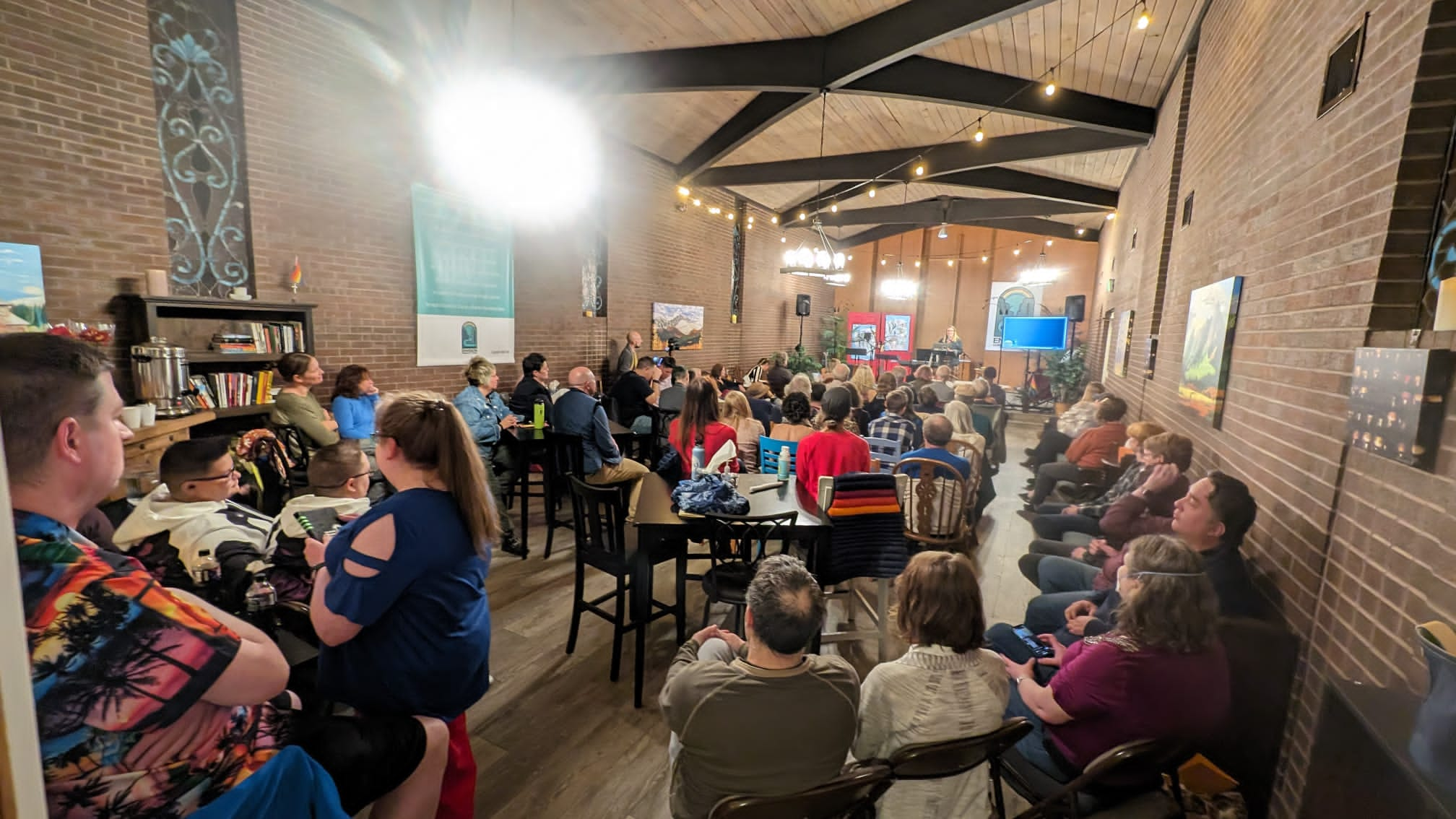
It’s been six months since Left Hand Church (later Envision Community Church) closed. The congregation existed for six years. I was the only one of the founding pastors remaining when the church closed. I was not ready to write about the church’s ending until now.
We did much right. For six years we provided a safe post-evangelical environment in which our community could work together to love God, neighbor, and self. I have no idea how many times I spoke these exact words:
“We exist to love the God who burst on the scene 14 billion years ago in all of God’s complexity, mystery, and ever-expansiveness, rooted in relationship and grounded in love. We want to love our neighbors, especially those who do not look like us. And we want to love ourselves. You cannot do the first two if you cannot do the third.”
With the first sentence I defined the Big Bang and so much more, including the reality that the ultimate building blocks of the universe are not made of matter, but of a pattern of relationships between nonmaterial entities. And if the ultimate building blocks of the universe are relationships, is it much of a stretch to say the greatest force in the universe is love?
In different seasons of the church Jen Jepsen, John Gaddis, Kristie Vernon, John Gaddis, and Nicole Vickey joined me in preaching. Heatherlyn provided our music for all six years. Her husband Jason was our very capable technical director. I thought our worship experience had the kind of quality rarely seen in churches our size.
We enjoyed our relationship with Longmont United Church of Christ, where we were gifted with full-time use of their chapel, including the freedom to completely redesign and remodel it to our liking. Through Kristie Vernon’s design and construction prowess and the help of our members, it became a wonderful worship space for a congregation of our size.
Modestly funded by Highlands Community Church, Denver Community Church, and Forefront Church of Brooklyn, the congregation began from scratch, building a nucleus of members through pre-launch dinners at Jen Jepsen’s home. Aaron Bailey joined Jen and me as the founding co-pastors. At the end of the first two years John Gaddis and Kristie Vernon joined the staff and Aaron and Jen left. Nicole Vickey came on staff the following summer. Kristie and I were the remaining co-pastors when the church ended.
The church had between 100 and 150 people at any given time who called it their church home.
I spent over three decades in church planting before starting Left Hand Church, including a quarter-century as the CEO of a large church planting agency. Since I was in a new gender, I was open to new ways of planting churches, and therefore willing to leave behind convictions from my previous work. As it turns out, there was no good reason to leave those convictions behind. I will never again start a church without incorporating the hard-learned lessons gained over 35 years of church planting.
In all of my days at the Orchard Group, I resisted any attempts to start a church with more than one lead pastor. When people wanted to start a new church with co-pastors I routinely said, “I know you think you are the exception, but it never works.” I was right. It never works.
We began LHC with the same trinitarian leadership structure of Highlands Community Church, one of our founding partners. By the time we ended, two of us remained. While the two of us worked pretty seamlessly, the trinitarian model was too unwieldy. There is always someone who is “more equal” than the others. I believe it is better to name that from the beginning. A vertical leadership structure is not inherently bad, not if the CEO is a good leader with excellent ego strength and low ego need. If I were to start another church, there would be one lead pastor.
We also adopted a board leadership structure similar to Highlands Church. From the beginning, it was a working board, involved in both the ends and means of the church. When I was with the Orchard Group, from 1989 onward we only started churches with a Carver Policy Governance board. The board determined the ends of the church, while the staff determined the means by which those ends were accomplished. The board hired the lead pastor, and the lead pastor hired his or her own staff.
Initial elders were chosen by the initial management team that formed and governed the church for the first three years. Subsequent elders were chosen by existing elders, with staff, since they held in-depth knowledge about the church, having input and veto power over those selected. All elders were expected to give financially to the church and have a demonstrated commitment to the core values of the church. I would never again plant a church in which a Policy Governance board was not a part of the leadership structure from the very beginning. Its absence was a major obstacle at LHC.
While LHC began with a budget one-tenth the size of churches started by the Orchard Group, for the most part our people did give sacrificially. Our members also attended more regularly than the average American churchgoer. However, because we were not able to fund a marketing program from the beginning, and were hampered by the arrival of Covid just two years after we started, we never did gain the critical mass necessary to build a sustainable church. That did not enable us to have the kind of robust children’s, teen, singles, and couples programming possible when a church begins with 200 or more people.
There were other mistakes made at LHC, including not developing adequate HR procedures from the beginning, and not committing to hiring a full-time staff focused on rapid, sustainable growth. On the whole however, LHC was a vibrant and healthy congregation. Kristie and I made the decision to close the church when we knew it was no longer sustainable. It was a painful decision, but we realized the trajectory was unmistakable and under the circumstances, irreversible.
I miss the people of LHC. I miss preaching weekly and caring for people’s pastoral needs. I miss helping people navigate their departure from evangelicalism and the toxic faith that harmed them so. I miss talking with those who had no religious background, and whose spirituality came alive at our church.
I do not miss the drama, both from without and within. I do not miss the attacks from other churches, or the attacks from within. I do not miss the pain that arose from the mistakes I made. Though instructive, it is never pleasant to realize you have missed the mark. The church has always been messy and always will be. In my experience, small churches are messier than big ones. At the Orchard Group, I learned more from our successes than failures. We did not have many failures, which gives one a false sense of confidence, I suppose.
The thing I will miss the most are the “Aha” moments when members grasped a new understanding of a scripture passage that had confused them for years. I miss the ordinances of baptism and the Lord’s Supper, and I miss working with Kristie, John, and Nicole.
For six vibrant years Left Hand Church (later Envision Community Church) touched lives and brought life to a community of people. We had both successes and failures. Mostly, we lived together in community, messy, vibrant, and hopeful. I will always be grateful for my time at LHC.
And so it goes.
 Paula Stone Williams
Oh Paula, hugs. I know when I found LHC, it was wonderful, loving and caring. I had grown up and away from ELS (male oriented to be polite). I did enjoy the zoom church a lot. After LHC went to Sundays, I usually watched via You Tube. It was a great comfort and I loved your insights. I definitely feel closer to Jesus than I have in a long time, so thank you. Continue to take care.
LikeLiked by 1 person
I miss it too along with seeing folks I grew to love. You too, dear friend.
LikeLike
The feeling is mutual, Sally. I miss you and your whole family.
LikeLike