It took me over a year to slog my way through Ron Chernow’s biography of Alexander Hamilton. Between Chernow and Iain McGilchrist’s two volume, four-inch thick, The Matter With Things, I find myself grateful for the 1600 words of a TED Talk. Does it really take 392,000 words (Chernow) or 700,000 words (McGilchrist) to tell a story or explain an idea? Don’t get me wrong. Both Chernow and McGilchrist are brilliant, but a good editor can be a marvelous thing.
My first TED Talk, at 1920 words, was about 300 words longer than the typical TED Talk, but I speak fast. I finished it in 14 minutes, the sweet spot for a TED Talk back in those days. In today’s TikTok world, they are shorter.
When I work with TEDx speakers, where the manuscript must be memorized word for word, they think they will never be able to get their “big idea” down to 1,600 words . First drafts usually come in at around 3,500. We ask the speakers to do their best to get the word count as low as possible, but every word of a speech is a baby to which the speaker has painfully given birth. They just can’t get rid of them.
That’s why we have to take over. We get the manuscript down to 1600 words and you’d be amazed how often speakers say, “I don’t even know what you took out.” That’s because what we took out was extraneous to the big idea. It is not an easy process. My first TED Talk was at edit 38 before it was done.
Had it been a TED Talk, Chernow’s book would have been 2,856 minutes long, or 47.6 hours. By contrast, the audio book of my memoir, which has about 70,000 words, is just under eight hours long.
Okay, I can tell, you are getting bored. Let me make this more interesting.
In the musical Hamilton, Lin Manuel Miranda took a book that would have taken 47.6 hours to speak and turned it into a 2 hour and 23 minute musical with 20,500 words, give or take a word. That’s 144 words a minute, twice the words-per-minute of a typical Broadway musical. I’ve seen it five times and I’ve still not picked up all the words.
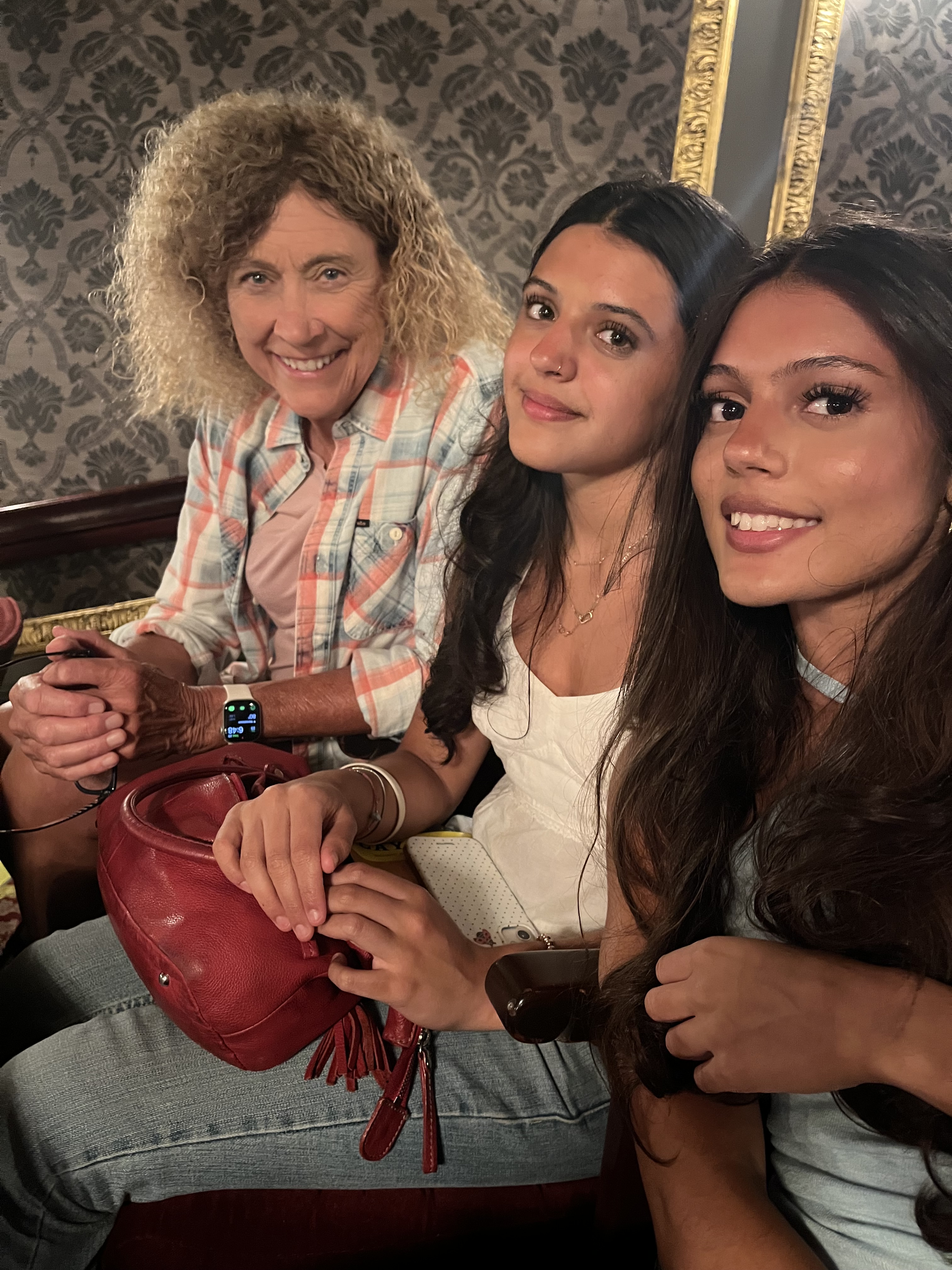
My two New York granddaughters, 17 and 18 years old, not only understand every word, they have memorized the entire libretto. Yeah, the entire libretto. Asha said apologetically, “Well, maybe there is one song late in the second act that I don’t know completely.” Seriously? Other than occasional phrases like, “I’m not giving away my shot,” or “I wanna be in the room where it happened,” or “I may not live to see our glory,” I haven’t memorized anything from Hamilton.
We took Asha and Lyla to see Hamilton last Thursday. The next night Cathy and I saw the Les Misérables 40th anniversary tour at Radio City Music Hall. Both shows were fantastic. I’ve seen Les Mis more times than I can count. As with Hamilton, I’ve seen it in New York, London, and Denver. I do have the entire 2:45 libretto of Les Mis memorized – I have for a long time. But it’s got half the words of Hamilton.
After watching both shows I realized how much has changed in our culture in the last forty years. When Les Mis came out we were still firmly planted in the modern age, with its certainties and clear moral standards. There were no ambiguities. We knew who the protagonist and antagonist were. It was obvious. We still lived under the fantasy that right and wrong were immutable and obvious. They never were, but for the better part of 500 years we hung on to that fantasy.
Hamilton is a completely different story. It is purely postmodern. There is no obvious protagonist except George Washington, who comes off looking pretty good. Certainly Hamilton and Burr, the two key characters, were not obvious protagonists or antagonists. Nor was Thomas Jefferson. Not even King George qualifies as an antagonist. He was relegated to comic relief.
In Les Mis you only see the bad side of Javert and the good side of Jean Valjean. In Hamilton you see the good sides and the dark sides that emerged from each main character because none of them had dealt with their shadow sides. The shadow sides are the unexplored parts of the psyche, the places we do not want to go because we do not want to find what is lurking there, waiting to be worked out. Working out what is in our shadows is hard and takes time.
Both Burr and Hamilton had a childhood that, left unexamined, created huge problems in their lives that finally landed them in Weehawken, New Jersey, where functionally both of their lives ended. You wonder what might have happened if more of our founding fathers had not just lived life at the surface. Washington had clearly done some work related to his early failings on the battlefield, but there did not appear to be much interiority in most of the founding fathers – not many poets in that group.
Which, come to think of it, is a lot like today’s national politicians, but that is another column (you can tell I’m an old magazine writer – I wrote “column”) for another day.
Hamilton, the musical, does capture the positive, negative, and unexamined shadow sides of the characters. That is quite a tribute to Lin Manuel Miranda and those who helped him shape the musical. Its depth and nuance are remarkable.
I’m headed to London next week, where I’ll see To Kill a Mockingbird. It seems odd to see it in London, but it’s having a short run there and I’ll be in town, and who wouldn’t want to see a play scripted by Aaron Sorkin. I just wish Jeff Daniel’s was playing the lead character. Now there’s someone who has explored his shadow side.
And so it goes.