Once Upon a Time

I have had most of my granddaughters with me for the better part of three weeks and paradoxically, I feel both tired and younger.  The days I have had all five (all between the ages of 7 and 10) I am definitely tired. But their wide-eyed expectation keeps me going from early in the morning until they are tucked in at night.

I tell the girls a bedtime story every evening.  I have no idea what story I am going to tell until seconds before I begin. It usually involves young girls on an adventure not exactly endorsed by their parents, but one that ends with children or animals being saved from peril.

I’ve known pastors who spend no more than one hour in sermon preparation.  They think it does not show.  It does.  But the pastor is so engaged trying to pull together cogently connected paragraphs that the sermon seems better than it actually is.  The pastor’s brain is working hard.  Not so the audience.

There are a lot of reasons creating a sermon on the fly is a bad idea.  Foremost among them is the difficulty of pulling together didactic information without forethought.  Telling a story is different.

We are narrative-based creatures.  We do not sleep without dreaming, and we do not dream in mathematical equations.  We dream in stories.  Our need for story is downright physiological.  Therefore, our brains are wired for stories.  That is one of the reasons I prefer narrative preaching.  Everyone loves a good story.

Good stories always have the same wonderful elements.  There is a protagonist who wants something with which the audience can identify.  There is an antagonist who wants to stop her.  Suspense builds to a dread/hope axis.  The audience dreads one outcome and hopes for another.  A good story always makes sure the audience gets what it wants, but not in the way it expects it.  The element of surprise is the icing.

I have a friend who once considered investing in a Broadway musical about a traveling executioner. I had a hard time imagining a story with an executioner as the protagonist.  So did audiences.  The show flopped.  You should be suspicious of a playwright who ignores conventional narrative wisdom.  We want our heroes to be flawed, but we want our stories to be redemptive.

There is another interesting truth about humans and stories.  We want the hero to behave better than we are likely to behave in real life.  There was one day in the last couple of weeks in which one particular granddaughter had difficulty with the truth.  As a grandparent, I do not believe it is my job to be the moral police; parents get to do that.  But I do need to keep the peace.  She showed little contrition.  She just wanted what she wanted and was willing to be untruthful to get it.

However, when story time came she desperately wanted the hero to make the right decision and tell the truth.  It seemed rather ironic.  Filmmakers know the audience is always moral.  In their real lives the viewer may have just embezzled massive sums from their employer, but when they show up at the movies they want the hero to make the right decision.  We are an endlessly fascinating species.

Since the girls were staying for a longer period, this summer’s stories turned into the bedtime equivalent of a ten-episode summer cable series.  That allowed me to create a story arc with a fair amount of complexity.  After I finished each evening, I was more eager than the girls to find out what was going to happen next.

Bedtime stories take on a life of their own.  You do not always control the outcome.  I cared about the characters I had created.  Would they find redemption?  Would the hero do the right thing?  A lot was at stake, especially the sweet dreams of five little girls.  I needed to get it right.

I always left each episode with a cliffhanger.  There would be collective groans, “Please GramPaula, tell us what happens next!”  “Ah, but you must wait,” I said.  I had ulterior motives.  It is easier to get five little ones to bed when they know the answer to a cliffhanger will be revealed as soon as they get under the covers.

This current series ended with everyone safe, but forever changed.  That felt about right.  Isn’t that about all any of us can hope for?

The New York girls left early this morning.  All five granddaughters will be asleep in their own beds tonight.  I will be sitting in my living room missing them monumentally.  To take my mind off the loneliness I will watch one of those summer cable series, hoping the protagonist makes the right decision and the writers and show runners are smart enough to know to give the audience what they want, but not in the way they expect it.

And so it goes.

The Camera Always Lies

I read the New York Times and Washington Post every day.  I do not watch “reality” television.  It is hard enough trying to discern what is true and what is not true without the carefully constructed fantasy world of “reality” TV .

Back in the 1970s British broadcasting legend Malcolm Muggeridge said, “Not only can the camera lie.  The camera always lies.”  He was not talking about the current world in which you can photoshop just about anything.  He was talking about a simpler time when the picture taken was the picture seen.  But even then, Muggeridge rightly understood that pictures do not necessarily tell the truth.

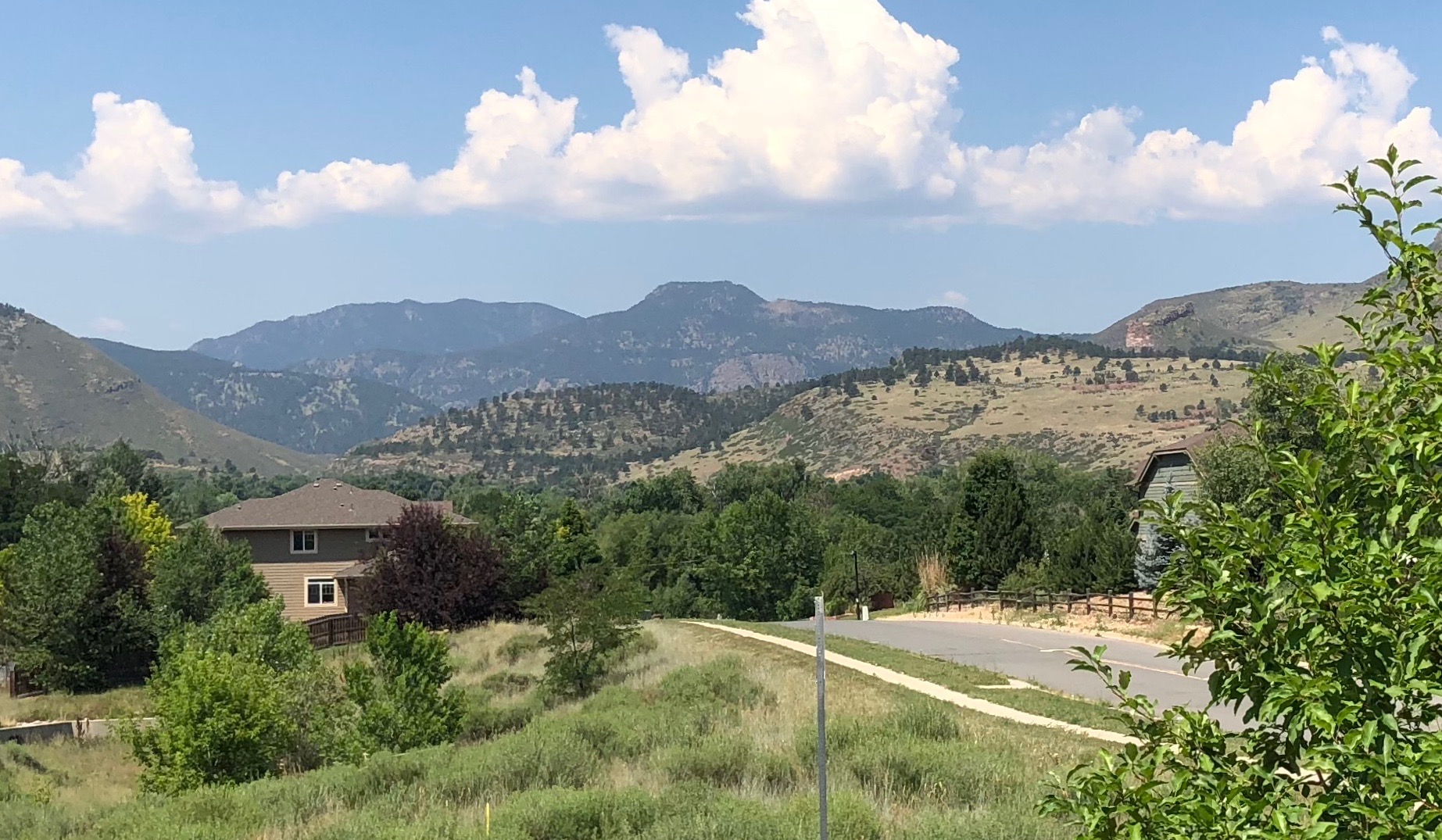
The common notion is that if you have seen something with your own eyes, it must be true.  But in reality, it is not that simple.  Consider the two photographs above.  The photo on the left would make one think it was taken outside a prison camp.  On the other hand, the photo on the right looks like it was taken from a vacation home in the Rockies.

Both photos were actually taken from the exact same spot in my side yard.  In the first the camera is pointed southeast and in the second it is pointed to the southwest.  Either picture, taken alone, does not present the whole story.  But if your brain sees only one of the pictures, it assumes the picture it has seen is true.

A second Muggeridge phrase was, “The editor is king.”  When I was an adoption caseworker back in the 80s, an international adoption issue necessitated doing interviews on CNN and the local television stations in New York City.  After the first interview was edited to give a completely inaccurate impression, I realized I should only do live interviews.  On videotape it was far too easy for the editor to tell the story she wanted to tell, instead of the story that actually took place.

When Donald Trump decided to run for president I was confident America was smarter than to elect a reality television star.  Didn’t people understand reality television has little to do with reality? Didn’t they understand that the editor determines exactly what they do and do not see?  Apparently not.

Mark Burnett, the creator of The Apprentice, made Donald Trump president.  Burnett has been selling fantasy to Americans since he started Survivor in 2000.  He is the one who made Trump a star, not by telling the truth, but by making the viewing public believe what Mark Burnett wanted them to believe about Donald Trump.  By the time he was done with his editing magic, Trump looked like a competent CEO and people believed the lie they had been fed.  After all, it was right there on the screen.

Print journalism is a better vehicle for truth telling.  Words are not as easily manipulated as images.  But even with print journalism, the editor still reigns.  The information you read is only as accurate as the editor makes it.  Last year there were two stories written about me in the Denver Post and the New York Times.  The Denver Post is owned by a hedge fund that keeps squeezing profits by cutting back on reporters and editorial staff.  Their 800 word article had eight errors of fact, two of which significantly altered the story.

The New York Times, which has added reporters and editors to its newsroom since the 2016 election, had a 4,000 word article with zero mistakes, not one.  Not all news outlets are created equal.

The Denver Post wants to get it right, but their owners make accurate reporting almost impossible.  But at least the reporters and editorial staff who remain at the Denver Post want to get it right.  When Fox News, Breitbart News, InfoWars and the London Daily Mail reported a very inaccurate story that involved a university in Pennsylvania and my TEDxMileHigh video, not one of those companies bothered to even attempt to contact me to verify their information.  Not one.  They did not care about the truth.  Period.

I want to get my news from people who care about the truth.  I want to get my information from people who are trying to get it right, even if their companies are owned by jerks.  I do not want to get my information from sleazy media outlets that only care about profits and do not care one iota about what is true and what is not true.

It is possible to tell which news outlets work hard to get it right.  You can start by seeing if your preferred newspaper has a “correction” section that appears in every edition and, when necessary, shows corrections at the bottom of any article in which they’ve gotten even one detail wrong.  If your favorite media outlet does not publish corrections, you need to find a new media outlet.

The truth matters.  It always has and always will.  If Malcolm Muggeridge was concerned about the objectivity of undoctored images, how much more concerned would he be with the mayhem we see today, particularly in the electronic media?  These are trying times, and we must not give up the conviction that the truth is ascertainable and will set us free.


Well, Now You’ve Gotten the Women Angry

It is not that hard to do the right thing.  Well, you might lose everything, but after the shock has worn off, you haven’t died. On the other hand, if you choose the wrong thing someone might die.  Children might die.

We are so bombarded by the constant stream of disturbing news that we pretty quickly move on from one frustrating reality to the next jaw-dropping event.  But even with Justice Kennedy’s announced resignation, one newsworthy item is staying in the headlines.  It is the more than 2,000 children who remain separated from their parents.

This past weekend there were 628 protests in 50 states against the current administration’s stance on immigration issues, particularly as it relates to those 2,000 children.  Many Americans are outraged, and with good reason.  These children will suffer lifelong mental health issues because of the unconscionable action taken by this administration.  But I have been almost as appalled by the lack of action taken by the evangelical church as I have been by the edicts coming out of Washington.

When it comes to the border crisis, megachurch pastors have responded like political pros, using flowery words that signify nothing. I read the response of one megachurch pastor that was silky smooth and utterly toothless.  Basically it said, “Whatever conclusion you reach, it is your conclusion, and as long as you’ve thought it through, your conclusion is good.”  Except that separating mothers from their children is not good.  It is never good.  It never has been good.  It never will be good.

But these guys, and they are all guys, are so afraid of alienating someone, they take no stand, which of course is a stand. To make a rather drastic but not altogether inappropriate analogy, the Holocaust would never have happened without the stony silence of the German church.

Of course, America’s evangelical churches do take a stand.  They take a stand on the pet subjects of their male leadership.  They take a stand against perfectly normal and healthy LGBTQ people, because their tribe has deemed that population to be a threat.  They take a stand against abortion, while allowing irreparable damage to be done to children who are already breathing.

I believe the lack of response to the border crisis is one more giant misstep sealing the fate of the current leaders of the American evangelical church.  Their empty rhetoric in these critically important hours reveals the mold eating away beneath their polished facade.  The evangelical church may not recover, and I am beginning to believe that is not a bad thing.  Last week a friend tweeted, “Okay, you got your Muslim ban.  When do we get our evangelical ban?”  This is how a large number of Americans feel about evangelicalism.

What goes around comes around.    Do evangelicals not know this?  Every church that gains political power eventually comes undone at the seams.  A David comes along with a sling and a stone and brings down the giant with one well-placed throw.

I love all the mothers who are coming together to address this crisis, because if we’re honest, it’s the mothers who get it.  Children are our most precious resource.  Those who mess with their wellbeing will pray a price.

It is courageous and brave women who are bringing power to the #ChurchToo movement.  They came together and spoke their stories, knowing they would be vilified by many of their former friends.  But nevertheless they persisted.

Some of the best-known female evangelical leaders have gotten behind the movement to return children to their parents.  All of these women are finding the courage to do what the male evangelical power brokers are unwilling to do.  They are calling evangelicalism on its misogyny, its racism, its homophobia, its anti-immigrant stance and its sexual abuse.  While the men stand with their deer in the headlights look, the women are boldly saying, “We will be silent no more.”

I think we might have found our David.

I Understand, Do You?

Over the past ccouple of weeks I’ve had some interesting conversations with evangelical leaders who wanted to glean information about the transgender experience.  Before the conversations ended, both either subtly or directly let it be known that their “belief about Scripture” stops them from accepting LGBTQ people as they are.  Both were confident I would understand.

I do understand. I believe it is also very important for them to understand.  When they say, “I hope you respect that my reading of scripture demands that I not accept gay relationships or people who transition genders,” they are saying, “My system of beliefs is actually more important than the flesh and blood humans I encounter who exhibit in their lives not one bit of measurable evidence that they are living anything other than whole and good lives.”

Gay relationships are every bit as healthy and strong as straight relationships. Transgender people are every bit as healthy as their cisgender counterparts.  Both have been confirmed by a plethora of peer reviewed studies.

So if you choose to reject LGBTQ people, you are doing so not because of any evidence-based empirical data.  You are doing so because of your interpretation of a particular set of 2,000 year-old instructions that you are choosing to accept over flesh and blood humans.

You have every right to do this.  But it is important to be honest about what you are doing.  You are accepting a specific hermeneutic that has been rejected by half of the world’s Christians, and you are following a specific exegetical understanding of a handful of passages that is disputed by many who hold to your own hermeneutic.

I really don’t think this is about the Bible.  This is about an unfortunate tendency of our species to create enemies that don’t exist.  The Pulitzer-Prize winning sociobiologist Edward O. Wilson and anthropologist and philosopher René Girard have written extensively about this.  Humans create scapegoats who must be driven from the tribe, and enemies who must be defeated for the supposed welfare of the tribe. The scapegoats and enemies do not have to be a genuine threat.  They just have to be named as a threat.

Consider today’s landscape.  Evangelicals are heavily involved in a number of initiatives to stop transgender people from using the appropriate restroom.  Even after North Carolina’s HB2 law was rescinded, they keep introducing similar bills in additional state legislatures, mostly in the south.

It is important to note that not a single transgender person has ever been arrested or convicted for being in a women’s restroom for nefarious purposes.  On the other hand, the facts are clear about a very real threat that does very much exist.

Between 1987 and 2007 the three largest companies that insure Protestant churches paid out 7,095 claims for sexual assault by church leaders, one assault for every 24 churches in America.  Over 99 percent of the offenders were male.

Again, to be perfectly clear, no transgender person has ever been arrested or convicted of assault in a women’s restroom, but thousands of pastors and church leaders have been guilty of assaulting their own parishioners.  These are the facts.

But none of this is about facts.  It never has been.  The evangelical tribe believes it needs an enemy, and at the moment transgender people are the enemy du jour.  Before the LGBTQ population, it was the divorced, Roman Catholics, the Irish, the Italians, the Scots-Irish, those who opposed slavery, those who believed the earth revolves around the sun, and so on and so on, back to the prejudice against first century believers who had not been circumcised.  This is what tribes do.

So one more time, just to be clear.  When you choose to say to a perfectly healthy and whole LGBTQ person, “I’m sorry, but my Christian faith stops me from accepting you as you are,” you are choosing a tribal belief system over a living and breathing human being. You have chosen an idea, and a vague one at that, over a person.

I enjoyed my meetings with you.  You seem like fine people.  I do appreciate your interest in meeting with me, and your desire to understand the transgender experience.  I would also like you to understand how puzzlingly dehumanizing your words are to me, the person you have chosen to judge unfavorably out of loyalty to your belief system.

Common Courtesy Equity

Most insights arrive slowly.  Information accumulates until you think, “Hey, something’s happening here.”  That is how I felt mountain biking last week.  As I headed down Picture Rock Trail, I thought, “Something is not right when I yield to male uphill riders.”

Except for a handful of jerks, always male, pretty much everybody follows the rules on a mountain biking trail.  The people headed uphill have the right of way.  Those coming down pull over to the edge of the trail to let the uphill riders pass.  If I am headed uphill and someone pulls over for me, I always say, “Thank you very much.”  As I go past, I also say, “Just me.”  That way they know I am riding alone and there is no one coming close behind.

As I rode downhill last week I pulled over for a 30-something male who, as he passed by said, “Hi.” He did not say, “Thank you,” nor did he say, “Just me.”  Only, “Hi.”  About a mile later I pulled over for another male rider who said, “Hello.”  Next up was a woman who offered a quick, “Thank you so much.”  Next was a man who said absolutely nothing.  I’ve seen him on the trail before.  He is always a jerk.  At least he is consistent.

It was a busy day and I pulled over for another six male riders, five of whom said either, “Hi” or “Hello.”  The sixth said, “Thank you.”  And that is when the insight became clear.

When I was a male and pulled over, men invariably said, “Thank you.”  Now that I am a female, some show that same common courtesy, but a large number of male riders do not say, “Thank you.”  Instead they offer some version of, “Hi.”  Could it be they expect a woman to pull over for them, so they think nothing more than a quick hello is necessary?

With male privilege so deeply ingrained in our culture, subtle misogyny is not always easy to identify.  And, “Hello” is definitely better than, “Thanks sweetie.”  But if the same guys are saying, “Thank you” to the men on the trail and, “Hi” to the women, that’s misogyny nevertheless.

Last week I had to go into a bank and speak with a banker, something I try to avoid at all costs. I needed to change signers on a corporate bank account and I’d been waiting for 30 minutes when the business banker, who already had my name and knew I was next in line,  ignored me and took someone else who had just walked in the door.  You can guess the person’s gender.

I was livid. By the time I left, the branch manager was well aware that I speak nationally on gender discrimination and there was a good chance their bank would be mentioned in my next speech.  It is also possible that I showed the manager a picture of me speaking in front of 5,200 people at a TED talk.  After several years of gender discrimination, I don’t take it anymore.  I throw around what little weight I do have.

Later the same day I had to go to my own bank to withdraw cash to pay the contractor doing some work at my house.  The teller went out of her way to be helpful, so I asked to speak with her supervisor. I praised the teller and then had another, “Hey, wait a minute,” moment.  The supervisor responded with a perfunctory, “Thanks.  I appreciate that.”

As a male, I often asked to speak with a supervisory to compliment the work of an employee.  The supervisor was always incredibly appreciative.  It was not unusual to get a note from the employee thanking me for my words of affirmation.

Another moment of insight.  My compliments do not carry the weight they once did.  They are not exactly dismissed, but they also are not received with the enthusiasm that accompanied a compliment from Paul.  I guess people just expect women to be more complimentary than men.

These insights are fascinating.  They are also maddening.  I cannot speak for the experience of any other transgender person, but to me there is nothing more aggravating than being summarily dismissed just because I am a woman.  It is another one of those things men just do not know, so it is frustrating on two counts.  First, it’s frustrating to be dismissed because of your gender.  Second, it’s equally frustrating to realize there’s not a man in the world who gets it.

The experts say it will be 100 years before we have gender pay equity in the United States.  I wonder how many years it will be before we have common courtesy equity?

Ceasing To Exist

The deaths of Kate Spade and Anthony Bourdain have brought depression and suicide to the forefront  this past week.  That is a good thing.  American culture is still resistant to the reality of mental illness.  We are particularly unresponsive to the growing epidemic of suicide.  Since 1999 there has been an increase of 25 percent in suicide rates in the United States.

There are resources available for those with suicidal ideation, but not enough people take advantage of them. One of the reasons is that people are afraid, and rightly so, that they will be judged negatively if they acknowledge their struggle with mental illness and thoughts of suicide.

The way in which American culture responds to suicide is part of the problem.  In America, your suicide defines your entire life.  Kate Spade will not be primarily remembered as a designer and Anthony Bourdain will not be remembered as a chef, travel writer and television host.  Both will be remembered as people who ended their lives by suicide.  That is not at all fair, but it is what Americans do.  We judge people negatively for their unbearable pain.

Those who end their lives are in such pain that they are not thinking the tiniest bit about how they will be remembered.  But I think about it, because in an odd way I actually know a little something about how you are remembered after your life “ends” abruptly and unacceptably.

I tend to speak of Paul in the third person.  I know that every part of Paul is contained within me, but so many of the people I loved and with whom I worked over the years do not see it that way.  To them Paul’s life ended in a tragic and terrible way.  Their judgment of my “ending” manifests itself in concrete ways that it took me a while to recognize and understand.

For instance, no one buys the books I authored.  You can’t even find them on a remainder table.  My videos have disappeared from the Internet.  I have bound copies of 12 years of a magazine I helped create and for which I wrote a weekly column.  But I doubt anyone will ever open the pages.

In my old religious community, nothing Paul did is remembered or celebrated.  Go to the web site of the ministry I helped build for 35 years and you will find nary a mention of me.  When the magazine changed hands last year, there were goodbyes among the contributing editors and columns written about that chapter in the life of the magazine, but not a single public word was written about me.  (I did receive a warm private letter from my fellow-editor.)

There are a few dozen people who have written to thank me for the contribution I made to their lives, but from a public perspective, there is virtually nothing to indicate I ever existed.  This is what we Americans do when we do not like the way in which a life “ended.”

I pray for the children of Kate Spade and Anthony Bourdain.  They are only 13 and 11.  I know the pain my own grown children went through losing their dad in a difficult and abrupt way.  I can only imagine how much more difficult it would have been if I had truly ended my life.

There is a lot of pain in the world, and for some, it is too much to bear.  I do understand. But taking one’s life doesn’t just create a terrible ending to one’s story.  For much of the world it erases the entire story.  And that is a tragedy at so many levels.

If you struggle with depression and find yourself thinking about ending your life, please contact me at paula@rltpathways.com.  If you are local, reach out to us at Left Hand Church, where I serve as one of the pastors.  We have therapists on staff who have available appointments this week.  We can help.  And remember, you can always call the National Suicide Prevention Hotline at 800-273-8255, where you can speak with someone 24-hours a day, seven days a week.

I feel gratitude for the joy Kate Spade and Anthony Bourdain brought into our lives. Kate inspired us with her colorful and whimsical celebration of what it is to be a woman.  And Anthony brought an honest and unique understanding of different cultures through, of all things, food!

Their ending is a sad postscript, but it is not who they were.  They were so much more. How they died is just the physical manifestation of a terrible illness.  But it is an illness that can be treated and cured.  Tragically, they did not receive the help they needed.  May God heal their souls.

Sometimes I Forget

Today I will take you on a little journey into the life of a transgender woman.  It will not be what you might imagine.

My day is rather like the average day of any female who lives in a nice house in a small town in the foothills of the Rockies.  I ride the trails on my mountain bike or pedal the roads on my touring bike.  If it’s Monday, I go for a long run.  If it’s Tuesday, I see counseling clients throughout the day and enjoy staff meeting and a relaxing lunch with my co-pastors at Left Hand Church.

Saturdays are a little different.  I sleep in, mow the lawn, run for 45 minutes, then head to church where we set up for services while the worship team practices their set.  After church a bunch of us go to dinner before I head home to watch Saturday Night Live.  Yep, pretty simple, the ordinary life of a woman in one of the nicer locales on planet earth.  And oh yes, I forgot to mention, absolutely no one, ever, treats me as anything other than the tall white woman I am.  Which is what makes me forgetful.

A wedding invitation came in the mail the other day.  It excluded me.  I have been informed I should not attend a few weddings and other milestone events in the past couple of years.  I was even disinvited from my high school reunion.  Until these social slights occur, I forget there are these peculiar spaces from which I am excluded.

I also forget about the troll-driven venues on which I am vilified.  Then a friend reminds me, “Have you seen the 3,000 YouTube comments about your TED talk?!”  I tell them no, I have not seen them.  I have no masochistic tendencies.

Last month I turned down an invitation to speak at a Christian university where I was asked to share the stage with a second speaker who believes, “being transgender is not a thing.”  The school was shocked when I declined their invitation.  I asked if an African-American speaker would be inclined to share the stage with a person who said being black, “wasn’t a thing.” I don’t think they got it.

Of course the truth is that every single day I interact with these people.  I see them at the grocery store, the corner Starbucks, the local shopping center.  They have no idea they are talking with a transgender woman.  They talk and laugh and joke like I am a normal human.

I sometimes want to reveal that I am transgender, but I never do.  I figure it is already hard enough for them to get up in the morning and have to be who they are.  We’re all just trying to get by.

If you tend to see me favorably, as most of my readers do, you need not lose sleep over my experience.  It is what it is.  I rarely take it personally.  My life is rich and full and filled with committed people, including people of faith, whose generosity knows no bounds.

I feel sorry for those who are afflicted with Hardening of the Categories.  It can be cured, but first you have to want to get well, and a lot of people have no interest in getting well.  They are happy living inside their self-imposed quarantine.

You know, those folks could go ahead and send their invitations.  They need not worry.  I am not inclined to go where I am not wanted.  I get the lay of the land.  I know I am not welcome in only one kind of place in America, evangelical spaces.

Of course, it does seem kinda ironic that every last evangelical website opens with the tagline, “Where Everyone Is Welcome.”

People are strange.

The Frightening Power of Alpha Leadership

Men and women behave very differently when they first enter a boardroom.  The men identify the alpha person in the room, then position themselves in relation to the alpha.  Every man will take a seat indicative of his perceived rank in the hierarchy.

Once the meeting begins, rank is confirmed by who speaks the most quickly and confidently. Extroverts and quick processors have an edge.  Introverts and slow processors are at a disadvantage.

Women are expected to find their place in this patriarchal ranking system.  That’s why there are books targeted to women with titles like, Lean In and, Nice Girls Don’t Get the Corner Office.  If they refuse to play by the rules, the women are summarily dismissed.

Other even more unsavory determinations are also made when men first walk into a room.  If they are straight males, they are inclined to sexualize females.  There are exceptions.  Men do not sexualize alpha females.  In fact, they run in the opposite direction.  Castration anxiety is real.  If the woman is not an alpha, however, the men will be inclined to sexualize her at the same time as they rank the woman in the power hierarchy.

It is important for males to acknowledge this reality, because if it is not acknowledged it can wreak havoc.  If men had good role models and appropriate instruction in their formative years, they quickly stop themselves from sexualizing women, almost before they start. They have been made aware of these male tendencies and of their agency to refuse to empower them.

But those are some awfully big “ifs.”  A lot of men did not have good role models or appropriate instruction.  A lot of evangelical men had no instruction at all.  They were taught to deny their sexuality, which leads to shame and an increased lack of ability to recognize when they are sexualizing females.  It also leads to a lack of owning the fact that a man does indeed have agency when he is with a woman.  He does not have to act on his impulses.

When both sexual attraction and agency are denied, what you end up with is the Billy Graham rule, also known as the Mike Pence rule, where a man refuses to be in a private meeting with a woman.  What is not acknowledged is how this diminishes the humanity of the woman in favor of “protecting” the man.  Talk about patriarchy!

There is something even more sinister.  As a male, I spent most of my time with other powerful males.  The narrative they told themselves was that they needed to avoid private meetings with women because, “there are a lot of women out there who want to bring down a powerful man.”  Yeah.  Right. I cannot tell you how often I heard that ridiculous narrative.  A lot of evangelical males will go a long way to deny their fundamental sexuality.

Bill Hybels, the founding pastor of Willow Creek Community Church, comes to mind.  What he did was so far outside the bounds of acceptable behavior that he should be suffering severe consequences.  The last thing his church should be doing is trying to reconcile prematurely with the women he abused.  What they should be doing is educating other male leaders about what is and what is not acceptable behavior.

I can’t help but wonder if things would have been different if Hybels had come to grips with his sexuality early in life.  What if he had learned to acknowledge it, and control it, long before he gained the power that gave him so many opportunities to make inappropriate advances toward women?  Unfortunately, if you deny the reality of your sexual impulses, it should come as no surprise when you deny the actions that result from those impulses.

Alpha males set the tone for how women will be treated.  If an alpha male sexualizes women, the rest of the men are likely to follow suit.  If an alpha male ignores women, the men will likewise follow suit. If you have any question about the power of an alpha male in a boardroom, you need look no further than press pool video of cabinet meetings in the current White House.  It is frightening.

There are few places in my life in which I feel more upside down than in a boardroom.  Are the men ignoring me because I am an alpha, or because I am an older woman, or both?  I have no idea.  But I can tell you with certainty that it annoys the hell out of me.

Watching everyone ranked and/or sexualized is disturbing.  I think, “Oh please, dear God, tell me when I was a male I was not like that.” I know I did not sexualize women. I refused to do so.  But when it came to the ranking system, I was more of a participant than I would like to admit.

There are so many difficult lessons I am learning.  Hardly a day goes by that I do not find one more thing to grieve about my male life, and many of those discoveries are about power and patriarchy.

How do we move from a system of alpha leadership to a system of collaborative leadership? I am not sure.  There are some of us who have moved toward a Trinitarian-inspired leadership model, but I’m not kidding myself.  The alphas still carry a lot of weight.  But the first step toward fixing a problem is recognizing its existence.  And oh my, am I recognizing its existence!


Nothing to Fear

When I was in college I used to go spelunking with four friends.  Carter Caves State Park was near my Kentucky home and we explored the dark tributaries of its caves. Three of us did not weigh an ounce over 150 pounds, but our fourth friend had the bearing of a offensive tackle.  The rest of us could wriggle through narrow openings into fascinating interior caverns while he was left alone on the other side of the divide.

That is how I felt at the She Is Called conference in Denver.   Capped at 50 attendees, the conference was focused on women in leadership.  For me, the highlights included a session on sex and power led by Dr. Tina Schermer Sellers, and Jen Jepsen’s talk on her awakening to white privilege.  I assisted in one conversation on Thursday and gave the keynote address on Friday evening.

Though women never treat me that way, I often feel like an interloper when I am in decidedly feminine spaces.  I believe my feelings are based on something more than self-deprecation.  The women were talking on Thursday about the cyclical lens through which they view the universe.  I do not have estrogen coursing through my body for 14 days, followed by progesterone for 14.  I have estrogen all 28 days.  I am always in the “feel good” portion of a period.  My experience is linear, not cyclical.

My surface life is pretty unremarkably female as I enjoy a satisfying and meaningful existence, but once I start crawling more deeply into the cave, I discover spaces into which I cannot fit.  But I can get close enough to see what is inside, and what I observe is fascinating.

Women are unafraid of intimacy with one another.  They don’t have the, “How ’bout those Bears” fear of physical touch that men so often express.  Most women are comfortable with each other’s bodies and at home in close spaces.  But I also observe that many of the same women are not comfortable in their own bodies.  After millennia of being treated as objects, they have bought into the notion they are only as good as they look.  This particular problem is something I understand.

As a male I never paid much attention to my appearance.  If I did glance in a mirror, I was comfortable with what I saw.  As a female I feel that way, let me think, yeah, never!  I always look in the mirror and find myself lacking.  The first response I had to seeing my TEDxMileHigh video was to cry, not because I was proud of the video, but because I thought I wasn’t pretty enough.

Carla and Kate, who host the She Is Called podcast and helped lead the retreat, bought dresses at Judith and Joe http://judithandjoeshop.com, a boutique in the Rhino neighborhood of Denver.  During Thursday evening’s main session they interviewed Brandee Castle, one of the owners.

You can be sure many of the rest of us were well aware we would never look as good as Kate and Carla did in their dresses.  It’s just not gonna happen.  We were thrilled for them, but acutely aware of our own limitations. Of course, the truth is that every woman at the retreat looked amazing, but none of them thought so.  And there is nothing you can tell them that will change what they see in the mirror.

When it comes to what you see in the mirror, I can squeeze into the cavern.  I understand that experience.  But there are other spaces into which I cannot crawl.  What did I see through the narrow tunnel as I looked into those spaces?  I saw women who not only thought they were not pretty enough, but women who thought they weren’t enough, period.  They measured themselves against the other women and came up lacking.

On Friday evening I encouraged the women to work more collaboratively and empower one another.  But the more I think about it, their tendency not to empower one another is not from any attitude of scarcity.  It is from a deep-seated lack of belief in themselves. They do not realize that if they harness all of that feminine energy, they can bring the whole world into alignment.  They have a hard time seeing their own power.  You cannot empower others when you are convinced you are powerless.

From my little space in the cave’s tunnel I saw what these women could not see.  While they saw dark rock walls, I saw rich earthy minerals ready to nurture growth.  What I saw was crystal clear water running over beautiful formations.  What I saw was the power to heal the nations.

On Saturday morning, as these beautiful women shared their thoughts about the retreat and laid bare their feelings as they read their own poetry, I realized I have nothing to fear.  These women will find the freedom and courage to empower themselves. I hear it in their voices.  And they will empower one another. They will change the world, and we will be better for it.  The Divine Feminine is alive and well.

Every Bit As Much, and More

A couple of weeks ago I was interviewed by a Detroit newspaper.  The reporter asked, “In watching your TED talk and reading through your articles, I notice you often refer to feeling unheard as a woman, but you never mention the difference in how people respond to your preaching now that you are a woman.”

I had not been asked the question before, and it got me thinking.  There is actually a discernible difference in how people respond to my preaching as a female.

People always responded well to the preaching of Paul.  (My apologies for speaking about myself in the third person, but sometimes it’s just easier.)  After preaching at a megachurch in Chicago, one woman said,  “Hey, what you said in your sermon, well, that’s the conclusion I was going to reach next month.  Thanks for getting me there a little earlier.”

You always want to be one step in front of your audience.  If you are a step behind, they are bored.  If you are two steps in front, they are confused.  But if you are a single step in front, they are ready to hear the insights you provide.  And that is what people are looking for in a sermon – insight.

I always want to be one step in front of my audience, and I always want to provide both information and insight.  I want them to say, “Oh I never thought of it that way before.” I have always wanted to touch both mind and heart, for that’s where the soul resides.

As a male in American evangelicalism, my presence carried weight.  I had authority, granted by my education and accomplishments, but mostly by my status as a white male.  Because I spoke to the right brain as much as the left, I was well received by women.  In fact, women seemed to be a good bit more responsive to my messages than men.  I used to speak at men’s retreats every now and again, but I was never a favorite.

When I preached as Paul, I felt alive.  With the exception of how I felt as a father, I felt more alive preaching than at any other time I was living as a male.  After I came out as transgender, it was 18 months before I preached again.  The first time I preached as Paula, I used a sermon I had preached before.  I paired it with different illustrations, but the guts of the sermon were the same.  I wanted to be as comfortable as possible, and I needed the continuity.  The sermon went wonderfully, but because it was a sermon I had preached before, the main sense I felt was comfort and familiarity.

The first time I wrote a new sermon as Paula, it was different.  Very different.  The writing process felt like I was opening drawers that had remained closed, well, forever.  There were no depths that could not be plumbed and no thoughts that had to be censored.  I brought all of myself to my study.  When I preached that sermon, something else happened.  People listened as I had never seen them listen before.

There is no question that as a woman I am often ignored by society.  But when I preach, I feel as though I have every bit as much authority as when I was a male.  In fact, I believe I have more.  I think it is because I have the courage to exist in the world, to answer God’s call to be true to who I am.  It is as though the audience says, “She was rejected by the church, but she still loves it, and the Spirit who gave birth to it.  So if she is still in the church, then I wanna hear what she’s got to say.”

People do listen, carefully.  They lean in and take to heart the words I speak from my own heart.  I really enjoyed writing my sermon and preaching this past weekend.  I’ve attached a link below.  I feel a pleasure preaching that gives me great joy.

I was made to preach.  Yes. Paula was made to preach.  And it is wonderful to preach every other week with another human who was also made to preach, Jen Jepsen.  We are the preaching pastors of Left Hand Church, and we love it!  And thanks to the hard work of our co-pastor Aaron Bailey, we will preach the Word, in season and out, for as long as we are able.