And I Should Be

It came to me mid-afternoon, after I had run, showered, and returned to my desk. It was an awareness, sudden and certain, that the world had changed in ways that were not personally helpful. I had just lost three speaking engagements at a major university, a Fortune 500 company, and a national women’s conference. For all three, someone at the c-suite level pulled the plug. “No transgender speakers here. Too controversial.”

It began around the time Dylan Mulvaney, a trans woman, was celebrated by the Anheuser-Busch company, not generally known for its embrace of liberal causes. They paid a huge price, stock plummeting after the far right attacked, as they have been doing for years now.

The sociobiologist E. O. Wilson said we are the only one of nine tribal species that believes an enemy is necessary for the tribe to survive, and where no natural enemy exists, we create one. Wilson said if we do not get ahold of that, we lose the species and the planet as we know it.

I transitioned genders in 2014, and in the early years after my transition, America became more and more accepting of trans people. Laws were passed allowing me to change the gender on my driver’s license and passport. Unless I was in evangelical territory, I was almost universally warmly received. The election of 2016 began to change that. After marriage equality had become the law of the land, the far right began looking for a new bogeyman as they became more and more bold in wanting to legislate their view of morality.

As our species has been doing for millennia, they chose a tiny and powerless segment of the population, transgender people, as the focus of their ire. About one in 200 people is transgender. The scripture of not one major religion says a single thing about the subject. (If you’re going to quote Deuteronomy 22:5, unless you are an Orthodox Jew, give me a break.) Nevertheless, the spotlight turned to us.

At first, most of corporate and liberal America rallied to our defense. When HB2 was enacted in 2016 in North Carolina, requiring trans people to use the bathroom on their birth certificate, companies canceled plans to expand in the state, sports teams moved tournaments elsewhere, and there was a general outcry against the law. Billions were lost and North Carolina rescinded HB2.

Last year there were 592 anti-trans laws introduced in state legislatures, 90 of which were signed into law in 22 states. From those same corporations not a peep was heard. The protective curtain that had included the “T” in the LGB community had parted. Transgender people were on our own.

For me, white male entitlement has known no bounds. I always assume good will and opportunity will be in abundance, as they always have. For about the first seven years after I transitioned, thanks to my TED Talks, opportunity did abound. I was speaking all over the world, commanding high fees, companies competing for my limited availability.

Last year the good times began to wane. I am still blessedly receiving great speaking fees. What has changed is the number of engagements booked. Inquiries remain high, but time after time, those at the top do not want to provoke the anger of their customers and constituents on the right.

My first cognizance of this shift was subconscious. When in public, I found myself no longer revealing the fact I am transgender unless it was necessary to do so. Now, a year or two later, I am always nervous when circumstances require revealing my gender identity.

Since Donald Trump’s election, the far right has been emboldened to be smug, boorish, and transphobic. For the first time since I transitioned I fear for my life. When I was in Scotland last month I realized how much has changed. The atmosphere there was about what it was in most parts of the US eight or nine years ago – complete acceptance. But as soon as I was back in the US, I tensed up. Hardly a week goes by without another anti-transgender bill being signed into law. It is not a safe time to be transgender in America.

It is not just us. As hate and bigotry multiply, it is happening again to a group that has been suffering oppression for centuries. I am speaking of the Jewish people. I am no fan of Benjamin Netanyahu and the military atrocities he has wrought, but I am frightened for my Jewish friends who have been caught in the maelstrom and vilified without justification. I see young people swarming on college campuses who have little awareness of the millions of lives lost in the Holocaust, or the circumstances surrounding the modern-day formation of Israel. Misinformation abounds, just as it does with gender dysphoria. People in echo chambers scream ever more loudly without the counterbalance of information based in discernible truth.

It is not a good time to be Jewish in America, or an immigrant, or refugee, or person of color, or transgender. I am frightened, and I should be.

“Give me your tired, your poor, your huddled masses yearning to breathe free.” I will run in the shadow of Lady Liberty when I am in New York this week. As I take step after step through the mosaic of Brooklyn, I will feel comfortable, secure, and safe, just as I am at home running up Stone Canyon Road, nestled in the foothills of the Rockies. But in the vast space between the two I am ill at ease. And again, I should be.

And It Was Good

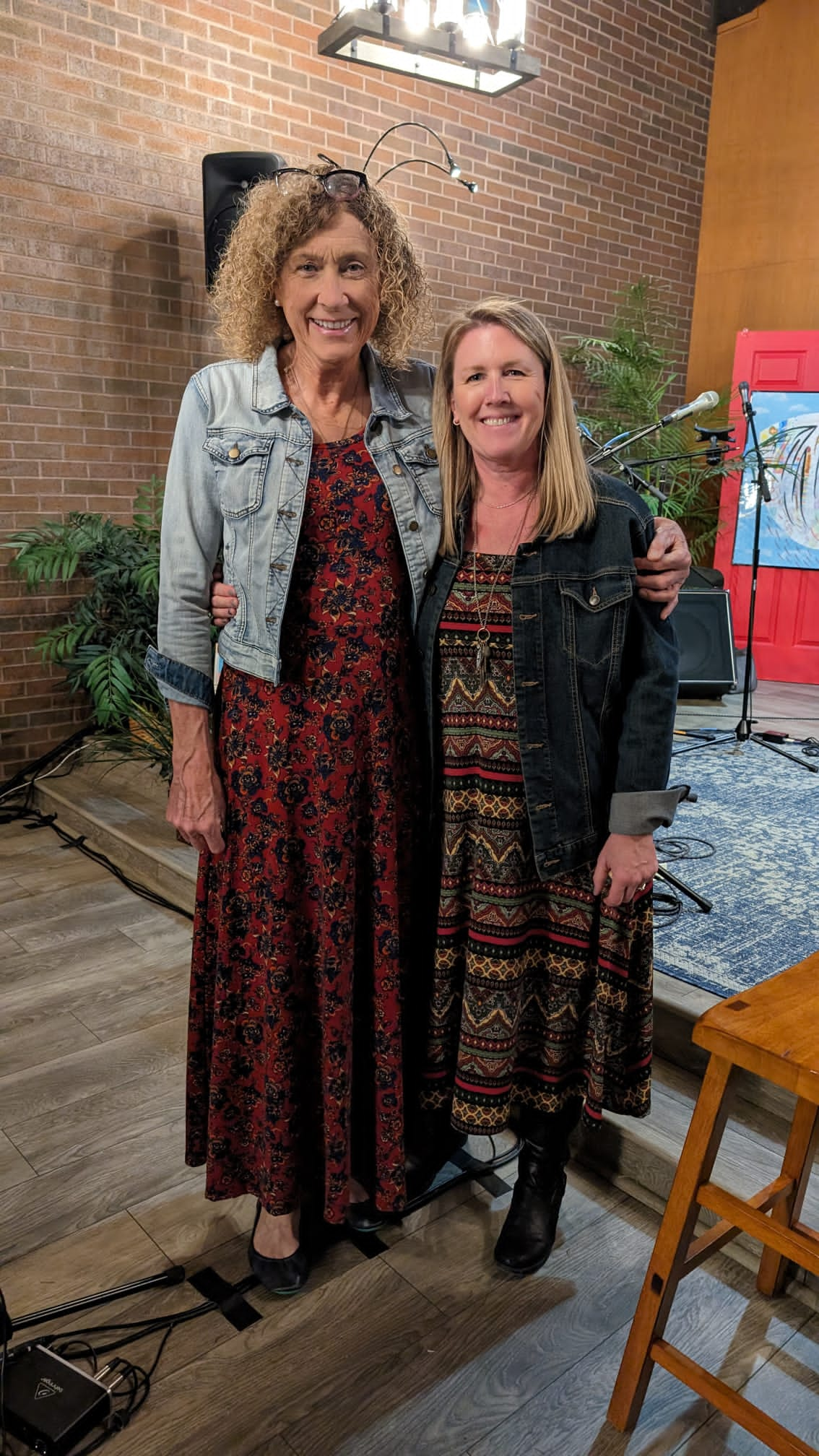
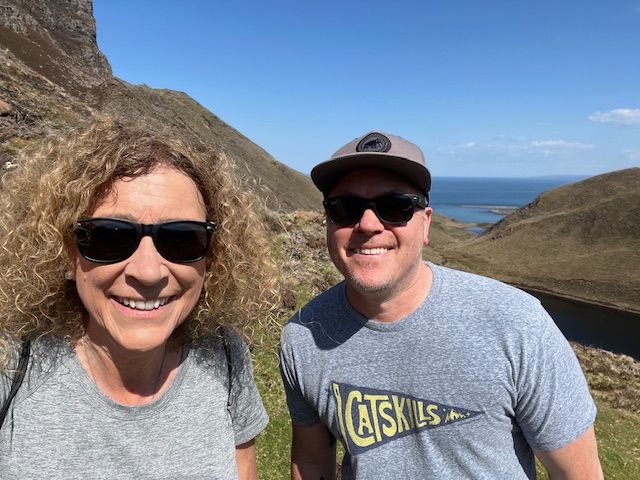
About a year ago my co-pastor and her wife traveled to Scotland at the same time I was in Hawaii. I love Hawaii and all, but their pictures of Scotland spoke to me in ways I could not explain. Right then and there, looking across the coast of Maui, I began planning a trip to Scotland. Jonathan and I would fly into Inverness, drive to the Isle of Skye, then return to hike the Highlands around Loch Ness (and no, we did not see her.)

I just got home from one of the best trips I have ever taken. Jonathan and I were at the TED Summit in Edinburgh in the summer of 2019, a truly epic time of great stimulation. This trip was equally wonderful. Skye was magical. I am one-quarter Scottish (and 99 percent British Isles) and between 1715 and 1760 the harbor at Portree was the last place many last stood on Scottish soil before coming to the American Colonies. That first mass wave of immigrants was about the time many of my ancestors arrived. To be back on that land, carrying the DNA of those determined souls, was a reminder of just how attached we are to those who came before, and those who will come long after we have departed.

I felt like I was home again. I cannot explain the feeling, other than to acknowledge what is already known, that ancient DNA lives within each of us, waiting to be awakened by the sights and smells of home.

Maybe it was being there with my son – our first hiking trip in a couple of decades. We hiked six of the seven days we were in Scotland. We took time off to visit three castles and two distilleries, as well as wander the streets of Inverness.

I always wanted to take an epic trip with each of my three children, but after I transitioned, I questioned if it ever would happen. When Kristie and Mara graced social media with their pictures from Scotland, I knew it was time for the trip with my son that I had always envisioned. Years ago, when he was visiting a friend in Northern Ireland, Jonathan traveled to the Isle of Skye and called me from the top of a mountain. This was before cell phones could take pictures, and he described the most beautiful view he was taking in. Right then I knew that someday he would return, and I would be with him.

Life today is lived from one busy, complicated moment to the next, virtually nonstop. This trip was a chance to put life in the context of an ancient culture that represents most of my DNA, and take in the truth that in our brief time on this planet, we change it irrevocably.

The was a wonderful trip, everything I hoped it would be. Life is good, and if we are patient and persistent, it is also redemptive.

And so it goes.

Religious and the Hemispheres of the Brain

This week we move to part four, the final post on maintaining balance. I’ve written about the differences between left and right brain functioning, including differences between the sexes. Today we look at how this has played out in the Christian religion.

For 1500 years Christianity was fairly balanced between right brain and left, though you could make an argument there was a heavier emphasis on the right hemisphere. That makes sense, since our species from its inception has been more right brain than left. The focus was on the numinous, the experience of God more than knowledge about God.

In the modern age, the age of science, that changed. The church could not wait to adopt the ways of Descartes, Newton, Bacon and other thought leaders to become scientifically respectable. Christianity moved from being focused on a holistic experience of life, to a religion that broke everything into its tiniest parts for analysis and interpretation. The Bible went from a narrative to a supposedly scientifically accurate book of facts, rules and regulations. Up to this time, the notion that the Bible might be without error in its original manuscripts (inerrancy) was not a subject of concern.

In the modern age Christianity became a system of beliefs instead of a story to be experienced. In evangelicalism, the charismatic movement of the 70s and 80s tried to counter the tide, but it had its own problems. Movements born of swinging pendulums rarely succeed. They just swing to the other extreme.

This paradigm shift took Christianity from an embodied religion to one that favored mind over body. An incarnational religion became a disembodied religion. A medium that specializes in disembodied images (computer, television, and smartphone screens) became preferable to a room full of embodied people. Does anybody else see this as a problem for what is, at its core, an incarnational religion?

When Christianity sold its soul to the modern age, it not only abandoned its roots, it rejected its role as an essential part of the nature of humans – our need for that which is numinous, ineffable, mysterious, awe inspiring, and wonder producing.

Should we be surprised that after a century in which 70 percent of Americans identified with a local religious body (emphasis on body), in just 22 short years – 1999 to 2021, that dropped to 47 percent? I mean seriously, why bother?

The right brain has always been more interested in the meaning of life, not the particulars of life. Whether Stonehenge, the carved bodies of Rapa Nui, or the burial mounds of indigenous Americans, the role of religion has always been to join people together to make meaning of life and experience life in community.

Quantum physics brought an end to the modern age. When it is understood that the ultimate building blocks of the universe are not made of matter, but of a pattern of relationships between nonmaterial entities, the modern age and its notion of scientific certainty was no longer able to maintain its stranglehold on the Western world. You know, Heisenberg’s Uncertainty Principle, Chaos Theory, and the like. When the only ultimate reality is relationships, is it much of a stretch to say the greatest power in the universe is love? Yeah, that doesn’t sound all that compatible with the modern age and its notions of scientific certainty.

I have hope that postmodernism will be more compatible with religion than the modern age was, that it will be more right-brain oriented than the modern age.

This difference between right and left brain functioning also has its impact on how we express and value the six core human emotions. That is where we next turn our attention.

The Six Core Emotions in the Modern Age

American psychologist Paul Ekman identified six core human emotions. We call them core emotions because they bring about a physiological response that can be measured. Those responses include a dry mouth, hair standing up on the back of the neck, goosebumps, rapid pulse, and sweaty palms, among others. The core emotions that elicit these responses are happiness, sadness, anger, fear, surprise, and disgust.

These six core emotions exist in the ether and come to us whether we want them to or not. They arrive with their bags and demand entry, and we have little we can do except allow them through the door and show them the guest room. We can let them know when they have overstayed their welcome, but whether or not we grant them entry is not an option. They arrive courtesy of the midbrain, the amygdala and hippocampus.

We also have feelings that develop in response to the six core emotions. Those feelings, numbering in the scores, are highly personal and arrive courtesy of our own personal experience.

The core emotions arrive via the right hemisphere of the brain, the hemisphere that focuses on experience. From there they are transferred to the left hemisphere, which tries to make rational sense of these core emotions. Normally, they are then passed back to the right brain where they can be placed in context. The right brain has the capacity to hold complex and competing concepts at the same time without rushing to premature conclusions.

During the 500 years of the modern age, the left brain was more respected than the right, though the right has always been the primary hemisphere of our species and the left its emissary. That means these core emotions end up not being placed in holistic context.

Let’s consider just two of the core emotions, anger and fear. If both remain in the left brain and are not placed in context, would it be possible for these emotions to be attached to purely external stimuli subject to the rational machinations of the left brain? Suppose you are a part of a society that says the greatest threat to our well-being is the transgender population, might you be inclined to attach your fear and anger to those external stimuli, as opposed to integrating them into your own narrative?

Eighty-seven percent of evangelicals believe gender is immutably determined at birth, and 67 percent believe we already give too many civil rights to transgender people. Interestingly, only 31percent actually know someone who is out as a transgender person. That means their knowledge about trans people is likely left brain and rational, based on their trusted sources of information.

That is one of the reasons I do my best to get in front of evangelicals whenever possible. If they actually see and listen to a transgender person, they have little choice but to allow their right brain to enter the equation and place that “rational” information in the context of an actual human. When that happens, I find fear and anger dissipate quickly. Proximity and narrative can cause the brain to move information from the rational information-based left hemisphere to the experiential holistic right hemisphere.

This is one of the reasons debates do little to change the narrative. Debates keep us in the left hemisphere of the brain. Human interaction and narrative bring us to the more context-oriented right brain.

In The Righteous Mind, Jonathan Haidt says people do change their minds, but not unless information comes to them in a non-threatening way. It took America 150 years to begin to deal with slavery. On the other hand, in little more than fifty years we moved from being a homophobic society to marriage equality becoming the law of the land. How did that happen so quickly?

I would suggest it happened because information came to individuals via the right brain in a very non-threatening way, through stories told via television comedies people watched in their homes. It began with Norman Lear’s All in the Family, which introduced the subject. From there we went to the scripted Ellen show, in which the protagonist was a woman who came out as a lesbian. Next was Will and Grace, a comedy in which the showrunners wanted to focus on will and grace, hence the names they gave the main characters. After that, we moved to Modern Family, in which one of the three main story lines was about a gay family.

And today? Today there are plenty of characters on television comedies who are gay people, but they are incidentally gay. The narrative has shifted. Outside of the evangelical world, most people are supportive of gay rights. Over half of Millennial and GenZ evangelicals are supportive of marriage equality. The tide has shifted, in part because information arrived in a non-threatening way, through narrative comedy that appealed to both hemispheres of the brain.

Every time we have a 500-year paradigm shift, movement happens in fits and starts, with those opposed to change fighting mightily to keep the status quo. Postmodernism is here. Evangelical Christians cannot stop it, but that does not mean they will give up the fight in the near future. They do seem to be softening on gay issues, while taking more strident positions on transgender issues. Eventually they will also give up that battle, though I will be surprised if it happens soon.

In the meantime, I will continue to say what I’ve said since my first TED Talk in 2017, “The call toward authenticity is sacred, and holy, and for the greater good.”

And so it goes.

Rational Consistency or Mystery?

This is the third of a four part series on how the modern age changed the way we receive and process information. Today, we look at differences between how the right and left hemispheres of the brain affect our perspectives, and whether or not any part of that process is related to gender.

During the modern age, left brain functioning was more respected and rewarded than right brain functioning. René Descartes, one of the most influential voices in the development of the modern age, saw the rational mind as the apex of human development. Francis Bacon thought the rational mind could set us free from the need for God. Isaac Newton saw a rational God who created the world as a machine that could be taken apart and put back together again. Scottish philosopher John Locke, a leading voice of the Enlightenment, guided the thinking of many a 19th century theologian as they turned the Bible from a historical narrative into a rational collection of rules and regulations.

Even today, as the modern age fades and postmodernism gains influence, we still see the triumph of the left brain throughout society, including elevating the scions of Silicon Valley, like Elon Musk and Bill Gates, over the theologians, philosophers, and artists who would have been held on a pedestal in a previous age.

One of the most obvious ways in which the modern age and its left brain focus still triumphs is in the amount of attention public education places on math and science at the expense of art, music, and social studies. Public education continues to be a left-brain dominated field.

Unless your folks raised you in a left-leaning commune on the coast of California, you were most likely raised in a world that valued the left brain over the right, which caused you to see information in parts rather than wholes. It caused you to prefer literal meaning over metaphor, objective truth over inter-subjective exploration, fact over feeling, analysis of isolated parts over integration into holistic contexts, scientific explanations over awe, certainty over mystery. What you know is far more important than what you experience. I could go on. Okay, I will…

Your education focused on the subjugation of nature over the otherness of nature; the rational consistency of God over the mystery of God; the logical judgment of God over the irrational love of God; didactic teaching over narrative (which is the opposite of the teaching style of Jesus.) Your world focused on the emissary left hemisphere over the primary right hemisphere; the later developing left hemisphere over the early developing right hemisphere; Freud over Jung. Okay, I’ve probably lost everyone except the psychodynamic therapists with that last one.

While there are unquestionably differences between how the two hemispheres of the brain function, what about differences in the way male and female brains function? We know there are physiological differences between male and female brains, but what about brain functioning?

In Nature Reviews Neuroscience an article titled, Why Sex Matters for Neuroscience, an article was published on May 10, 2006 showing significant differences between male and female functioning brains. Larry Cahill noted that the unstated assumption has been that male and female brains are identical except for fluctuating sex hormone influences and a larger hippocampus in women than in men. He noted those differences are far more significant than previously thought, including showing that the left amygdala was more involved in memory of emotional material for women, particularly visual images, while the right amygdala was more active in memory for men.

An article by Alga Khazan in The Atlantic on December 20, 2013, Male and Female Brains Really Are Built Differently, referred to a study by Ragini Verma and others at the University of Pennsylvania involving 949 people ages 8 to 22. The male brains had more connections within each hemisphere while female brains had more interconnections between hemispheres. The brain’s fiber pathways, bundles of axons that act as highways routing information from one part of the brain to the other, ran back and forth within hemispheres for men, while in women they tended to zig-zag between left and right.

The article also quoted a study in November of 2013 at the University of Glasgow which found women have an edge when it comes to switching between tasks rapidly based on functioning between hemispheres. Another showed the hemispheres of women’s brains are more functionally interconnected when at rest than men’s.

A study published in April of 2012 by Dardo Tomasi and Nora D Volkow in Human Brain Mapping showed significant differences in the functional organization of the brain in 336 women and 225 men.

While all of these studies indicated differences between the sexes in brain functioning, a study reaching a widely different conclusion was  published by Rosalind Franklin University of Medicine and Science on March 29, 2021. It showed only about a one percent difference between the sexes in how brains function within and between hemispheres.

Regarding differences between the sexes in brain functioning, it is wise to heed the words of Anke Ehrhardt, a psychiatry professor at Columbia, who said in the 2013 Atlantic article, “Acknowledging brain effects by gender does not mean these are immutable, permanent determinants of behavior, but rather they may play a part within a multitude of factors and certainly can be shaped by social and environmental influences.”

Next week we end this four-part series by looking at how religion has been shaped by left brain/right brain thinking.

Experiences and Knows

This post is a continuation of last week’s post on gender. This week we will explore the ways in which men and women lead. While we do not know exactly how much of that difference is biological and how much is socialization, we do know the differences are significant.

During the first phase of the coronavirus pandemic, six countries did extremely well responding to the crisis – Norway, Finland, Germany, Iceland, Taiwan, and New Zealand. All six had a female head of state. They all worked collaboratively with their health departments, seeing them as co-workers, not subordinates. They were willing to compromise, without ego need getting in the way of good decisions. They were also willing to admit when they were wrong. Jacinda Ardern was particularly adept at that, quickly switching directions when necessary.

Compare those nations to three countries that did spectacularly poorly in the early phase of the pandemic – Brazil, the United States, and England. All three had heads of state at the time who did not work collaboratively, did not compromise, and could not admit they had been wrong. To make broad generalizations from nine examples is a stretch. Nevertheless, by most measures women are better leaders than men.

Women show more empathy than men. Women are more decisive than men, taking energy from action.  They work more hours and are better at multi-tasking[1], while taking fewer unnecessary risks.[2] Women complain less often than men, because they are more accustomed to deferring to others. Women are better at embracing nuance, because they tend to have a higher emotional intelligence.[3]

Women comprise more easily than men. Women are more open to being corrected when they are wrong than men. They have more humility. Women are more resilient than men, and are more communicative than men. They are also more collaborative[4] and inclusive than men.

How much of that difference in leadership is socially determined, and how much is a matter of inherently biological differences between male and female brain functioning, particularly as it relates to the two hemispheres of the human brain?

There are three parts to the human brain. The brain stem (reptilian brain) takes care of bodily functions, including breathing. The midbrain, also known as the limbic system, includes the amygdala and hippocampus. When we are in crisis, the limbic system decides whether fight, flight, or freeze are the appropriate response. These decisions are made in a split second by the amygdala, and the hippocampus responds by recording the circumstances.

If the amygdala has decided upon fight or flight, the hippocampus goes into heightened memory mode. If the amygdala decides the danger is too great for fight or flight, the body goes into freeze mode and the hippocampus erases conscious memory so the brain does not have to experience the trauma. Unfortunately, the trauma does not leave by some hidden portal. It moves from the brain into the body. The body remembers the trauma. This keeps therapists in business.

The prefrontal cortex is the thinking part of the brain. When a significant threat occurs, the cerebral cortex is overpowered by the midbrain. Under normal circumstances the prefrontal cortex is constantly processing every stimulus, both internal and external.

The brain is also divided into two hemispheres, the right and left. People often say the right hemisphere is where images are stored and the left is where words are stored. The truth is that both hemispheres trade in words and images. It is how the two hemispheres process those words and images that is markedly different.

The human right brain develops earlier than the left, and therefore has a kind of primacy in our development as a species. The right brain is online in early childhood and much of the work done in depth psychology is focused on those early right brain experiences. As I say to my clients, “We focus on the past for the same reason a bank robber focuses on banks. That’s where the money is.”

Iain McGilchrist a psychiatrist, writer, and former Oxford literary scholar, says the right hemisphere is the primary hemisphere and the left hemisphere is its emissary. The right hemisphere, more connected to the brain stem and the limbic system, sees things in wholes rather than in parts. It sees things in context, in relationship to other things.

The right brain is more integrative, searching for patterns. Its take on the world is based on complex pattern recognition. The right brain has a greater capacity than the left to hold several ambiguous possibilities at the same time without prematurely choosing a particular outcome or interpretation.[5] It prefers metaphor over literal meaning.[6] It understands the world based on empathy, inter-subjectivity, and metaphor.[7]

The right brain is where EQ resides, and is more concerned with meaning as a whole, in context.[8] Metaphor, irony, humor, and poetry are all the realm of the right brain. Awe, mystery, otherness and paradox are also right brain phenomena. The right hemisphere is deeply connected to the self as embodied. It is where the child’s early sense of identity is determined through interaction with the mother’s face.

The right brain is primarily concerned with what it experiences. The left brain is primarily concerned with what it knows. The right brain is more focused on feelings, while the left brain is more interested in turning those feelings into thoughts.[9]

The left brain removes information from context and analyzes the information in bits, assigning words to the bits and organizing them into categories. McGilchrist calls it the hemisphere of abstraction.[10]The left brain allows us to control, manipulate, and use the world. It breaks wholeness into parts for categorization, creating a hierarchically organized world.

The right brain processes information first, then sends it to the left brain for analysis and organization into categories and thoughts. A healthy person is then able to return that processed information to the right brain, where wholeness is created from what both hemispheres have processed. Wholeness occurs when we achieve balance between the hemispheres.

Is it possible that men have a greater tendency to function within hemispheres, while women have an easier time crossing between hemispheres? Is it easier for women to move information from the analytical left brain back to the holistic right brain, or are men equally capable of placing information in context? We will take a look at that next week.

[1] Kay and Shipman, The Confidence Code – Harper Collins, 2014

[2] Quarterly Journal of Economics 116 No. 1 February, 2001

[3] Journal of Applied Psychology 95 No. 1 January 2010

[4] Facebook symposium on diversity

http://managingbias.fb.com

[5] McGilchrist, Ian. The Master and his Emissary:  The Divided Brain and the Making of the Western World, New Haven, Connecticut, University Press, 2009, page 49.

[6] ibid, 82.

[7] ibid, 51.

[8] ibid, 70.

[9] ibid, 48.

[10] ibid, 50.

Do The Gender Wars Matter?

J.K. Rowling has again spoken out against transgender women, taking an extreme binary position on gender. She, comedian Dave Chapelle, and other anti-trans activists fight against all transgender rights, especially the extreme position that gender is a social construct, a perspective born of the work of French postmodern philosopher Michel Foucault and more recently American philosopher Judith Butler.

I believe the truth, as is so often the case, is in the radical middle. I call it radical because our human tendency is to go from one extreme to the other. I believe the manner in which we are socialized greatly affects our expression of gender. In the ten years I have lived as Paula, I have lost a lot of confidence, because the world does not encourage women in the same way it supports men. It does not empower women as much as men. There is a reason women are always apologizing for themselves. It is expected of them.

At the same time, so much of gender is, in fact, biologically determined. Only women can give birth. Men’s bodies are more powerful than women’s, and there are significantly different ways in which our gendered bodies respond to a myriad of human experiences and stimuli.

If a person has one of the many conditions that are collectively referred to as intersex, there are bodily ways in which that individual has physical characteristics of both sexes. If the sexual differences are primarily in the brain, as is true with the majority of transgender people, it is more difficult to know how to approach the physical bodies that have developed. I tried for decades to live responsibly and peacefully in my male body. My brain, however, had other ideas.

The way in which my brain responded to the departure of testosterone and the arrival of estrogen, and the changes that brought to my body, is all the proof I needed to know I am transgender. A cisgender male would be greatly distraught to have his body begin to appear female, or to lose the effects of testosterone. In my case, it felt like my brain had been screaming for a lifetime to feel the effects of estrogen and the absence of testosterone. It is as if my brain said, “Finally, this is the way things are supposed to be. I told you the body you had did not match what I knew myself to be.”

I do not know the cause of gender dysphoria. There are indications it happens in the second trimester of pregnancy when the developing brain does not make a complete connection to the body that is being created. The truth is that we do not know the exact cause of this brain disconnect. We do know it has a powerfully negative effect on the individual. Transgender people have a 41 percent suicide attempt rate, six times higher than any other condition in the DSMV. I do not have to understand causation to understand the mental distress of being transgender.

What I know to be true is that I personally feel like I come from the borderlands, the liminal space between genders. I also know I am much happier being seen by the world as a woman than I was being received by the world as a man. I am much more at peace in this body, living in this gender.

While I do not personally need to know any more about the causation of my gender dysphoria, I am interested in what the current studies are telling us about the differences between male and female brain function, particularly as it relates to how information is processed in the hemispheres of the brain.

A study, Structural Connectivity Networks of Transgender People, was published in the journal Cerebral Cortex (October 25, 2015) compared the brain functioning of 93 people, 23 of whom were male to female transgender individuals and 21who were female to male. The study compared the transgender people with a group of 25 cisgender males and 25 cisgender females. The 44 transgender people were studied prior to hormonal treatment. Using fMRI ,the study determined that the brains of transgender people function about halfway between male and female. Post hormonal treatment, transgender women’s brain functioned more closely to cisgender women. The same is true for trans men; after hormonal treatment they functioned more like cisgender men. I resonate with those findings.

Gender is a spectrum, and everyone has more masculine and feminine qualities in specific areas of their lives. For example, the human voice typically functions between 80 hertz and 255 hertz. Women’s voices usually register between 165 hz and 255 hz, while men’s voices register between 80 hz and 180 hz. As you can see, between 165 hz and 180 hz a voice can be either male or female. We decide which it is based on visual and verbal clues. How are words pronounced? Where in the body are they formed, the chest or the throat? What gender does the person appear to be? The process is not nearly as easy as we think. People of both genders are often misgendered on the telephone.

All of that to say that gender is fluid. Nevertheless, there are characteristics that are more common among those with XY chromosomes than those with XX chromosomes. Women are more likely to fire neurons across the two halves of the brain than men. Men’s brains tend to function within hemispheres, but have a more difficult time crossing between hemispheres. Women’s neuron activity looks more like a ball of yarn across the hemispheres of the brain, while men’s activity is more linear, within hemispheres.

This difference in brain functioning accounts for how differently men and women tend to lead. In  my next post, I will talk about those differences.

Where Did They Get All That Passion?

Is the right more passionate about the positions they hold than the left? In his book, The Righteous Mind, Jonathan Haidt identified six moral passions of our species. His perspective might provide an answer to my question. The six moral passions he describes are, Care versus Harm, Fairness versus Cheating, Liberty versus Oppression, Loyalty versus Betrayal, Authority versus Subversion, and Sanctity versus Degradation

The first moral passion is care versus harm. When we see a child being mistreated, we all experience moral revulsion and are driven to intervene. We want to see children being cared for, not harmed. That is the strongest moral passion for most people.

The second is fairness versus unfairness. We all know life is unfair, but nevertheless, it bothers us. In the United States women earn 84 cents on the dollar of what men earn.. African-American women earn 67 cents on the dollar, Native American women 64 cents on the dollar, and Hispanic-American women 57 cents on the dollar. That is not fair, and we want to bring about change.

The third moral passion is freedom versus oppression. The desire to be free birthed the US as a nation. The fight against oppression continues today, as people of color, the LGBTQ+ population, and others fight for the right to be free from oppression.

All three of these moral passions are held by all Americans in fairly equal measure. But while we all want care versus harm, fairness versus unfairness, and freedom versus oppression, how we define care, fairness, and freedom and for whom differs greatly from one group to another.

The remaining three moral passions are more often held by the right than the left. The fourth is loyalty versus betrayal. To understand this passion, we need to shift for a moment from moral passions to moral standards. While there are six moral passions, there are three moral standards for our species.

The first and oldest moral standard is that there is no greater moral good than to protect the integrity of the tribe. The second, common to all forms of religious fundamentalism, is that there is no greater moral good than to obey the teachings of the gods. Those on the right often hold to one or both of those moral standards.

Those who lean politically left hold to the third moral standard, that there is no greater moral good than to protect the freedom of the individual. This is the youngest of the three, though it is the most common standard in Europe and the secular US. It is in the very core of the US Constitution and Declaration of Independence: We hold these truths to be self-evident, that all men are created equal,, that we are endowed by our creator with certain inalienable rights.

Those who hold to this third moral standard, that there is no greater good than to protect the freedom of the individual, speak often of a person living their truth, which is an indication that we believe, all things being equal, that the locus of control should be within the individual..

If you hold one of the first two moral standards, then the moral passion of loyalty versus betrayal is in the warp and woof of your moral standard. Loyalty to the tribe and/or the gods is paramount.

If your moral standard is the freedom of the individual, then you are more likely to accept the likelihood that individuals will change their loyalties as they grow and develop. A switched loyalty may have nothing to do with betrayal. It may be moving from one stage of faith to the next, or one hierarchy of need to the next. It’s nothing personal, just an outcome of personal growth.

A fifth moral passion is similar to the fourth. It is authority versus subversion. Growing up as an evangelical Christian, my insatiable curiosity was not seen as a positive trait. The Bill and Gloria Gaither tune, “God said it, I believe it, and that settles it for me” was the mantra of college and seminary classmates and professors.

If you hold to the third moral standard, that there is no greater good than to protect the freedom of the individual, then subversion is a way of life. Disrupting systems is in your DNA. Calling out injustice is imperative.

For those on the right, questioning authority is anathema. You decide which tribe is yours, which god is yours, and you unquestionably follow them.

Derek Flood in his book Disarming Scripture says that in the Judeo-Christian tradition there were always two different kinds of religious followers. One group was unquestionably obedient and comfortable letting someone else do their thinking for them. The other group could be called faithful questioners, understanding there is a trajectory to religion that will bring about changes in understanding and practice over time, based on the growth and development of the species over time. It is interesting to note that when he quoted Hebrew scripture texts, Jesus quoted the faithful questioners, not those who were unquestionably obedient.

The current cultural wars have been initiated by those who are unquestionably obedient.  They are not interested in the conclusions of science or common human understanding. They are not open to questioning, because that would be subverting authority.

The sixth moral passion, also the realm of the religious right, is sanctity versus degradation. This is the logical outcome of viewing scripture as sacrosanct and set in stone. Any adjustment of views is not due to accumulated knowledge leading to new conclusions. It is degrading the perfection of the original.

This view of scripture did not come into being until the Modern age arrived with the Renaissance and carried through the Enlightenment. After 1500 years of Western civilization’s focus being on God, the focus shifted to science. As science became more respected and religion less respected, religious leaders sought respectability according to the scientific method popularized during the Modern age. Scripture went from being seen as a narrative history of God’s people to being seen as a book of facts, rules, and regulations.

This led to woefully inadequate attempts to prove the world was created in seven twenty-four hour days, that the earth is six thousand years old, and that every species was saved on Noah’s Ark. It also led to the very unfortunate doctrine of inerrancy, the belief that the original copies of scripture were without error in every jot and tittle. Never mind that we don’t have the original copies of scripture. The closest we have are fragments of copies of copies. Nevertheless, the Southern Baptist Convention purged its seminaries of “liberals” who did not believe in inerrancy.

The truth is that scripture never claimed to be inerrant. The notion of inerrancy hadn’t been invented yet. It was a Modern age adaptation of the wrongly understood scientific method  toward a Christian end. To accept anything other than the conviction that the original copies of the Bible were without error was a degradation of the Christian message.

Unfortunately, what that entire Modern age Christian agenda accomplished was not to make Christianity respectable. It was to take the focus off of Jesus and place it on the inerrant Bible. We moved from worshipping Jesus to worshipping the Bible, from Christology to bibliolatry.

These last three moral passions do help us understand why the religious right is more dedicated to their platform and ideology than the religious left. One group works from all six moral passions, while the other only works from the first three.

What is the solution to this dilemma. Yeah, I’m not sure. I keep waiting for Jonathan Haidt to write a new book that lays out a path forward for the left, but so far that hasn’t happened, though his book, The Coddling of the American Mind did give us a starting point. His newest book, focused on the damage smartphones are doing to our young people, looks promising, but not within this realm.

If you know if someone addressing this issue, let me know. I’d be happy to bring that information to all of you.

Those Pesky Assumptions

I was in a situation recently in which people chastised a group of us for making a decision we had not, in fact, made. Some were soft-spoken and thoughtful. Others were angry and accusatory. Most had already reached a conclusion not supported by all of the facts. Decisions were made on partial information, taken out of context.

When partial information is taken out of context, you can assume almost anything. If I told you I was freezing as I write this, you might accurately assume I am not actually freezing, I’m just cold. That would be correct. You might also assume it must be a very cold day. That is not correct. It’s a relatively warm late winter day, but when I got dressed this morning I somehow thought it was much warmer than it is, and I’ve not yet gone to get a sweater. I am cold, but not cold enough to go get the sweater. As I write this, it occurs to me that I am, in fact, cold enough to get that sweater. Hang on a minute.

Okay, now I’m back and much warmer. The sweater is crew neck, blue and white horizontal stripes. I got it at PacSun when I was in Soho with my granddaughters last winter. Now where was I? Oh yeah.

In my counseling practice, I often recommend the little book, The Four Agreements. One of the agreements is, Do Not Make Assumptions. The human mind is inclined to make assumptions, particularly in a left-brain oriented world. For eons, our species received information in the right brain, sent it to the left brain for analysis, and then returned it to the right brain to place the information in context. That works quite well. Unfortunately, since the modern age arrived about 500 years ago, we have been fixated with the left brain. From Descartes to John Locke to the present day, the left hemisphere of the brain has been valued over the more wholistic right brain.

The problem is that purely left brain thinking leads to premature conclusions not placed in context. The right hemisphere is able to hold competing ideas without jumping to premature conclusions. The left is not.

All of this gets worse when there is no arbiter of truth trusted by the majority of people. As an analogy in a recent article in The Atlantic states, once we no longer trust metallurgists or jewelers or any other group of experts that can tell us if that ring on our finger is truly made of gold, we begin to question whether or not real gold even exists. Is everything fake gold? Is the social media influencer who writes about gold the person I want to trust on the matter, even if he is a college dropout who has never read a book on metallurgy?

You see the problem. I do not know where the folks in the meeting got their information, but I have a hunch it was not by contacting those who actually had the information necessary to draw a fact-based conclusion. As one who was in a position to have that information, I find it interesting that no one bothered to come to me before drawing their conclusions.

It is easy to point fingers, but I have been guilty of the same behavior. I recently had a delightful conversation with a person with whom I disagree about many things. It was interesting how subtly my perspective changed when I moved from viewing him as a right wing “other” to a person with whom I have a lot in common.

Maybe it’s a good time to remind myself of the Four Agreements. First, use impeccable words. Second, do not take it personally. Third, do not make assumptions. Fourth, do your best.

I always say the truth will set you free, but it will make you miserable first. Maybe I should add another sentence to that. The truth will set you free, but you have to do the work to discern it first. The truth matters, and it always will.

And so it goes.

Outflanked on the Left

Last month I wrote about Yascha Mounk’s book, The Identity Trap. He writes about the origins and problem of standpoint theory, cultural appropriation, limits on free speech, progressive separatism and identity sensitive public policy.

Given the current political environment, with anti-woke attacks from the right and cancel culture from the left, Mounk was pretty brave to tiptoe into these controversial waters. As a professor at Johns Hopkins and a Contributing Editor at The Atlantic, Mounk comes from a supportive environment. Nevertheless, I have no doubt he will be attacked from both the right and the left.

My longtime friend David and I have a phrase we have been using for years – The Radical Middle. Mounk speaks from the radical middle. The radical middle is radical because it is a hard position to hold. Humans have a tendency to think in binary categories. You are either with me or against me. And if you are in the middle, well then, you are against me.

I have been receiving attacks from the far right for a decade. There are over 13,000 comments on my first TED Talk. I’ve never looked at any of them. I’m told it’s not a pretty sight. Over the last year, for the first time, I have been attacked from the left. All of it has come from one stance I have taken.

If from a very early age a child has consistently and persistently claimed to be the gender not on their birth certificate, I believe it is all right to consider medical intervention for that child as soon as they reach puberty. These adolescents are transgender, and every indication is that they will always identify as such.

On the other hand, studies done in Europe and elsewhere are consistently showing that adolescents who first identify as transgender or nonbinary during their teen years are often no longer identifying that way when they are older. The majority of these individuals were identified female at birth. According to the 2022 US Transgender Survey, those identified female at birth are almost four times as likely to identify as nonbinary as those identified male at birth. All of these studies lead me to the same conclusion.

The World Professional Association of Transgender Health (WPATH) Standards of Care previously said no medical treatment should begin before age 16. Their new standards have removed any specific age, but state that no medical treatment should be started before natal puberty has begun, and in all cases, comprehensive multidisciplinary evaluation must be completed before treatment begins. I believe that evaluation should be informed by the latest peer reviewed studies regarding the medical treatment of transgender adolescents.

I have always been cautious in what I do and do not say on this subject, not only because it is controversial, but because not enough research has been done to draw ironclad conclusions. However, I have not been cautious enough.

I will no longer publicly comment on the issue. I am accustomed to being attacked from the right. I am not accustomed to being attacked from the left. Being attacked from either direction for sharing legitimate concerns is troubling.

Cancel culture says if you are not with us in every jot and tittle, you are not with us at all. I am a transgender woman, but if I do not agree with the currently popular positions regarding transgender medical treatment in every way, then I must be cancelled, no opportunity for rebuttal or continuing discourse. That is similar to what I have experienced from the far right, where attacks do not come with an opportunity for response or rebuttal. Whether from the right or the left, these attacks accumulate, and I no longer have the energy to fight back. I am weary.

It is not easy being transgender and Christian. It is even harder when you are prepared for a frontal attack, and receive one from the flank.

And so it goes.

Legitimate Suffering – Sounds Fun!

Carl Jung said the foundation of all mental illness is the unwillingness to experience legitimate suffering.

Jungian analyst James Hollis writes about what he calls existential guilt. He says, “The ironic consciousness can see the flawed choices, can understand their consequences, but this knowledge is neither redemptive nor avoidable. Such a person is always left with a troubled consciousness, but at least, as Jung pointed out, he or she is thereby less like to contribute to the burdens of society.”

What he calls existential guilt, I call abiding shadows, those parts of ourselves that got us in trouble at 18, again at 38 and 58, and will probably still be getting us in trouble at 88. Try as we might, we just can’t rid ourselves of these tendencies. They are often the shadows sides of our strengths. One of mine is a tendency to speak when it would have been better to keep my mouth shut. I have a plaque that reads, “It’s all right to have an unexpressed thought.” I keep it in a prominent place because I need to keep it in a prominent place.

Hollis writes, “Perhaps this existential guilt is the most difficult to bear. To know oneself responsible, not only for the things done, but the many undone, may broaden one’s humanity but it also deepens the pain.”

His words remind me of a stanza I have committed to memory from William Butler Yeats’ poem, Vacillation:

Though summer sunlight gild cloudy leafage of the sky

Or wintry moonlight sink the field in storm-scattered intricacy

I cannot look thereon, responsibility so weighs me down

Things said or done long years ago or things I did not do or say

But thought that I might say or do weigh me down

And not a day but something is recalled

My conscience or my vanity appalled

In the previous stanza he talked about the great sense of wonder experienced after he turned 50, that he was blessed and could bless. He kept both parts of himself in close proximity in the poem, I suppose because they are in close proximity in real life.

In her book, Own Your Self, Dr. Kelly Brogan writes about how modern medicine rushes to treat people struggling through depression by prescribing SSRIs and other medications. Anti-depressants have been very helpful to me over the years. In my opinion, the problem is not their use. It is that we rush to use them, and even more problematic, we use them to avoid doing the work to which depression calls us.

Most of my clients who experience depression are working through legitimate existential issues that are depressing. Ultimately, a good bit of life is working through such issues. Brogan writes supportively of the work of Carl Jung and depth psychotherapists who focus on working through problems, not medicating them into submission.

A couple of years ago, for about six months, I went through a period of great struggle. There were decisions I had made born of my own abiding shadows. As I worked through my issues, friends and family were concerned. “You’re not okay,” they said. I did not disagree. I was not okay.

I preached about it more than I should have, but that period of struggle was absolutely necessary for my personal growth. I remember saying to Cathy, “I must be fundamentally different as Paula than I was as Paul. I never had to deal with these kinds of personal issues before.” She said, “Actually, you’ve always been this way. As a man, you just got a free pass, that’s all. Now people are calling you on your shit.” That was a sobering revelation. Powerful white men get a free pass. Women do not.

Did I like going through that period? Of course not, it was awful. I lost 15 pounds and wore out my welcome with my closest friends. Was it necessary? Absolutely. Well, if I want to keep growing it was necessary.

Too often people are delivered by fate, or the gods, or their prayers into the desert, but retreat as soon as they arrive. I see people do this in therapy all the time. The second we get close to the real issues, they bolt for the door, occasionally literally.

The only way through the desert is through the desert, and the wisdom gained in that dry land is essential for the accumulation of wisdom. Great successes make you a little wiser. Great failures are the birthplace of greater wisdom, but only if you abide in those failure, until your ego is broken and your soul can rise. Those experiences do not destroy your sense of self. They hone your sense of self.

None of us can go through the dark night without honest, steadfast companions and spiritual guides. Those folks  have been there and know that while religion is for those afraid of hell, spirituality is for those who have already been there.

My doctorate is in pastor care, a variation of pastoral counseling. We have the same training as LPCs, MSWs, or psychologists. In our case, woven through our education is a spiritual perspective, often appearing as a crimson thread through the tapestry of the therapy experience.

We are inherently spiritual creatures. Our spirituality is driven by the right hemisphere of the brain, the part of the brain that is more holistic and focused on experiences, not facts, the left brain’s focus. Since the beginning of the modern age, religion sought respectability by making itself a left brain endeavor full of facts, rules, and regulations. It failed miserably. Religion should have stayed in the right brain, where it finds is greatest expression.

The right brain came online in the species long before the left. It comes online in infants earlier than the left. Pastoral counselors tend to focus on the right brain because, well, as a therapist, that’s where the money is. Most unresolved issues that result in suffering are born of unintegrated experiences.

The Buddha said life is suffering. The only path to true wisdom, the kind that leaves the world a better place than you found it, is through suffering. If we choose to suffer well, not only will we find a more redemptive life, we will be living our lives for the greater good.